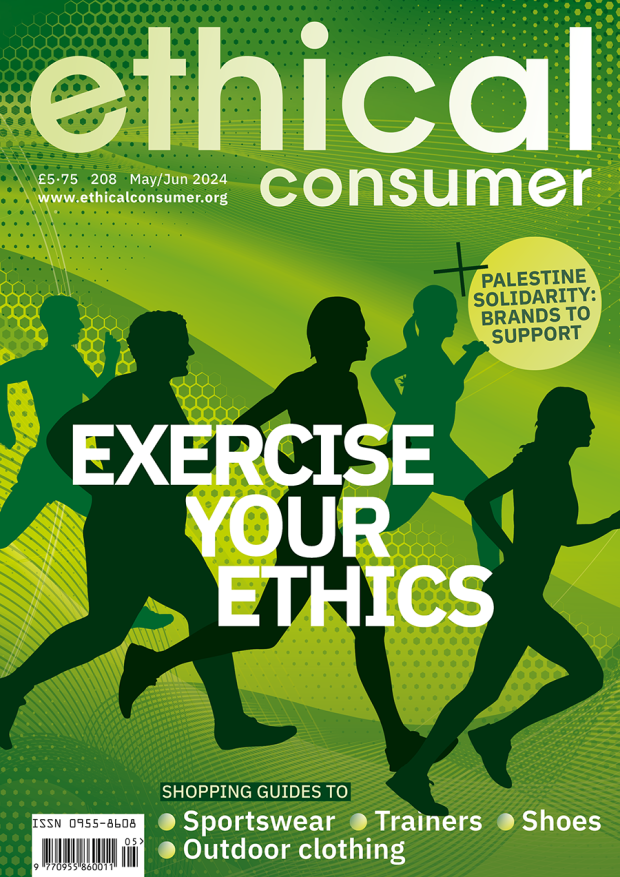
Trainers - sport

Free shopping guide to Sports Trainers, from Ethical Consumer

Free shopping guide to Sports Trainers, from Ethical Consumer


This is a buyers' guide from Ethical Consumer, the UK's leading alternative consumer organisation. Since 1989 we've been researching and recording the social and environmental records of companies, and making the results available to you in a simple format.

The report includes:

  • Ethical and environmental ratings for 19 trainer brands
  • Best Buy recommendations
  • Workers' rights in trainer companies
  • Code of conduct ratings, violations and positives
  • Animal issues
  • Environmental issues from trainer production


Research Report Download - includes all the detailed research behind this buyers' guide.

Download this Report now (£3 or free to subscribers).
Free sample report & A-Z list

Customise the scorecard ratings

Click the + icon to expand categories
Help

Score Ratings

Our ratings are live updated scores from our primary research database. They are based on primary and secondary research across 19 categories. Find out more about our ethical ratings


Score table

The score table shows simple numerical ratings for each product.

Move the sliders to customise these scores. 

Click on a product name to see the stories behind the score (subscribers only). 


Full Scorecard

The Full Scorecard shows the 'black marks' for each product, by each of the 19 categories. The bigger the mark, the worse the score. So for example a big black circle under 'Worker Rights' shows that the company making this product has been severely criticised for worker abuses.

The Full Scorecard is only available to subscribers. Click on the More Detail link at the top of the score table to access it.


Customising Rating Scores

Move the sliders to change the weighting given to each category. You can open up each of the 5 main categories by clicking on the + sign. This way you can compare products according to what's ethically important to YOU.  


Saving Your Customised Weightings

You must be signed-in to save your customisations. The weightings you have given to each category will be saved premanently (subscribers) or only for this visit to the site (registered users).  Once set, they will be used to calculate the scores in all the buyers' guides that you view. 


Stories and Data behind the scores

To see all the stories and research data behind the ratings you'll need to be a subscriber.

How the Sliders work
Move the sliders to see how different issues affect the score table
Refine each category by clicking the + icons
Save your settings (you need to be signed in first)
Key to expanded Score table

Best Buys

as of Jan/Feb 2007


As our ratings are constantly updated, it is possible that company ratings on the scorecard may have changed since this report was written.


ASICS, Brooks & Gola are the best buys for sports trainers.


Running away from responsibility?


High profile campaigns have forced many of the major sports brands to improve the way they do business when it comes to workers' rights. Ruth Rosselson asks whether this is enough.


“We have overtime work until 11pm or midnight every day. The price they pay us per piece is so low, so there is no point to us working such long hours. If our income was higher, I would have no complaints. But all we have now is exhaustion and a low income. Some of us do not even have enough money to spend on food”.(1) This is the voice of one of the women producing goods for Adidas. Unfortunately, it is not an isolated voice. Time after time, when campaigners interview workers in factories producing products for the major sportswear brands, they hear the same story. An Oxfam International report earlier this year found some workers in Asia making football boots and other sports gear were paid as little as 3.76 euros a day.(2) Campaigners argue that workers aren’t earning enough to meet their individual basic needs, or those of their families. At the same time, companies pay millions for celebrity endorsements.(2) Nike pays $13 million a year to the Brazilian football team and $21 million to golfer Tiger Woods. David Beckham receives around $3.3 million to endorse Adidas. Labour Behind the Label argue that with this endorsement money alone, 100,000 workers in Indonesia could receive a living wage.(1)


The good news

It might sound all doom and gloom, but there has been some progress. As a result of pressure from consumers, many companies have adopted important codes of conduct and this, at least in part, is likely to have led to some improvements in the lives of the workers. Some companies are entering into dialogue with campaigners, or joining multi stakeholder initiatives like the UK’s ETI or the US Fair Labor Association. Campaigners also recognise further progress by the following companies, who have all released some details of the names and addresses of their factories: Nike, Reebok, Puma and to a lesser extent, Adidas.(2) Campaigners have long been calling for companies to publish the full names and addresses of the factories where their goods are made because this kind of transparency “makes it easier for civil society organisations to investigate and report on working conditions in company supply chains”.(2) Oxfam’s report praised Reebok, Nike, Puma, Adidas, Umbro, and ASICS for positive initiatives which have improved the conditions in some of their factories, while Fila was criticised for doing the least.


Our codes of conduct rating

We asked all the companies on the table for their supply chain policy. None of the major brands supplied us with a code that would receive our top rating as none has committed to paying workers “a living wage”. This is defined as one which for a full-time working week, without overtime, is enough for workers and their families to meet their needs for nutritious food, clean water, shelter, clothes, education, health care and transport and allows a small amount for discretionary spending.(2,3) Most companies state that they will pay “legal national minimum wages” or “industry benchmark standards”. The problem is that in many cases, neither come close to meeting basic needs.(3)

In addition, many companies do not yet have adequate third-party monitoring in place. Some also use vague terms which can be interpreted in a number of ways - such as setting a maximum working week, “except in exceptional circumstances”. Where one is set, the maximum is most commonly 48 hours, plus 12 hours overtime. Some might argue that these hours are already excessive, and indeed the International Textile, Garment and Leather Workers Federation is campaigning for a 40 hour working week in developing countries.(4) No Sweat’s code of conduct was a model code, with detailed stipulations regarding wages (including a full definition of a living wage), union involvement, holiday entitlement, a minimum age of 18, independent auditing and details of its purchasing practices.


Violations

Unfortunately, the existence of a code is no guarantee that it is being implemented. Violations of codes include excessive or forced overtime, inadequate wages, harassment and bullying of workers, discrimination and intimidation.(1,2,3) Violations have been found in factories supplying products for most of the companies on our table, including: Nike, Adidas, Puma, Skechers, New Balance, Reebok, Umbro, Pentland Group (Ellesse, Lacoste), Fila, ASICS, Mizuno and Saucony.


What is left to do?

Campaigners argue that brands need to do the following:
• Increase wages so that workers have enough to live off on a regular working week that doesn't exceed 48 hours.
• Change purchasing practices to ensure that they don't lead to worker exploitation – this means negotiating appropriate delivery times and fair prices which allow factory managers to meet orders while respecting labour standards. Many brands have admitted that their buying practices are contributing to excessive working hours.
• Be more transparent overall.
• Increase training for workers on their rights and related issues.
• Do more to ensure workers are allowed to exercise their rights to join trade unions.(2)


Positive choices

A response to anti-sweatshop campaigns has seen a rise in the number of ‘ethical’ trainers being produced. Canada’s Adbusters Blackspot shoe is made by unionised workers in Portugal with profits going to Adbuster’s anti-corporate campaigns.(5) Worn Again is a collaboration between Terra Plana shoes and Anti-Apathy and combines environmental and social concerns. No Sweat is a US based brand which sources its products from unionised factories in Indonesia while Fair Deal’s Ethletic baseball boot is the only one on our table to be produced under Fairtrade principles. Fair Deal Trading distributes No Sweat shoes while Adbuster’s Blackspot can be bought through Vegetarian Shoes.


Animal Issues

All of the companies on the table except for Vegetarian Shoes, Blackspot, No Sweat and Ethletic produce some trainers made from leather, giving them a mark on the table under “other animal rights” for the use of slaughterhouse by-products. However, you should also be able to find trainers by many of the brands made from synthetic fibres. Also of concern to animal rights campaigners is the use of kangaroo leather by some brands. Animal Rights group Viva! argues that kangaroo slaughter in Australia is particularly cruel.(6) A 2005 Australian RSPCA report concluded that at least 100,000 adult kangaroos were not killed “humanely”.(6) Many more animals escape, only to die later while millions more orphaned baby kangaroos also face a painful death. Viva! urges consumers to look out for and avoid “k-leather” products. Companies using kangaroo leather include: Adidas, Umbro, Mizuno, Rebook and Nike.(6)


Environmental issues

Materials of concern to environmental campaigners include PVC as well as hazardous substances such as brominated flame retardants and triclosan. Those committed to or having already implemented a no PVC- policy include Nike, Adidas, Reebok, PUMA, New Balance and ASICS. No Sweat, Ethletic, Worn Again, Vegetarian Shoes are all PVC-free. Ethletic is the only trainer to have sourced Forest Stewardship Council (FSC) certified rubber for its soles and receives an extra product sustainability mark for this. Worn Again also receives an extra product sustainability mark because its trainers are all made from recycled fibres.


LINKS

Oxfam Australia’s report is available to download from www.oxfam.org.au  or read the Labour Behind the Label and TUC report “Sweet FA” from the Labour behind the Label website, www.labourbehindthelabel.org

The Viva!-led campaign on stopping the slaughter of kangaroos is at www.savethekangaroo.com

Other organisations campaigning on these issues:
IGTWF: www.igtwf.org
National Labor Committee: www.nlcnet.org/news/


References

1

Sweet FA? Football Associations, workers' rights, and the World Cup, Labour behind the Label, June 2006


2 Offside! Labor Rights and Sportswear Production in Asia, Oxfam international, May 2006
3 Let's Clean Up Fashion, Labour Behind the Label August 2006
4 International Textile & Garment & Leather Workers' Federation website, www.itglwf.org
5 http://adbusters.org/metas/corpo/blackspotshoes/home.php November 2006
6 www.savethekangaroo.com October 2006
7 China Labor Watch 'The Kingmaker Company's Factory in Zhuhai' June 2005 <
b>8 Saucony supplier values statement, Feb 2004
9 Boston Herald online edition, www.bostonherald.com 7/1/06
10 Hi-Tec company supply chain policy.
11 Jane's International Defence Directory 2004

Navigate To:

top-5-shops

Advertising

CoopBank2011
One Village
Bishopston Trading Company
Triodos Bank
stop climate chaos