Ethical buyers' guide to Yoghurt, from Ethical Consumer

Ethical buyers' guide to Yoghurt, from Ethical Consumer


This is a buyers' guide from Ethical Consumer, the UK's leading alternative consumer organisation. Since 1989 we've been researching and recording the social and environmental records of companies, and making the results available to you in a simple format.

Research Report Download - includes all the detailed research behind this buyers' guide.

Download this Report now (£3 or free to subscribers).
Free sample report & A-Z list

The report includes:

  • Ethical and environmental ratings for 18 brands of yoghurt
  • Best Buy recommendations
  • A look at some not so eco friendly dairy practises
  • Organic alternatives to mainstream yoghurt
  • Health issues from yoghurt
  • A soya alternative

Customise the scorecard ratings

Click the + icon to expand categories
Help

Score Ratings

Our ratings are live updated scores from our primary research database. They are based on primary and secondary research across 19 categories. Find out more about our ethical ratings


Score table

The score table shows simple numerical ratings for each product.

Move the sliders to customise these scores. 

Click on a product name to see the stories behind the score (subscribers only). 


Full Scorecard

The Full Scorecard shows the 'black marks' for each product, by each of the 19 categories. The bigger the mark, the worse the score. So for example a big black circle under 'Worker Rights' shows that the company making this product has been severely criticised for worker abuses.

The Full Scorecard is only available to subscribers. Click on the More Detail link at the top of the score table to access it.


Customising Rating Scores

Move the sliders to change the weighting given to each category. You can open up each of the 5 main categories by clicking on the + sign. This way you can compare products according to what's ethically important to YOU.  


Saving Your Customised Weightings

You must be signed-in to save your customisations. The weightings you have given to each category will be saved premanently (subscribers) or only for this visit to the site (registered users).  Once set, they will be used to calculate the scores in all the buyers' guides that you view. 


Stories and Data behind the scores

To see all the stories and research data behind the ratings you'll need to be a subscriber.

How the Sliders work
Move the sliders to see how different issues affect the score table
Refine each category by clicking the + icons
Save your settings (you need to be signed in first)
Key to expanded Score table

Best Buys

as of Jan/Feb 2006


As our ratings are constantly updated, it is possible that company ratings on the ethiscore website may have changed since this report was written.


Dairy-free Best Buys are Alpro Soya organic (0800 018 8180) and Sojasun organic (0033 299 04 11 11).
Dairy Best Buys are Woodlands organic sheep's milk yoghurt (01202 822 687) followed by Yeo Valley yoghurt (all organic) (01761 462 798).


Corrupt Cultures

Katy Brown peels back the lid on the yoghurt pot.

Yoghurts are brought to market by the usual mix of huge multinationals and smaller local providers. Market leaders are Nestl?, Molkerei Alois Muller (Muller) and Danone. Danone has been criticised recently for angering local farmers in Indonesia by draining wells necessary for daily and agricultural use (7). It has also been criticised by Baby Milk Action for violating the International Code of Marketing of Breastmilk Substitutes (8). Muller's logistics division, Culina Logistics, has been criticised for hiring union busting firm The Burke Group to prevent union organisation (9).

Dairy

The animal rights group Viva! released a report this year on the dairy industry, which exposes what it describes as "the cruel, dark side to the dairy industry."(1). To keep them constantly producing milk, cows are forcibly impregnated whilst still lactating, meaning they endure both pregnancy and lactation at the same time, usually for seven months of the year. Once a cow gives birth her calf is removed after only a day or two. This separation causes severe stress to both animals and has been described as the most potentially distressing incident in the life of the dairy cow.

Male calves are considered a waste by-product as they can't produce milk. Dairy/beef crosses are sold to beef farms with calves as young as seven days old enduring long journeys to and from livestock markets. Pure dairy males are usually killed within a week or two for baby food, pie ingredients or rennet for cheesemaking (1). Most female calves replace the dairy cows that are killed each year when their productivity drops. They usually spend the first six to eight weeks of life in tiny calf stalls, unable to exercise or socialise with other calves (1). They are fed commercial milk replacer and artificially inseminated at 15 months old to begin the cycle of pregnancy and lactation.

Cows would naturally live for up to 20 years, but the hard existence of the average commercial dairy cow takes it toll. Milk productivity begins to drop at 5-7 years of age at which point the animals are commonly killed for meat (1).

The dairy industry is also highly polluting. Approximately a quarter of all agricultural water pollution incidents recorded by the UK National Rivers Authority are related to dairy farming (2). The UK's 2.2 million dairy cows also produce 230 000 tonnes of the greenhouse gas methane (2).

Organic alternatives

Soil Association certified products are better for the environment and for the consumer in terms of avoiding much of the antibiotics, hormones and GM feed used in conventional milk production. But do they offer a better deal for the cows?

There are no guidelines for the length of time organic dairy cows may be housed indoors, but completely indoor systems are prohibited. Highly invasive practices such as embryo transfer are forbidden but artificial insemination is allowed. Fertility hormones are prohibited for synchronising calving but not for bringing an infertile cow into heat. Calves must be group housed after seven days old. Castration with a rubber ring is allowed within the first week of life. Disbudding (permanently preventing horn growth by applying a hot iron to the horn-forming tissue) is allowed up to 3 months. Calves can't be taken to market under one month old, but after this, eight hour journeys are allowed. Organic cows are still impregnated each year to provide a continuous supply of milk and separated from their calves within 24-72 hours of birth. The scheme also allows unwanted calves to be killed soon after birth (1).

Health issues

Dairy products have been linked to osteoporosis, heart disease, cancer, diabetes and a range of allergy related problems (3). Despite the dairy industry's claims that milk is an essential source of calcium, a diet high in dairy products may leach the body of more calcium than it provides (26). Alternative calcium sources include green leafy vegetables such as broccoli and nuts and seeds such as brazil nuts and sesame seeds.

Soya solution?

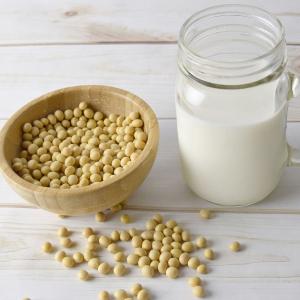
There are now a range of widely available dairy-free alternatives made from soya. However, soya has problems of its own. 56% of the world's soya crop is now genetically modified (4). GM is high on many people's agendas, mainly for the health, environmental and social issues surrounding the technology. All the soya yoghurts in this report are marketed as GMO free.

Historically, logging and cattle ranching have been responsible for most rainforest destruction in the Amazon. Recent increases in demand for soya have accelerated this destruction, particularly in Brazil. However, the majority of the world's soya is actually fed to cattle, including dairy cattle (5,6).

References
1 The Dark Side of Dairy, a Viva! Report by Toni Vernelli BSc Animal Biology and Conservation, 2005
2 Wrecking The Planet, Joni Seager, The State of The Environment Atlas, Penguin Books, 1995
3 Physicians Committee for Responsible Medicine www.pcrm.org, viewed on 21/10/05
4 www.food.gov.uk, viewed on 4/11/05
5 www.viva.org.uk, viewed on 4/11/05
6 www.purifymind.com/Hippo, viewed on 4/11/05
7 Corporate Watch newsletter: issue 24, June/July 05
8 Breaking the Rules, International Baby Food Action Network, 2004
9 www.itfglobal.org, viewed on 8/11/05 10 Earth Island Journal: Winter 2002/Vol17
11 Responsible Shopper website: Dean Foods viewed on 02/02/05
12 Ethical Consumer: 85 October/November 2003
13 Who Owns Whom: 2003/2004
14 The Ecologist: May 2003
15 The Ecologist: December 2004
16 Companies that test on animals, PETA, July 2004
17Breaking the Rules: 2004
18 Corporate Watch newsletter: issue 22, Feb/March 2005
19 BUAV Factsheet E3 Cosmetics Companies Guide, November 2004
20 Power Hungry - six reasons to regulate global food corporations: ActionAid report 2005
21 Ecolinks Boycott list - www.ecolinks.net, viewed on 25/02/03
22 www.oilpackers.com, viewed on 8/11/05
23 www.scconline.org, viewed on 11/10/05
24 Yeo Valley Group Corporate Communications: ?Minimising Our Impact on the Environment' 2005 < br>25 www.notmilk.com, viewed on 9/11/05
26 http://milk.elehost.com, viewed on 9/11/05

Links

Navigate To:

Register

Advertising

One Village
Bishopston Trading Company
Triodos Bank
CoopBank2011
stop climate chaos