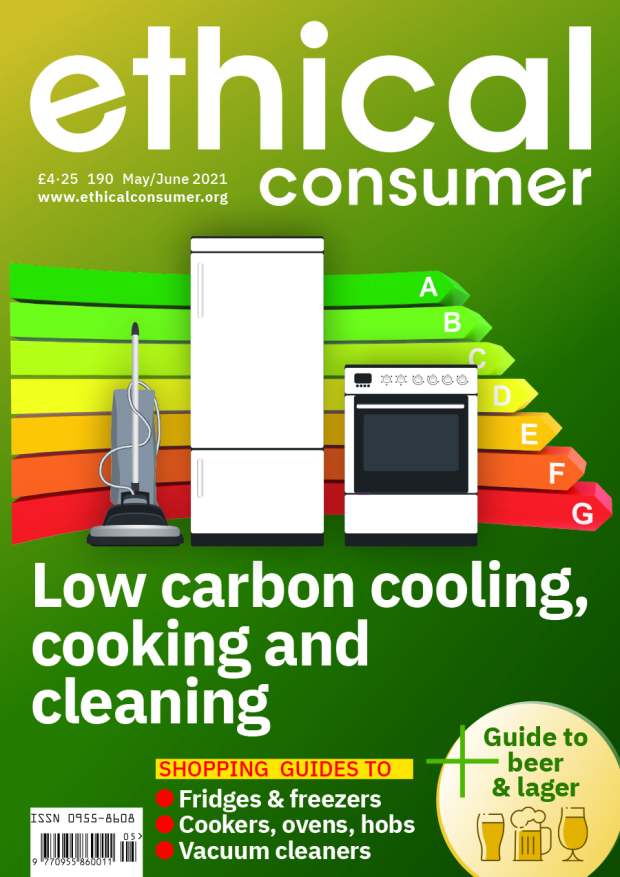
Shopping guide to Gas & Electric Cookers, from Ethical Consumer.

Shopping guide to Gas & Electric Cookers, from Ethical Consumer.


This is a product guide from Ethical Consumer, the UK's leading alternative consumer organisation. Since 1989 we've been researching and recording the social and environmental records of companies, and making the results available to you in a simple format.

How can we heat up our food without heating up the planet?

This report includes:

  • ethical and environmental ratings for 29 cookers
  • Best Buy recommendations
  • whether cooking with gas or electricity has the least environmental impact
  • energy labelling and the move towards A rated cookers
  • recycling your old cooker, renting and second hand
  • company profiles
  • reduce your climate change impact when cooking with our energy saving facts and tips

Customise the scorecard ratings

Click the + icon to expand categories

To save your personal score settings and use them elsewhere around the site, please  Log In.

If you don't already have a log in, you can Register for free.

Help

Score Ratings

Our ratings are live updated scores from our primary research database. They are based on primary and secondary research across 19 categories. Find out more about our ethical ratings


Score table

The score table shows simple numerical ratings for each product. The higher the score, the more ethical the company.

Move the sliders to customise these scores. 

Click on a product name to see the stories behind the score (subscribers only). 


Full Scorecard

The Full Scorecard shows the 'black marks' for each product, by each of the 19 categories. The bigger the mark, the worse the score. So for example a big black circle under 'Worker Rights' shows that the company making this product has been severely criticised for worker abuses.

The Full Scorecard is only available to subscribers. Click on the More Detail link at the top of the score table to access it.


Customising Rating Scores

Move the sliders to change the weighting given to each category. You can open up each of the 5 main categories by clicking on the + sign. This way you can compare products according to what's ethically important to YOU.  


Saving Your Customised Weightings

You must be signed-in to save your customisations. The weightings you have given to each category will be saved premanently (subscribers) or only for this visit to the site (registered users).  Once set, they will be used to calculate the scores in all the buyers' guides that you view. 


Stories and Data behind the scores

To see all the stories and research data behind the ratings you'll need to be a subscriber.

How the Sliders work
Move the sliders to see how different issues affect the score table
Refine each category by clicking the + icons
Save your settings (you need to be signed in first)
Key to expanded Score table

Best Buys

as of July/August 2011

As our ratings are constantly updated, it is possible that these companies will not always come out top on the scorecard.

Gas cookers will almost always be the lowest carbon choice. For gas and electric cookers, Belling, New World or Stoves comes out best and all make models recommended by the Energy Saving Trust.
If you are buying one of these brands of electric cooker, choose an A-rated product.

Also recommended are all Rangemaster’s dual fuel and induction range cookers. These have received the Energy Saving Trust’s Recommended label and do not need to be on 24 hours a day.


Research Report Download - includes all the detailed research behind this buyers' guide.

Download this Report now (£3 or free to subscribers).
Free sample report & A-Z list


A guide to lower impact cookers

Jo Southall rattles those pots and pans in frustration at the lack of progress on ethical issues in the cookers market.


In a typical household 3-4% of its total energy use is attributable to cooking.1 There is also a slow decline in the amount of cooking being done in the home because of the rise in ready meals and take away food.


ABC, simple as do-re-mi?

All electric ovens are meant to carry an EU Energy Label. The rating goes from G to A, A being the best (there are no A+ or A++ ratings in the ovens market, unlike the fridge-freezer market). The lowest rating discovered during a review of the companies’ websites was D. There is currently no labelling scheme covering gas ovens, but more on this later.
An analysis of cookers featured on the appliancesonline.co.uk website showed that 60% were A-rated.3 Blomberg stands out as the only company in this report that has a policy of only selling A-rated electric cookers. However, all the other companies sold electric cookers that were predominantly A-rated.


Ecodesign Directive

In 2009 a project looking at the energy efficiency of hobs, grills and ovens was launched under the auspices of the European Commission’s Ecodesign Directive. The purpose of this work is to get energy efficiency built in at the design stage. The final report was due in April 2011 but is not yet available on the website.2


Label babel

As well as the the EU Energy Label, the following initiatives provide advice on cookers and energy efficiency:

Energy Saving Trust Recommended
The UK Energy Saving Trust (EST) are expecting to include gas ovens in their labelling scheme (EST Recommended) quite soon. This would certainly fill a gap, as avid readers will recall that last time we looked at cookers (EC 99, 2006) we reported that a European Energy Label for gas cookers was expected in 2008 (at the earliest), and this is yet to come to fruition.
The EST label, which is based on “criteria set by an independent panel and reviewed annually”, has also been available for electric cookers since mid-2009, but take-up has been low. So far only AGA Rangemaster Dual Fuel and Induction cookers have received the label, but other companies are in the process of applying.4
Some readers may have picked up on the debate around the excessive energy use of some Agas, but the EST label has only been awarded to A-rated electric models. Aga is busy trying to update the lifestyle it’s selling, and this group of companies now mentions farmers’ markets and includes renewable energy products in its range. However it’s worth noting that the lifestyle on offer won’t chime with all readers as Aga sponsorship of a point-to-point (hunting horses) championship demonstrates. Oh well, hey ho. Or should that be tally ho!?

Sust-it.net
Amongst critics of the EU Energy Label are Sust-It.net, an energy efficiency website for electrical equipment. Sust-It points out that the EU label does not take account of the volume of appliances, making comparisons between different sizes of ovens not as straightforward as they could be. Sust-it take the hassle out of comparison by using their own rating system which addresses this shortcoming.


Compare and contrast

Comparing the energy efficiency of cookers is an onerous task, as the company websites will only usually let you compare a maximum of four products at a time, and they all seem to use software that’s quite jumpy and distracting. The Sust-it site has better functionality as a comparison tool, but unfortunately only has 27 cookers listed on it and these are all electric. Sust-it cannot feature cookers if the manufacturer has not published the Kwh information as this forms part of the data needed for Sust-it’s comparison calculations.  Appliancesonline.co.uk has 144 cookers listed but only provides the less sophisticated EU Energy Label ratings.


Gas or electric?

The table below, using information from the National Energy Foundation and confusedaboutenergy.com, gives some idea of the relative impacts of using the hob vs oven, and gas vs electric (conventionally generated). As you can see the low CO2 choice is pretty much always gas where it is available. Of course, using electricity from renewables is likely to have less impact than gas.

Type Average energy consumption per use (kWh)* Average grams of CO2 per use
Ovens*    
gas 1.52 280
electric 1.09 590
Hobs*    
gas 0.9 170
electric 0.72 390
electric induction 0.5 271


*  ‘Average energy consumption per use (kWh)’ figures come from the confusedaboutenergy.com site.  The National Energy Foundation calculator  is then used to calculate the average grams of C02 per use.  The calculator will only calculate large figures, so the kWh per use is multiplied by 100, entered into the NEF calculator, the result being divided by 100 to give the grams of C02 per use.


Induction hobs

Induction cooking works by applying electromagnetism to ferrous pots or pans (so it won’t work with ceramic/glass/aluminium pans). The effect of the electromagnetism is to make the pan heat up, in turn heating the food. This is different to other forms of cooking, whereby heat is generated (eg. gas flame, electric element) and the pan then applied to the heat.
There is a general consensus that induction hobs are significantly more energy efficient than standard electric hobs. Having said this, once the ethical impacts of replacing your existing hob and some/all of your pans are taken into consideration, along with the ‘opportunity cost’ of the price of the hob itself, you may be best sticking with your existing hob.


Raw food

As ethical food geeks will know, raw food is the latest trend in healthfood, but it’s also a good way of cutting your energy consumption, and there are more ready-made raw food products on the market than ever before. There is a fair amount of advice out there about raw diets including websites, books and courses, but there doesn’t seem to bean obviously reputable, established national body in the UK yet. The Vegan Society website has a useful section on raw food diets for vegans, and if you’re lucky enough to have access to an independent health food shop, they will most likely be able to give you some advice.


Waste

There are several options for getting rid of your old cooker. You can use the ‘Search for Re-users’ function on the homepage of the Furniture Re-use Network’s website, but it’s worth bearing in mind that this isn’t an exhaustive list of local furniture re-users. Your local council will also provide facilities via it’s ‘tips’ (civic amenity/recycling sites) or a collection service, which is sometimes free. Also, by law, retailers have to make it possible for customers to dispose of WEEE free of charge, regardless of where you bought your old cooker.


Clever cooking

You can reduce your cooker's contribution to climate change when you are using it by following these energy saving facts and tips:

  • fan ovens use around 20% less energy than conventional ovens
  • replace damaged seals around the oven door
  • avoid opening the oven door when cooking where possible — choose an oven with a glass panel in the door to check how the food is doing
  • cook more than one item at a time in the oven
  • cook smaller meals under the grill, or, with a double oven, in the smaller one
  • use a microwave if you have one, they use 70% to 90% less energy than ovens
  • for gas cookers, an electric ignition rather than a continuous pilot light, saves energy
  • induction hobs are the most energy efficient electric hob
  • glass and ceramic pans heat more efficiently than metal
  • match the pan to the size of the hotplate or to the flame
  • always put lids on pans - more than a quarter of electricity is wasted when you cook your food without a lid
  • use pans with a flat base
  • boil water for cooking in a kettle first instead of in a pan
  • pressure cookers and steamers save energy as they enable you to cook several different foods on one ring
  • for toast, use a toaster instead of the grill
  • the ultimate energy saver — eat more raw food!

See also:
Energy Saving Trust
How to Live a Low-Carbon Life by Chris Goodall, Earthscan 2010
How Bad are Bananas? By Mike Berners-Lee, Profile Books 2010
 

Company profiles

Robert Bosch Stiftung is a charitable foundation that owns 92% of Robert Bosch GmbH. The foundation’s website holds a breakdown of what the charity funds, including healthcare and research. However, no links with animal testing could be found. Bosch is also “the largest independent supplier worldwide of original equipment for automotive manufacturers,”5 earning it a mark in the Climate Change column. Bosch Security Systems provides equipment for surveillance and security.


Whirlpool has made a gas hob that uses the company’s own iXelium coating which was developed using nanotechnology. The coating was said to have “anti-ageing” properties that would prevent surface stains, yellowing, corrosion and marking.6 Like Oil of Olay, but for hobs.
In 2010 The US Equal Employment Opportunity Commission (EEOC) announced a final court judgement of $1m against Whirlpool Corporation in a race and sex discrimination lawsuit. The case involved an African American former employee who alleged that the appliance manufacturing giant failed to protect her from persistent harassment by a white male co-worker, which ultimately resulted in her being physically assaulted by him.7
According to UK government tests carried out in 2009, Whirlpool and Zanussi (owned by Investor AB) were two of the companies selling washing machines that did not live up to their energy efficiency claims.8


Koc Holding This Turkish conglomerate, pronounced ‘coach’, is involved in several sectors. The subsidiary Arcelik has been found to sell furniture without the FSC label. It’s also very active in climate-busting industries, proudly boasting that it owns “all of Turkey’s refining capacity” and accounts for “48% of Turkey’s total automotive production.” One of its Arcelik-branded ovens (therefore not on sale in the UK) has an easy-clean “nanotechnology coating” and this subsidiary also uses nanotechnologies in some of it manufacturing processes.9

Both Aga Rangemaster and Glen Dimplex have operations in the USA and China, both of which are on Ethical Consumer’s list of oppressive regimes.10


Investor AB is a large “Nordic-based industrial holding company”, which owns Electrolux. In February of this year, US and European companies, including Electrolux were criticised by the Dirt Diggers’ Digest for “shoring up the regime” in Egypt. Electrolux came under fire due to announcing in October 2010 that it intended to buy a controlling interest in Egypt’s Olympic Group, which was said to be “the largest producer of household appliances in the Middle East and North Africa”.11 At the time of writing, the deal had still not progressed.12
Climate Change marks come from investments via EQT Partners in Swedegas and a gas-fired co-generation plant in the US. Another EQT subsidary, Sanitec, contributes to the Anti Social Finance mark due to its involvement in a cartel with other bathroom manufacturers.13
The company picks up Pollution and Toxics marks through its investment in Ericsson. A coalition of NGOs found evidence of heavy metal pollution in China from manufacturers supplying companies including Ericsson.
Investor AB also invests in ISS, a leading global provider of ‘facility services’ (eg. cleaning and security). ISS is criticised by campaigners as providing services to settlements in Palestine that are discriminatory as they are provided solely to the Jewish settlements and not to their surrounding Palestinian neighbours. These services help connect the settlements to Israel and normalize their status. These services can include security functions dedicated to keeping Palestinians out of the settlements.”22
ISS was also involved in a UK case where its cleaners had been “deceived” into attending a meeting, only to be ambused by around 40 officers from the UK Border Agency dressed in full body armour. This was seen as an attempt to suppress union activity.14 In a separate case, a labour tribunal awarded compensation on the grounds of discrimintation to a woman who was fired in her seventh month of pregnancy.23


Siemens owns 50% of Nokia Seimens. There is an ongoing Facebook-based boycott call of Nokia Siemens for its implication in state oppression in Iran.15 An Iranian journalist and political dissident was suing Nokia Siemens before a US court, accusing the firm and its parent companies of supplying the Iranian government with technology it used to spy on dissidents. The activist alleges that, “human rights violations committed by the Iranian government [were carried out] through the aid of spying centres which were provided by Nokia Siemens Networks.” However, the plaintiffs were not pursuing the case due to the current legal environment not being conducive and concerns about how legal action would affect Isa Saharkhiz, who is detained in Iran. The dissident was arrested as a result of his mobile phone use being monitored, he was then said to have been tortured.16
As well as all its climate-destructive energy operations (Siemens is “one of the most important technology partners for the oil and gas industry” and is active in the fields of fossil-fuelled power generation, transmission and distribution) Siemens has interests in renewable energy, which is a somewhat ironic given its opposition to scrapping the import duty on Chinese energy-saving light bulbs in 2008. WWF referred to this opposition at the time as “disappointing, unfair and seriously inconsistent.”24 The company maintains its longstanding interest in the nuclear industry via its Siemens Power Corp and Siemens Water Technologies subsidiaries, which are involved in a range of activities from fuel fabrication to analysis and control equipment.17 Siemens was involved in a cartel in the power transformers market in 2009, but escaped without being fined.18 The company is also involved in research into nanotechnologies, particularly in the field of healthcare.19


Indesit has operations in the United Arab Emirates and Russia, both of which are on Ethical Consumer’s list of oppressive regimes.20 In 2009 a warehouse supervisor for the company was awarded £150,000 after sustaining soft tissue injuries to his neck and shoulders when a dishwasher fell on him as he unloaded a container.21


Links

  • Furniture Reuse Network Tel: 01924 375 252 www.frn.org.uk
    Has details of organisations that take furniture, white goods and household appliances.
  • The SOFA Project, Tel: 0117 954 357 www.sofaproject.org.uk
    Furniture and electronic equipment scheme across the west.
  • Chain Store Reaction - The Chain Store Reaction website stated that Bosch and Whirlpool had not replied to criticisms about the prevalence of slave labour in Coltan supply chains. Visit the website to send one of the campaign’s ready-made emails to these companies.


References
1 How to Live a Low-Carbon Life 2010 
2 ecocooking.org 5/11 
3 but this figure did not include appliances with double ovens, where only one oven was A-rated (this is what is meant by ratings that show up as A/B, eg there are 2 ovens, one is A-rated, the other is B-rated) 
4 Phone conversation with EST representative 5/11 
5 bosch-service.com/bs/en/start/index.htm 5/11 
6 nanotechproject.org 4/11 
7 www.business-humanrights.org on 19/1/10 
8 ENDS Report 12/09 
9 koc.com.tr 4/11 
10 glendimplex.com 4/11, agarangemaster.com 5/11 
11 dirtdiggersdigest.org 3/2/11 
12 ft.com 3/5/11 
13 bbc.co.uk 10/3/10 
14 Labour Research 8/10 
15 Boycott Nokia Siemens Facebook page 5/11 and ipetitions.com/petition/nokia/ 5/11 
16 dw-world.de 18/11/10 
17 neimagazine.com 4/11 
18 bbc.co.uk 7/5/09 
19 siemens.com 4/11 
20 indesitcompany.com 4/11 
21 Risks newsletter:399 28/03/09 
22 whoprofits.org 29/4/11 
23 business-humanrights.org 9/06 
24 ENDS Report 9/07

Navigate To:

Register