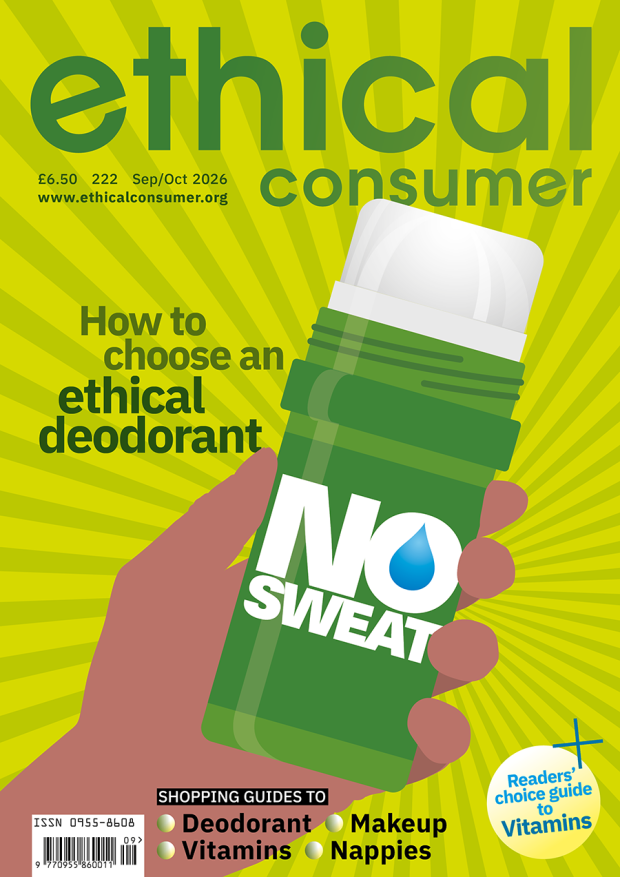
Deodorant - free shopping guide from Ethical Consumer

Deodorant - free shopping guide from Ethical Consumer


This is a buyers' guide from Ethical Consumer, the UK's leading alternative consumer organisation. Since 1989 we've been researching and recording the social and environmental records of companies, and making the results available to you in a simple format.

Research Report Download - includes all the detailed research behind this buyers' guide.

Download this Report now (£3 or free to subscribers).
Free sample report & A-Z list

We take a look at the companies in the smelly business

The report includes:

  • ethical and environmental ratings for 17 brands of deodorants and anti-perspirants
  • Best Buy recommendations
  • which brands contain parabens
  • which brands contain pore-blocking aluminium
  • aerosols v plastic v glass etc

Companies have played on our insecurities about getting smelly through clever — you might say manipulative — advertising campaigns. Major deodorant brands such as Lynx (just one spray and you'll have women chasing you through the streets, apparently) package spray-on-smells as the answer to our love lives and general success as a human being. But just a quick glance at the ingredients label on a conventional deodorant raises some important questions....

Customise the scorecard ratings

Click the + icon to expand categories
Help

Score Ratings

Our ratings are live updated scores from our primary research database. They are based on primary and secondary research across 19 categories. Find out more about our ethical ratings


Score table

The score table shows simple numerical ratings for each product.

Move the sliders to customise these scores. 

Click on a product name to see the stories behind the score (subscribers only). 


Full Scorecard

The Full Scorecard shows the 'black marks' for each product, by each of the 19 categories. The bigger the mark, the worse the score. So for example a big black circle under 'Worker Rights' shows that the company making this product has been severely criticised for worker abuses.

The Full Scorecard is only available to subscribers. Click on the More Detail link at the top of the score table to access it.


Customising Rating Scores

Move the sliders to change the weighting given to each category. You can open up each of the 5 main categories by clicking on the + sign. This way you can compare products according to what's ethically important to YOU.  


Saving Your Customised Weightings

You must be signed-in to save your customisations. The weightings you have given to each category will be saved premanently (subscribers) or only for this visit to the site (registered users).  Once set, they will be used to calculate the scores in all the buyers' guides that you view. 


Stories and Data behind the scores

To see all the stories and research data behind the ratings you'll need to be a subscriber.

How the Sliders work
Move the sliders to see how different issues affect the score table
Refine each category by clicking the + icons
Save your settings (you need to be signed in first)
Key to expanded Score table

Best Buys

as of March/April 2007


As our ratings are constantly updated, it is possible that company ratings on the ethiscore website may have changed since this report was written.


Dr Hauschka (01386 791 022), Weleda (0115 944 8222), Urtekram and Green People (01403 740 350) all come out on top. Lush’s (01202 667830) deodorant bars are an environmental Best Buy because they use less packaging materials.


A smelly business

Mary Rayner gets up close and personal with the deodorant industry...

There are two main types of deodorant: simple deodorants that work to mask any nasty niffs, and anti-perspirants, which contain ingredients (most commonly aluminium) which block pores to reduce sweating. All of the brands with an Ethiscore of 10.5 or higher are deodorants rather than anti-perspirants.
Companies have played on our insecurities about getting smelly through clever – you might say manipulative – advertising campaigns. Major deodorant brands such as Lynx (just one spray and you’ll have women chasing you through the streets, apparently) package spray-on-smells as the answer to our love lives and general success as a human being. But just a quick glance at the ingredients label on a conventional deodorant raises some important questions.


Parabens

Parabens are a group of compounds widely used as anti-microbial preservatives in food, pharmaceutical and cosmetics products, including underarm deodorants. Research indicates that parabens are oestrogen mimics and that they can penetrate the skin. However, the effect of daily low level exposure to parabens in a number of different products is unknown.(1) Possible links have been made to breast cancer, but research is inconclusive.
Although more research is needed into the effects of parabens, for those who wish to err on the side of caution, the following brands are paraben-free:
Crystal, Dr Hauschka, Green People, JASON, Lush, Mitchum, PitRok, Tom’s of Maine and Urtekram.
A spokesperson from Unilever stated that its Dove, Impulse and Lynx aerosol deodorants and anti-perspirants were paraben free, but wasn’t clear about the stick/roll-on products available under these brand names. Some Sure deodorants contain parabens. Nivea spray, but not the roll-on, contains parabens.(2)
Common names to watch out for on ingredient labels include: butyl/methyl/ethyl/ propyl/isobutyl paraben.(3)


Aluminium

Aluminium is a highly contested area. It’s used in a number of anti-perspirants to plug the sweat glands – apparently staying there for anything up to four days.(4) Although most major cosmetics companies attest to its safety, a couple of studies have tentatively linked anti-perspirants to breast cancer.(5) It’s alleged that as pores are blocked, the body cannot effectively rid itself of toxins, resulting in the spread of cancer-causing toxins via the lymph nodes. However, most cancer-causing substances are removed by the kidneys and liver.(6) The lack of major scientific studies in this area make it very hard for consumers to make a properly informed decision.
The aluminium compound usually found in anti-perspirants is aluminum chlorohydrate.
Avoiding anti-perspirants generally seems like a good idea. In addition a number of the alternative deodorants companies have eliminated aluminium from their products. So again, if you wish to err on the side of caution, the following brands are free of the aluminium compound listed above:
Crystal, Dr Hauschka, Green People, JASON, Lush, PitRok, Tom’s of Maine and Urtekram.


Other environmental impacts

Packaging will contribute to a great deal of the environmental impact of deodorants. The Lush deodorant range, rather than coming in glass or plastic containers, is sold in bars, rather like soap. It will be wrapped at the checkout, but Lush states: “Of the cardboard and paper we use, approximately 90% of it is already made from recycled material.”(8)
Otherwise, try to buy deodorants that are packaged in glass, rather than plastic, as they can be recycled more easily. The following come in glass bottles:
Dr Hauschka, Pitrok (spray) and Urtekram.
Aerosol deodorants contain propellants – usually butane, isobutane or propane – all of which are Volatile Organic Compounds (VOCs). They’re not thought to be harmful in the small quantities that are used in aerosol deodorants, however.


Unilever and palm oil

The company was confronted in 2006 by workers represented on the Unilever European Works Council who were concerned about the possibility that it was associated with Indonesian palm oil supplier Musim Mas. Musim Mas was the subject of an international labour rights campaign after it was accused of “the mass firing of union members, eviction from their homes, the expulsion of children from their schools and the use of the police and judicial system to criminalise legitimate trade union activity.”(9) Unilever’s “Sustainable Agriculture Manager”, Jan Kees Vis, is the Executive President of the Roundtable on Sustainable Palm Oil (RSPO). The IUF – an international federation of trade unions – has directed scathing criticism at the RSPO for denying it has any responsibility for dealing with Musim Mas repression.(10) The IUF has stated: “Musim Mas trampled rights and broke the law, and the IUF [is] determined to fight for justice for these workers. As long as it refuses to take action within its own organization, the RSPO will remain the target of public action and protests.”(9) If you’d like to express your concern over this issue, you can write to Unilever using the address given in the Action Page of the bind-in of this issue.


Links

  • British Union for the Abolition of Vivisection (BUAV) www.buav.org, info@buav.org, 020 7700 4888
  • Campaign for Safe Cosmetics www.safecosmetics.org, info@safecosmetics.org
  • International Union of Food Workers (IUF) For information on Unilever and Indonesian palm oil supplier Musim Mas
    www.iuf.org, iuf@iuf.org, Rampe du Pont-Rouge, 8, CH-1213, Petit-Lancy, Switzerland
  • Roundtable on Sustainable Palm Oil www.rspo.org, rspo@rspo.org, Mont Kiara Business Centre, Suite D-03-01, Plaza Mont Kiara, 2, Jalan Kiara, 50480 Kuala Lumpur, Malaysia


References

1 Women’s Environmental Network, “Chemicals and Cosmetics Factsheet”, September 2003 2 ECRA shop survey, 18/1/07 3 www.safecosmetics.org/faqs/#paraben_free, 18/1/07 4 www.unilever.com, 18/1/07 5 www.easylivingmagazine.com/Beauty/TruthOrScare/antiperspirants/default.aspx, 18/1/07 6 www.cancer.org, 18/1/07 7 www.greenpeople.co.uk, 18/1/07 8 Email from Lush, 16/1/07 9 CSR Asia Weekly: Vol 2 week 18, 3/5/06 10 www.iuf.org, “Round and Round the Roundtable: RSPO Washes its Hands of Corporate Brutality”, 21/3/06 11 www.buav.org, 1/07 12 PETA – Companies that test on animals, 1/07 13 Naturewatch Compassionate Shopping Guide 10th Edition, 2005 14 WRM Bulletin, 2002 15 HJ Heinz Annual Report 2006 16 www.henkel.com, 11/04 17 www.boycottpandg.co.uk, 7/06 18 BUAV Cosmetic Companies Guide, 11/04

Navigate To:

Related pages


Unilever boycott profile

quick guide

Advertising

One Village
CoopBank2011
Triodos Bank
Bishopston Trading Company
stop climate chaos