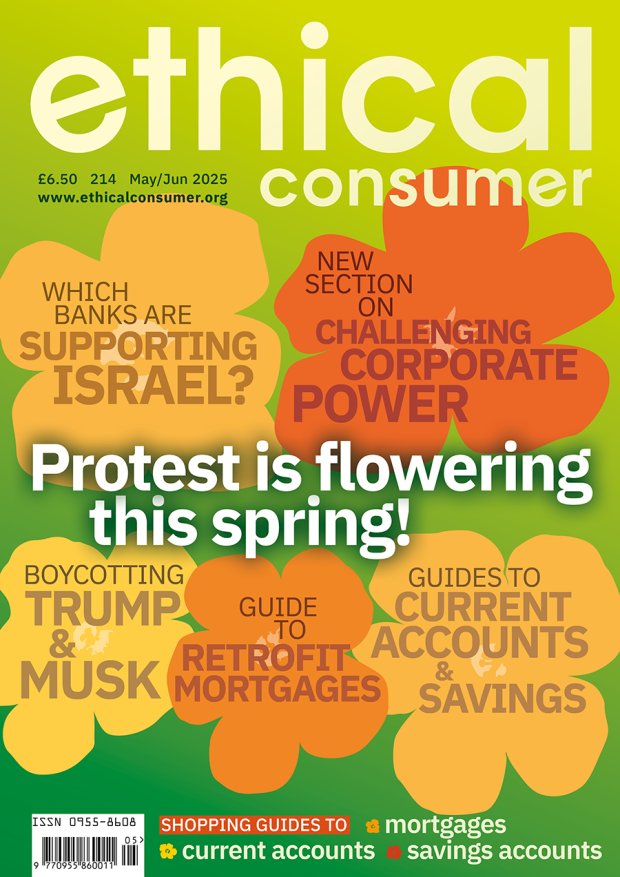
Bank current accounts

Free guide to Banking Current Accounts, from Ethical Consumer

Free guide to Banking Current Accounts, from Ethical Consumer


This is a product guide from Ethical Consumer, the UK's leading alternative consumer organisation. Since 1989 we've been researching and recording the social and environmental records of companies, and making the results available to you in a simple format.

It's time to bank on something better and move your money. This buyers' guide is part of a Special Report on Banking.  See what's in the rest of the report.

This guide includes:

  • ethical and environmental ratings for 30 current accounts
  • Best Buy recommendations
  • what's the problem with banks?
  • what's the solution?
  • how to switch banks

Customise the scorecard ratings

Click the + icon to expand categories

To save your personal score settings and use them elsewhere around the site, please  Log In.

If you don't already have a log in, you can Register for free.

Help

Score Ratings

Our ratings are live updated scores from our primary research database. They are based on primary and secondary research across 19 categories. Find out more about our ethical ratings


Score table

The score table shows simple numerical ratings for each product. The higher the score, the more ethical the company.

Move the sliders to customise these scores. 

Click on a product name to see the stories behind the score (subscribers only). 


Full Scorecard

The Full Scorecard shows the 'black marks' for each product, by each of the 19 categories. The bigger the mark, the worse the score. So for example a big black circle under 'Worker Rights' shows that the company making this product has been severely criticised for worker abuses.

The Full Scorecard is only available to subscribers. Click on the More Detail link at the top of the score table to access it.


Customising Rating Scores

Move the sliders to change the weighting given to each category. You can open up each of the 5 main categories by clicking on the + sign. This way you can compare products according to what's ethically important to YOU.  


Saving Your Customised Weightings

You must be signed-in to save your customisations. The weightings you have given to each category will be saved premanently (subscribers) or only for this visit to the site (registered users).  Once set, they will be used to calculate the scores in all the buyers' guides that you view. 


Stories and Data behind the scores

To see all the stories and research data behind the ratings you'll need to be a subscriber.

How the Sliders work
Move the sliders to see how different issues affect the score table
Refine each category by clicking the + icons
Save your settings (you need to be signed in first)
Key to expanded Score table

Best Buys

as of February 2012


As our ratings are constantly updated, it is possible that company ratings on the score table may have changed since this report was written.


Best Buy current accounts from the Co-op Bank and its Smile internet brand offer a unique ethical policy and a campaigning brand. Their relatively low score (explained in the main text below) is more than compensated for by their sector-leading approach.

Also coming out well are the other mutual building societies: Coventry, Cumberland, Leeds, Nationwide and Norwich and Peterborough are also good, mutual alternatives to the Co-operative.

25 Credit Unions across the UK now offer basic current accounts (through the Co-operative).

Research Report Download - includes all the detailed research behind this buyers' guide.

Download this Report now (£3 or free to subscribers).
Free sample report & A-Z list


Bank on something better


The Ethical Consumer research team explains why and how consumers can switch to a more ethical banker.


What’s the problem?

Monthly bank statements are somewhat misleading things. They give the impression that your money just sits there in a lump, and that the bank provides a virtual equivalent of a mattress in times of old. But money in the hands of an international financial institution very rarely sits still, and figuring out where your money might end up can be tricky.
In other sections of this report we detail how banks have been criticised for a litany of abuses including: speculating on food prices, avoiding tax through the use of tax havens, investing in oil, nuclear and other polluting industries, paying absurdly large sums to directors, and financing the arms trade.

If this isn’t enough to put you off, we have also looked at the companies which banks provide services for.  For example, Barclays is banker to arms manufacturer BAE Systems, NatWest is BP’s banker, whilst HSBC is banker for mining company Rio Tinto.

The score table has condensed all the information we hold about these and many other controversial areas of operation for banks. We include marks in all the columns where banks have provided finance for problem areas. For example, Citibank is listed as a banker for British American Tobacco, so it receives a half mark in the Irresponsible Marketing column on the table. Just click on the names on the score table – or in the PDF of this report.

Where best engagement practice is evidenced and the institution is only a shareholder, the group will not receive a negative mark for controversial shareholdings.

For readers with a strong disposition there is also an excellent interactive website at www.banksecrets.eu with a world map detailing harmful investments of each of the major banks around the world.


What’s the solution?

As the ranking table and best buy advice show, there are now a wide range of alternatives to banking with one of the big five. Building Societies and Credit Unions score well. They are effectively restricted by law from the kind of controversial investments detailed above, and are discussed extensively in the article ‘Flight to mutuals’. The fact that you are an owner as well as a customer, and that mutuals exist for the benefit of their members rather than to maximise profit, is also an attractive feature.


Why is the Co-op Bank a Best Buy?

Another mutually-owned business, and a clear best buy in the report is the Co-operative Bank. Since 1993 – and in response to the kind of concerns shown above – it has been developing detailed public position statements on who it will and who it will not lend to. These now cover seven human rights areas, five environmental areas, four international development areas and five animal welfare issues. More details are available at www.co-operative.coop/corporate/ethicsinaction/ethicalpolicies. It also uses your money to campaign on key issues of the moment such as unconventional fossil fuels or the decline of bees. Although other banks have come up with similar policy statements, none come close to the Co-operative’s for clarity and ambition.

One of the most frequently asked questions at Ethical Consumer is how the Co-operative can be a best buy when its score is much lower than other providers. Our answer is that its relatively low score is the result of it being part of the Co-operative Group which – as a supermarket – is involved in animal farming and other activities which its banking competitors are not. Best Buys are there for us to apply a sense check to our mechanistic, but largely useful, rankings. In other areas, we weight key categories for the sector when choosing the best buys – such as workers' rights and supply chain management for clothing. In banking, having a clear ethical lending policy is a prime concern, which is why the Co-operative tops the pile.


A new entrant into the banking market in 2010 was Metro Bank with a few branches in London. Although it doesn’t appear to have any particular ethical policies, its current position as a consumer-only bank means that it hasn’t attracted criticisms for problem investments like some of the other banks, and so scores quite well.


How to switch banks

The fact that the big five banks hold 85% of all current accounts is perhaps testimony to the ‘high degree of customer inertia’ in this sector. Switching current accounts can be more complicated than just opening a new savings account, but banks often have ‘switching advice teams’ now, and Which? has a useful online guide to switching.

And the good news is, unlike some markets where the ethical choices can be more expensive or less high quality, the most ethical banks are highly rated in Which?’s ‘Recommended Provider’ list. For banks the list includes: First Direct, Smile, The One Account, Co-operative Bank and Nationwide BS.

Comments (3)

Sign In or Register to add a comment

At 04:32PM on 06 Feb 2012, Anna L wrote:

I don't understand how the Co-Op is among the "best buys" (and widely regarded as an ethical bank) but it is lower in the ratings table than banks such as Santander, Citibank and many others..and is rated the same as HSBC. Please help, as I am looking to switch to an ethical bank and am a bit lost. Thanks!

At 12:56PM on 06 Feb 2012, Jane Turner wrote:

Please see our new February 2012 ratings and the explanation of why Co-op is a Best Buy in the text.

At 04:06PM on 07 Aug 2012, Rob Harrison wrote:

If the supermarket aspect of the Co-op's score were removed the Co-op Bank would score 13/20. Move your money has already asked this question and the answer appears on its site too: http://www.moveyourmoney.org.uk/where-can-i-move-my-money-to
Just edges it over Nationwide then.

First Direct describes itself as "A Division of HSBC". It will have some operational independence then, but in terms of its main impacts - the rules it applies to what it chooses to invest in or hold asstes in - they are, so far as we can tell, the same as HSBC...hence the identical rating. rel='nofollow'


Navigate To:


30 day trial subscription

Customisable ethical ratings for over 40,000 companies, brands and products, plus Ethical Consumer Magazine. The simple way to shop with confidence.

Discover more