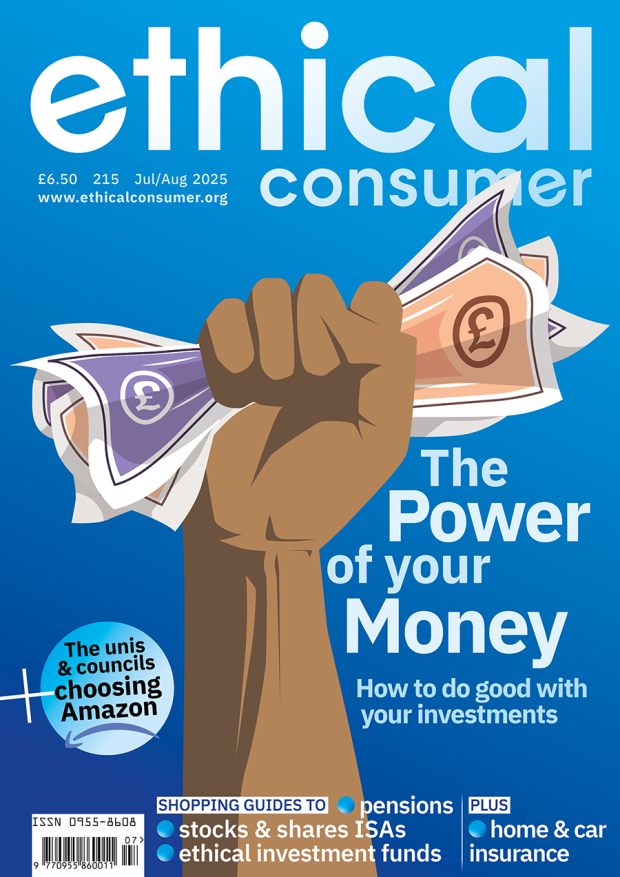
How to find an ethical investment fund with our ethical shopping guide. We rank 22 green and ethical investment funds, with Best Buy recommendations to help you invest ethically.
Our guide to ethical investment funds explores why it is important where you invest your money, and gives you top tips on how to invest ethically.
We look at things you might need to consider such as the return on ethical investments, as well as how to look out for greenwashing, when terms like sustainability can be used, and what a transparent ethical investment fund might look like.
Investing ethically means selecting funds that don't invest your money in things like fossil fuels, weapons, gambling, tobacco and other unethical industries, but do invest your money in positive areas, such as renewable energy.
If you have money available to invest, then choosing which funds to invest in can make a big difference to the environment.
Disclaimer: Our ratings reflect independent ethical and environmental research. This guide is for information on ethical performance and does not constitute advice on the economic performance or safety of financial products. If you invest in any products mentioned, capital may be at risk and past performance is not a guide to future performance. Ethical Consumer is registered as a co-operative society with the Financial Conduct Authority, and is not regulated by them as an investment advisor. For significant financial decisions, please think about consulting a regulated ethical financial adviser.
This is a shopping guide from Ethical Consumer, the UK's leading alternative consumer
organisation. Since 1989 we've been researching and recording the social and environmental
records of companies, and making the results available to you in a simple format.
Already a subscriber? Sign in to view our recommendations.
What to buy
What to look for when choosing an ethical fund:
Does it have a strong ethical policy? Funds should be clear about what they do and don’t invest in. The best funds will screen out the most harmful companies and actively invest in companies that are positively contributing to the world.
Does the asset manager specialise in sustainable investing? Some asset managers primarily focus on sustainable or impact investing, while others only have a few sustainable funds among many “traditional” funds. Opt for the former.
Does it have a sustainability label? Recent regulation introduced sustainability labels to stop the rampant greenwashing in the sector. So, if a fund has one of these labels, it is taking sustainability seriously. We recommend funds with the Focus or Impact label.
What not to buy
What to avoid when choosing an ethical investment fund:
Does it invest in harmful companies and sectors? Most funds that aren’t explicitly focused on sustainable or impact investing will invest in a host of harmful companies and sectors, such as weapons, fossil fuels, and tobacco.
Does it only disclose its top ten holdings? We believe that transparency is essential, so only opt for a fund which discloses all of its holdings before you purchase. That way you can see what it is investing in.
Best buys (subscribe to view)
Companies to avoid (subscribe to view)
Subscribers get more recommendations
In addition to the score table, subscribers can see which companies we recommend as Best Buys, which companies to avoid, and why.
This guide will highlight the most ethical investment funds out there and explore some of the most important issues in the sector.
We cover what ethical investment funds are, the difference between active and passive investments, sustainability labels and regulations, how the companies rate for climate, tax, their investment policies and company ethos. Plus, which investment funds have holdings in unethical industries.
There is also a jargon buster to help you with the complex and often exclusionary language of finance.
What is an ethical investment fund?
It is possible to invest your money by directly buying shares in a company, and many people do this. But this is seen as a relatively risky way of investing because if that company gets into trouble or goes bust then you could lose everything you put in.
If you put your money into an investment fund it will likely be invested in the following:
Equity (aka ‘shares’ or ‘stock’) – an ownership stake in a company, the value of which can go up or down. When you buy equity in a company you own a (probably small) proportion of it.
Bonds – essentially debt. Governments and corporations issue bonds (or gilts in the case of the UK Treasury) to raise money. Bonds usually provide a fixed income for the investor, e.g. 3% per year.
Other investment funds – many investment funds also invest in other investment funds, which is a rather meta way of spreading risk.
An investment fund (also known as a mutual fund) will invest in many companies across a range of sectors, which is less risky than just investing in one or two companies. The lowest number of holdings a fund has is typically about 40, but some funds will have hundreds.
But, the investment fund may include companies that don't align with your ethics. For an ethical investor, the idea that they might be earning money from something that they consider unethical does not sit well within them. If your job is treating cancer patients, you might feel uncomfortable if your savings are invested in tobacco companies.
For this reason, many people wish to align their investments with their morals to make sure that they are profiting from companies and sectors that are benefiting the world, rather than harming it.
What is ethical investing?
When you invest, your money is supporting whatever it is invested in. When you buy shares in a company or put money in an investment fund, most of the time you aren’t providing them with new credit – you are purchasing shares that are already on the market. But the purchase of company shares technically makes you a part owner of that company and is essentially a vote of confidence in it, and helps to maintain a company’s value on the stock market.
“Traditional” investing doesn’t really bother with ethics – the aim is just to make money through any means possible. So, if you put your money in any old investment fund, chances are it will be invested in all sorts of dodgy stuff: arms, tobacco, fossil fuels, and everything else.
Ethical investing is about investing your money in a place that aligns with your values and avoiding harmful companies and sectors. As you’d expect, some funds are more ethical than others. And some aren’t ethical at all.
Ethical investing is a growing market
The ethical or ESG (Environmental, Social and Governance) fund market has been growing for many years now, as more investors seek to align their investments with their morals. As is generally the case in the world of finance, the numbers are staggering.
According to the investment research company Morningstar: “global sustainable fund assets reached an all-time high of $3.2tn at the end of 2024, an 8% increase from the previous year and more than quadruple the size in 2018.” European investment funds have long dominated sustainable investing and, in 2024, accounted for 84% of the market’s assets.
Other names for ethical investing
Ethical investing has many names, some are interchangeable, others differ from one another.
Other terms used are: ESG, impact, responsible, and sustainable investments.
Throughout this guide we use these terms relatively interchangeably, unless specified. For more on these terms see the jargon buster and the sustainable disclosure labels (SDR) section below.
Which funds are in this guide?
There are around 4,700 funds available to UK investors, so even though our researchers are incredibly adept, we were only able to cover a small proportion of them. We’ve picked funds from a range of asset managers, all of which market themself as sustainable or responsible in some way.
Most asset managers have a range of sustainable funds which are governed by the same ethical policy. So, although we’ve only included a small proportion of the ethical funds available, you can use these funds as a guide for selecting others.
For example, we’ve included the Liontrust's 'Sustainable Future Managed Growth' fund in this guide, but Liontrust has over ten “sustainable” funds that are all governed by the same sustainable investment policy. Similarly, Triodos has six funds available, all of which must meet its minimum ethical standards.
Active vs passive investing: which is more ethical?
Funds that are actively managed have a fund manager who uses their expertise to guide investment decisions. Passive funds generally follow a certain index, such as the FTSE 100, so just invest in companies on that index – investment “decisions” are therefore made automatically.
In theory, passive funds can be ethical, but generally they are not. They lack the human oversight needed for moral decision making and usually consist of a very large pool of companies, some of which will likely be bad apples.
The most ethical funds tend to be actively managed, which is the case for the vast majority of the funds in this guide. An exception is the Handelsbanken fund, which describes itself as having 77.8% passive investments and 14.8% active (the remainder are direct and cash investments). As you can see from the portfolio holdings table of harmful investments (further down), it invests in a lot of harmful companies.
How to invest in a fund
There are three main ways to invest in an ethical investment fund. These are:
Directly – many funds allow you to invest directly through their website, though check the minimum investment required.
Through a platform – you might want to invest through an online platform, which can make it easier to invest in multiple funds. For example, the Big Exchange, which is an Ethical Consumer Best Buy, allows you to invest in a range of ethical funds, with a minimum investment of only £25. See our guide to Stocks and Shares ISAs for more on the Big Exchange.
Use an ethical financial advisor – it might be worth getting an expert opinion on how to invest in a way that meets your moral and financial expectations. Read our article on choosing an ethical financial advisor for more information on this.
Direct ethical investing
You can invest in a company or crowdfunder directly. There are a number of good platforms that focus on ethical investment opportunities, such as investing in renewable energy farms or community housing projects e.g.:
When you put money into an investment fund, your money is not just supporting the companies in which the fund holds shares, but some of it is actually paying the fund manager.
For this reason, you should think about the ethics of the asset manager, and you might want to ask questions such as:
Do they engage with companies and vote in a way that you agree with?
Do they exclusively manage ethical funds, or is their ethical fund merely one good apple among an orchard of rot?
Do they award their directors excessively?
Do they pay their tax?
Are they employee owned?
Getting independent financial advice
If investing is an area that you are unfamiliar with, it may be useful to consult an independent financial advisor (IFA) that specialises in ethical investment.
The short answer is it depends on the fund. Just like with traditional funds, some funds will do better than others, as you can see from the Portfolio Holdings table below, which is ordered by the cumulative performance of each fund.
But overall, it appears that sustainable funds might have the edge over more traditional funds.
There is always risk involved in investing, and just because a fund has performed well in the past, doesn’t mean it will continue to perform well, though some will see past performance as an indicator that the fund is well managed and so more likely to be profitable in future.
Most funds will have a risk number, usually the higher the number the greater the risk. More risky funds will usually invest more heavily in equities (company shares), which can go up or down in value. Less risky funds will put more into assets with a fixed rate of return, such as bonds.
Sustainability disclosure labels: regulators crack down on greenwashing
Until recently use of terms such as “sustainable” and “environmental” have not been subject to regulatory oversight. A fund could call itself “sustainable” but still invest heavily in the fossil fuel industry – as we uncovered in our Fossil Free Funds report, published in 2022.
For most people, financial regulation is not something to get the pulse racing, but the Sustainability Disclosure and labelling Regime (SDR), which came into force in the UK in 2024, is an exciting development and good news for the ethical investor.
Firstly, the Financial Conduct Authority (FCA) introduced an “Anti-greenwashing rule” which requires firms to “ensure their sustainability references are fair, clear and not misleading, and proportionate to the sustainability profile of the product and service.”
The FCA also introduced four labels for investment “products with sustainability objectives that aim to improve or pursue positive outcomes for the environment and/or society.” These are:
Sustainability Focus: Funds which aim to invest in assets that are environmentally and/or socially sustainable
Sustainability Improvers: Funds which aim to invest in assets that have the potential to improve environmental and/or social sustainability over time
Sustainability Impact: Funds which aim to achieve a predefined positive measurable impact in relation to an environmental and/or social outcome.
Sustainability Mixed Goals: Funds which use a blend of the above approaches.
These labels will usually be displayed on a fund’s webpage, with more detail on its SDR Consumer Facing Disclosure document.
All the labels require an evidence based approach. For example, funds using the Improvers label must set a definite time frame by which certain improvements are made, and have clear evidence of whether these improvements are achieved. In practice that might mean investing in companies that have carbon reduction targets in line with the Paris Agreement. If a company is failing to meet its targets, the asset manager must carry out an escalation plan, the final element of which is divestment from that company.
The regulation generally limits the use of certain terms in a fund's name and marketing unless the fund has a sustainability label. These terms include: ESG, environment, green, impact, responsible, sustainable, or “any other term which implies that a sustainability product has sustainability characteristics.”
Caveat to sustainable labels
Somewhat bizarrely, the FCA does allow fund managers to use most of these terms (ESG, environment, green, impact, responsible etc) without a sustainability label if they meet certain requirements, including a clear statement that the fund does not have a sustainability label and a clear explanation as to why.
The only terms that are reserved just for label holders are “sustainable”, “sustainability”, and “impact”. As such the FCA’s regulation of sustainability-related language seems a bit half-baked.
For this reason, we advise consumers to go for funds that have obtained a sustainability label, rather than those that have chosen to keep the language of sustainability but don’t have the label. The only exceptions to this are Castlefield and Triodos. Castlefield’s “Thoughtful” fund range doesn’t currently have a sustainability label, but our research found that they were governed by a strong ethical investment policy, while Triodos Investment Management is not based in the UK so its funds aren't eligable for sustainability labels.
The SDR regulation requires that a minimum of 70% of the fund’s assets are invested in accordance with its sustainability objective. So just because a fund has an SDR label, it doesn’t necessarily mean that all of its investments will be sustainability focused, but the majority will be.
Which sustainability label is best?
The labels are not intended to have a hierarchy but are different approaches to pursuing sustainability objectives. Though the FCA admits that consumers will likely apply a hierarchy to them, and its research found that Impact was most positively received because it was seen as most action oriented.
From our perspective, the stated objectives of the Improvers label certainly leave more scope for investing in what most people would consider to be harmful companies and sectors, and this is borne out by our research. Only one of the funds in this guide (the AXA Global Sustainable Managed Fund) carried the Improvers label, but many of its investments appeared on our list of harmful companies, including:
Amazon.com: criticised in the Forest 500 report.
Booking.com: listed on a UN database of business enterprises that are involved in illegal Israeli settlements.
HSBC: criticised in the Banking on Climate Chaos: Fossil Fuel Finance report.
TotalEnergies: listed 6th on the list of the largest oil and gas companies in the world.
So, if you are wanting to avoid your money going to companies such as these, we recommend you stick to the Focus and Impact labels (the mixed label may comprise investments that meet the “Improvers” criteria).
What is ESG?
The term ‘ESG’ is one you may come across when looking for ethical funds. It stands for Environmental, Social and Governance, and refers to a number of issues that funds should be taking into account.
It is usually found in the pages of corporate sustainability reports shortly before AGMs, nesting between photos of clean-energy windmills and poor-but-seemingly happy children from some low-income country.
While it is most certainly a good thing that ESG has become common in the world of finance, some stock market listed companies seem to think that just mentioning the phrase a few times is enough to be able to say you’ve dealt with it.
How do funds rate for their investment policies?
We rated the companies and funds in this guide on a number of ethical issues, including their investment policy.
For this category we looked primarily at the policy governing each manager’s ethical or sustainable funds, but more marks were gained if the policy applied to all its funds.
There were a lot of fairly high scorers in this category, but the top scorers were Triodos and EdenTree, both getting full marks for having a range of robust exclusions and good transparency. Both asset managers applied their ethical investment policies to all funds under management.
When assessing investment funds we also rated funds and companies for their portfolio holdings (what they were actually investing in), as well as what they said they were investing in (see investment policy above). Specifically, we looked to see if they had any investments in particularly harmful companies.
For this guide, we put together a list of 868 harmful companies, against which we compared the portfolio holdings of each investment fund. While this method is great at actually assessing what funds are investing in, it has its limitations which readers should be aware of:
It is a snapshot at a certain point in time. It may be the case that we found no harmful companies in a particular fund, but if we looked next month that might not be the case. For example, the two Triodos funds we included in this guide are both governed by Triodos’ Minimum Standards but scored slightly differently in this category because we found one harmful company in the Pioneer Impact Fund, but not the Global Equities Impact Fund.
It only looks at harmful companies, not companies acting ethically.
Some funds aim to engage companies with poor ethical records so that they can improve them. There is debate over whether this is effective, but in some instances it definitely will be.
How we rated funds for their portfolio holding
In this category all funds started with a score of 100, and for each harmful investment we deducted 20 points. Bearing in mind the above limitations, it is wise to interpret this category with some nuance.
For example, if a fund scores 80 it means that we only found one harmful investment, which is arguably not much of a red flag. However, if a fund scores zero in this category it means we found five or more harmful investments in its portfolio, which is a very big red flag, and likely means that it will always hold investments in a lot of harmful companies.
List of harmful companies
We used a range of sources to compile our list of 868 harmful companies:
Business Benchmark on Farm Animal Welfare 2023 Report.
Banking on Climate Chaos: Fossil Fuel Finance Report 2024.
Fashion Transparency Index 2023.
Forest 500 Report, 2024 (which scores companies on their deforestation impact).
Largest oil and gas companies by market cap (published by CompaniesMarketCap.com).
Norges Bank: Observation and exclusion of companies list. Issued by the Norwegian Ministry of Finance, this is a list of unethical companies that Norway’s sovereign wealth fund is not allowed to invest in.
SIPRI Top 100 arms-producing and military services companies in the world, 2023.
UN database of business enterprises that are involved in illegal Israeli settlements, 2023.
Our list isn’t exhaustive (an impossible task) and there will be harmful companies that aren’t included in this list, but we believe it covers many of the most harmful, across a range of issues.
The table below shows how each fund scored, with each column mapping onto one of the reports listed above (the “Deforestation” column, for example, represents companies criticised in the Forest 500 Report). 'Yes' means that one, or sometimes more than one, harmful company was found. To find out exactly which harmful company was found in each fund, view the stories in each company's profile page (stories are available to subscribers only).
Portfolio holdings: Table of harmful investments found
Fund(ranked by 5 year cumulative performance)
5-year cumulative performance (5/5/25)
SDR label?
Harmful investments found?
(Animal exploitation, Climate change, Deforestation, Fast fashion, Fossil fuel companies, Illegal Israeli occupation, Norges Bank exclusions, Weapons)
Janus Henderson Global Sustainable Equity Fund
78.0%
Focus
Deforestation; Weapons
Royal London Global Sustainable Equity
72.0%
No label
Animal exploitation; Deforestation
Jupiter Ecology
64.5%
Focus
SVM All Europe SRI Fund
55.5%
No label
Castlefield Thoughtful European Fund
51.9%
No label
Animal exploitation
Vanguard ActiveLife Climate Aware 60-70% Equity Fund
46.2%
No label
Animal exploitation; Climate change; Deforestation; Fossil fuel companies; Norges Bank exclusions; Weapons,
Sarasin Responsible Global Equity
45.9%
No label
Animal exploitation; Fast fashion
Liontrust Sustainable Future Managed Growth
43.9%
Focus
SVM UK Opportunities fund
43.6%
No label
Fossil fuel companies; Norges Bank exclusions; Weapons
abrdn Global Sustainable Equity Fund
41.0%
Focus
Impax Environmental Markets Plc
39.5%
Impact
Triodos Global Equities Impact Fund
37.6%
No label^
Rathbone Greenbank Global Sustainability Fund
37.3%*
Focus
Legal & General Future World Global Opportunities Fund
*Cumulative performance: Rathbone Bond only one year available; CT & EdenTree only three-year performance available. Figures multiplied to give five-year equivalent. ^ Triodos Investment Management is based outside the UK so it isn’t allowed to apply for SDR labels.
Ratings for climate policies and actions
There were a lot of low scorers in our climate rating, with many asset managers losing points for likely investments in fossil fuels. While their sustainable funds might exclude fossil fuels, we took away marks from any asset manager that hadn’t explicitly excluded fossil fuel investments across the board – which was most of them.
Again, Triodos gained full marks in this category, and Castlefield is notable for having good climate reporting, despite being a relatively small asset manager.
Company ethos of investment fund companies
Disappointingly, only five companies received more than 0 in our company ethos category.
Triodos topped the rankings, earning full marks. It remains the gold standard in ethical finance: uniquely foundation-owned to safeguard its social mission. Triodos exclusively offers sustainable financial products, maintains a low CEO-to-median pay ratio, and exists to serve its customers – not just shareholders.
Employee-owned Castlefield followed closely, maintaining its reputation for values-led investing and independence from large financial institutions.
A frequent reason for losing marks in this category was a failure to apply blanket exclusions for fossil fuels, arms, or nuclear power. While a number of asset managers now offer some sustainability-themed funds, very few are wholly focused on sustainable investing across their operations. As a result, only a handful qualified for marks as genuine environmental or social alternatives.
Although some, such as WHEB, have previously scored highly, they did not feature prominently in this year’s table. This is, in part, due to WHEB’s recent acquisition by Foresight, a firm that did not match WHEB’s stronger ethical standards under our methodology.
In a sea of low performers, a few names still managed to sink lower than the rest. Vanguard and Lloyds Banking Group (owner of Scottish Widows) scored poorly, with no ethical ownership model and both marked down over executive pay – Lloyds paid its highest director £3.7m in 2023. Both companies were also linked to investments in arms, fossil fuels, and nuclear weapons.
Special mention to AXA, which was found to be a member of two harmful lobby groups and is subject to an ongoing boycott by the BDS National Committee and the Stop AXA Assistance to Israeli Apartheid coalition.
Ratings for tax conduct
Our tax conduct rating evaluates how transparently and responsibly the companies behind ethical investment funds handle their tax affairs.
Just five companies scored a full 100/100: Benefact Trust (EdenTree), Castlefield, Jupiter, River Global, and Triodos. These organisations had no known subsidiaries in tax havens and no public allegations of tax avoidance. Notably, Jupiter is also certified by the Fair Tax Foundation, a mark of responsible tax conduct.
While we are in support of the Make My Money Matter campaign to get people to green their pension, we don’t believe this is the right way of understanding the impact of pension or investment funds.
How should we understand the impacts of our decisions – particularly those around our finances? Let’s take the fictional example of Mrs Jones, who is on a mission to do what she can to reduce her carbon impact.
Firstly, she decides to do her weekly grocery shop on foot rather than using her petrol car. Her decision results in her using less petrol, which means her carbon impact is lower than before. The cause and effect is direct and easily measurable.
Next, she decides to stop buying meat (which generally has a high carbon impact) and instead buys plant-based foods. The real-world impact of this choice is not as immediate as her first because the meat that she would have bought has already been produced. However, over time the grocery shop will react to Mrs Jones’ changing diet by supplying less meat than before, which in turn will mean less is supplied by the producer, leading to lower carbon emissions produced.
Although this impact is less direct and immediate than the first, it is fair to say that Mrs Jones’ decision contributed to a reduction in carbon emissions.
Finally, Mrs Jones decides to green her investments by selling the shares she owned in a fossil fuel company and using the money to buy a stake in a renewable energy company. According to Make My Money Matter’s logic, this action would cut Mrs Jones’ carbon impact significantly because she is no longer responsible for the high carbon impact of the fossil fuel company.
The problem with this logic is that the carbon impact of the fossil fuel company has not reduced as a result of Mrs Jones selling her shares – the ownership of this impact has simply been passed to someone else. It is not right to claim that she has cut carbon because no carbon has actually been cut!
While Make My Money Matter’s ‘21x’ statistic may encourage people to green their investments, there is a danger that it might also make people complacent about other actions that have very direct impacts.
If you think that other actions pale in comparison to greening your investments, why bother reducing your daily intake of Brazilian grass-fed beef?
Associated impact
After reading the above, you might wonder why you should bother investing ethically, but there are several important reasons. The first is what we might somewhat cautiously call ‘associated impact’.
Some, if not most, of the positive impact associated with a product can be attributed to the end user (the person who buys and uses the electric car). But we can also attribute impact to others in the value chain, notably: those that run the company (the workers/managers) and the owners (shareholders).
Having a share in a company does not mean you can claim full responsibility for its impacts, positive or negative, but you are becoming part of the wider network that allows it to function and survive, so it is fair to say that your investment has an associated impact.
Expressing support for a sector
By purchasing shares you are expressing support for that company and the industry it represents – similar to how your vote at an election is a vote of confidence for a specific candidate and their wider political party.
When a company’s shares are in high demand, this is generally interpreted as a sign that it is healthy and its future prospects good. This makes it easier for that company to raise capital in future. By the same logic, when no one wants to buy a company’s shares, it may be difficult for it to raise capital in future.
As such, maintaining a buoyant share price is important for a company’s longevity. If a significant number of investors choose to shun or divest from a particular company or sector, it will make it more difficult to operate in future. According to research into the oil and gas sector across thirty-three countries, published in the Journal of Economic Geography, divestment can reduce access to capital for fossil fuel companies and make further exploration more difficult.
A company’s share price can also drop dramatically, such as following a controversy. This was the case in 2020 when the share price of fast fashion retailer Boohoo dropped 18% following revelations about poor working conditions in its factories. Some investors, including Aberdeen Standard Investments, sold their shares, while the Boohoo PR team no doubt went into overdrive in order to stop all the other horses from bolting.
Voting and engagement
If you own shares in a company, you get the right to vote at their AGMs and other meetings – the more shares you own the more influence you have. This gives you power to vote on matters such as who runs the company day-to-day (if you don’t like what the director is doing you can vote them out) and what should happen to any profits made (should they be awarded as director bonuses or should they be used to finance the company’s carbon-reduction plan?).
If you own a significant number of shares, as investment funds often do, you will likely be able to engage with companies throughout the year, especially if you are a long-term investor, as many of the best ethical funds are. For example, an investment fund might pressure a company by threatening to withdraw its investment if that company doesn’t start reporting on its carbon emissions by a given date.
Asset managers should be transparent about how they have engaged with a company so that consumers can assess whether they are engaging and voting in a way that they agree with. Of course, engagement doesn’t necessarily yield results: one small, iconoclastic fish in a big, conservative pond will struggle to have significant influence. For this reason, asset managers should also report on the outcomes of their engagement, to show what effect, if any, they have had – signatories of the UK Stewardship Code are required to do this.
Shareaction - engaging for good
ShareAction is a charity and campaign group that aims to “define the highest standards for responsible investment and to drive change until these standards are adopted worldwide.” One of its main tactics is through voting and engagement with companies.
By owning shares in some of the world’s biggest companies, ShareAction gets a chance to ask difficult questions at corporate AGMs, and also gathers individual and institutional investors to co-file resolutions on important topics in order to demand change.
For example, after putting sustained pressure on HSBC, the bank announced in late 2022 that it would no longer finance new oil and gas fields.
Jargon buster: a glossary of ethical investing terms
The finance world is notoriously jargon-filled, and when looking to invest ethically, you’ll likely come across a range of different investment styles. There are no regulations governing the following terms and as such their definitions vary and they are often used interchangeably.
Active investing: when investment choices are made on a case-by-case basis by a human, rather than made automatically. Most sustainable funds are actively managed. Compare with passive investing.
Asset: something owned that has value. In the context of investment funds, assets are usually shares, bonds, or cash.
Asset manager: a firm that specialises in buying and selling the assets that sit inside investment funds.
Cumulative performance: shows the total increase, or decrease, in value over a certain time period.
ESG: a ubiquitous acronym in the world of finance, standing for Environmental, Social and Governance. An investment manager that integrates ESG into their strategy supposedly considers all these factors when choosing whether to invest in an asset. It is partly about morality, but more often because they believe these non-financial factors affect the long-term value of a company. ESG investing is basically interchangeable with ethical, sustainable, and responsible investing.
Equity: an ownership stake in an asset, usually a company, the value of which can go up or down.
Exchange-Traded Fund (ETF): a type of investment fund traded on the stock exchange. Most ETFs are passively managed so track the performance of a stock or bond index.
Exclusions: a rule governing what a fund won’t invest in. Also known as screens or negative screens. Common exclusions are controversial weapons, tobacco, and pornography, but can be anything – we even found one fund managed by Sarasin that excluded companies that manufacture contraception! Exclusions usually come with a maximum revenue threshold. For example, if a fund excludes investments in companies that sell tobacco and the maximum revenue threshold is 5%, that means that the fund will not invest in any company that makes more than 5% of its total revenues from the sale of tobacco.
Holdings: see “portfolio holdings”.
Index: essentially a list. The FTSE 100 is an index of the largest UK companies by market value. Index funds track indexes like the FTSE 100 and invest in the companies on that index.
Impact investing: while ESG and SRI investing rely heavily on negative screens (not investing in certain things), the primary aim of impact investing is to maximise positive impact, ie investing in solutions, like solar panel manufacturers, rather than just avoiding problems. The Global Impact Investing Network (GIIN) defines impact investing as, “investments made with the intention to generate positive, measurable social and environmental impact alongside a financial return.”
Investment fund: an investment vehicle in which the money of multiple investors is pooled together and invested collectively, usually in shares and bonds. Investment funds may also invest in other funds.
Passive investing: investment decisions are made automatically, rather than by a fund manager, usually by following an index such as the FTSE 100.
Portfolio holdings: a fund’s assets, its investments. Nearly all funds display the top ten holdings (the ten biggest investments), but those with the best transparency will disclose all their holdings.
Screens/negative screens: see “exclusions”.
SDR: Sustainability Disclosure and labelling Regime. Regulation introduced in the UK in 2024 that aims to prevent greenwashing in the sector. Funds can apply for sustainability labels to show that they are taking sustainability seriously.
Share classes: often denoted as “Class A”, “Class B”, etc. Different types of shares are available within a company and come with different voting rights,ownership restrictions, and privileges.
SRI: Socially Responsible Investment. Much the same as ESG investing, though some might argue that social and environmental considerations are more core to its strategy. Will likely have some exclusions.
Due to the blurring of these terms, one isn’t necessarily a more ethical approach than the others. That said, we believe that a good ethical fund should have a clear set of exclusions and a clear policy to invest impactfully.
Anti-woke funds: the backlash to ethical investing
The rise of ESG investing has sparked a fierce conservative backlash in the US, where a new breed of funds are now being launched explicitly to exclude so-called “woke” companies. One such fund, led by Azoria Partners and set to launch under the provocatively named S&P Meritocracy, is targeting firms with diversity, equity and inclusion (DEI) policies – beginning with Starbucks.
Azoria’s pitch is simple: ditch companies that factor race or gender into hiring and reward those that focus solely on “merit”. Their campaign was unveiled at Donald Trump’s Mar-a-Lago resort, symbolising the increasingly politicised nature of financial markets.
This anti-woke strategy borrows from ESG tactics – using exclusions and public pressure – but in reverse. It highlights that shareholder activism works both ways, and that exclusion-based investing does have an impact.
Critics argue these funds risk promoting discrimination under the guise of neutrality, while some data shows diverse companies outperform less inclusive ones. For companies like Starbucks – a frequent flashpoint for both right- and left-wing criticism – it’s a sign of how polarised the politics of corporate responsibility have become. Whether the S&P Meritocracy fund gains traction remains to be seen, but its existence is a stark reminder that markets don’t exist outside politics – they operate within it.
Additional research by Yalda Keshavarzi.
Company profile: Aberdeen
Aberdeen Group (formerly abrdn, no that’s not a typo) is one of the UK’s biggest investment firms. The company’s 2021 rebrand, which ditched vowels entirely, was widely mocked – drawing comparisons to word puzzles, and "irritable vowel syndrome." In 2025, the company quietly brought the vowels back, now styling itself as aberdeen (lowercase only, to keep things interesting). The CEO called the reversal “pragmatic,” but many saw it as a final end to one of corporate branding’s most mocked detours.
Name games aside, the company manages billions in assets but has failed to clean up its ethical act. Its baseline investment policies apply to most funds, but deeper exclusions – like avoiding fossil fuels or arms – only apply to some ESG-labelled products.
abrdn (as it still legally operates in many documents) excludes thermal coal and controversial weapons but allows investments in conventional oil and gas with up to 40% revenue from the sector – far above Ethical Consumer’s acceptable threshold of 10%.
In fact, aberdeen was found to have invested $134m in newly issued fossil fuel bonds in 2024. One activist group even designed a protest video game, Asset Manager Quest, satirising its role in fuelling climate breakdown – and invited aberdeen staff to play it.
On tax, the company operates several subsidiaries in known tax havens like Luxembourg, Guernsey, and Jersey, and is not Fair Tax accredited. While it claimed these structures are industry standard, Ethical Consumer found its explanations lacking.
It also lost points for being linked to illegal Israeli settlements (via the Don’t Buy Into Occupation 2024 report), and for scoring a poorly on the Forest 500 index, which tracks links to deforestation.
While it is Living Wage certified, that positive is overshadowed by excessive director pay (£2.1m in 2024) and membership of harmful lobby groups. Overall, despite reclaiming its vowels, aberdeen group continues to fall short on meaningful ethical reform.
Want to know more?
See detailed company information, ethical ratings and issues for all companies mentioned in this guide, by clicking on a brand name in the score table.
All the information and inspiration you need to join thousands of others and revolutionise the way you shop, save and live. Full online access to our unique shopping guides, ethical rankings and company profiles. The essential ethical print magazine.
6 issues of Ethical Consumer Magazine in print and/or digital format
12 months full access to all Shopping Guides and Company Profiles
Special discount offers from selected Best Buy companies.
Digital versions of our entire catalogue of back issues.