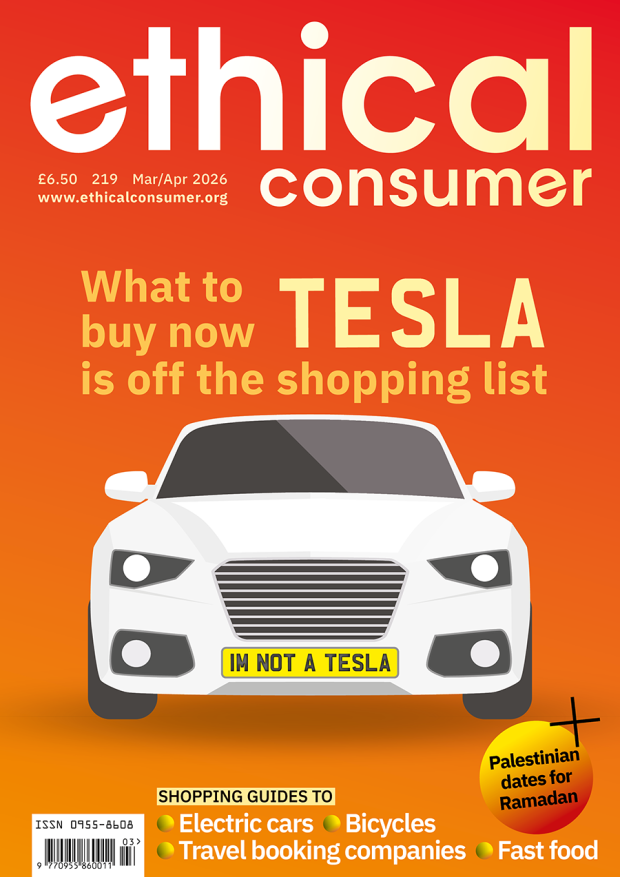
Free buyers guide to Bicycles, from Ethical Consumer

Free buyers guide to Bicycles, from Ethical Consumer


This is a buyers' guide from Ethical Consumer, the UK's leading alternative consumer organisation. Since 1989 we've been researching and recording the social and environmental records of companies, and making the results available to you in a simple format.

We take a look at the companies peddling bicycles

The report includes:

  • ethical and environmental ratings for 55 brands of bicycle
  • Best Buy recommendations
  • which bicycles are hand-made in the UK
  • whether to buy new or second hand
  • why repairing your bike is the greenest option


Research Report Download - includes all the detailed research behind this buyers' guide.

Download this Report now (£3 or free to subscribers).
Free sample report & A-Z list

Customise the scorecard ratings

Click the + icon to expand categories
Help

Score Ratings

Our ratings are live updated scores from our primary research database. They are based on primary and secondary research across 19 categories. Find out more about our ethical ratings


Score table

The score table shows simple numerical ratings for each product.

Move the sliders to customise these scores. 

Click on a product name to see the stories behind the score (subscribers only). 


Full Scorecard

The Full Scorecard shows the 'black marks' for each product, by each of the 19 categories. The bigger the mark, the worse the score. So for example a big black circle under 'Worker Rights' shows that the company making this product has been severely criticised for worker abuses.

The Full Scorecard is only available to subscribers. Click on the More Detail link at the top of the score table to access it.


Customising Rating Scores

Move the sliders to change the weighting given to each category. You can open up each of the 5 main categories by clicking on the + sign. This way you can compare products according to what's ethically important to YOU.  


Saving Your Customised Weightings

You must be signed-in to save your customisations. The weightings you have given to each category will be saved premanently (subscribers) or only for this visit to the site (registered users).  Once set, they will be used to calculate the scores in all the buyers' guides that you view. 


Stories and Data behind the scores

To see all the stories and research data behind the ratings you'll need to be a subscriber.

How the Sliders work
Move the sliders to see how different issues affect the score table
Refine each category by clicking the + icons
Save your settings (you need to be signed in first)
Key to expanded Score table

Best Buys

as of November 2007


As our ratings are constantly updated, it is possible that company ratings on the scroe table may have changed since this report was written.


Moulton (bikes with small wheels, 01225 865895 ) and Pashley (a traditional 1950s style bike 01789 292 263) come out best. None of the companies score particularly badly if you need a different type of bike.


Get on your bike

Katy Brown takes a look at the companies peddling bicycles

One hundred million bicycles are built worldwide each year with 2.4 million of them bought in the UK.(1) Domestic bicycle production has all but ceased, the majority has been shipped out to the Far East. We asked all of the companies in the report for supply chain codes of conduct for workers' rights. Working conditions are likely to be poor in the industry, since long working hours for little pay are common in factories in these parts of the world.

Cycling is one of the most environmentally friendly modes of transport there is - bicycles don’t require fossil fuels to run, and compared to cars require much lower amounts of energy and raw materials to build. Around ten million car and truck chassis and 250 million tyres are dumped annually, little of this is recycled. Worn out bicycles and parts on the other hand, of which some are recycled in many areas, need much less space for their disposal.


Six things you didn't known about bikes


• Bicycle use has been falling steadily since the 1970s, despite the fact that more of us than ever own bicycles.
• The energy efficiency of cycling is estimated to be the equivalent of a car doing 1600 miles on a gallon of petrol.
• In the UK, an average car produces about 3.3 tonnes of carbon dioxide per year
• Cycling contributes zero to green house gas emissions.
• Bikes save space - you can park ten bicycles in the space required for one car.
• At least half of all car journeys in Britain are short enough to be cycled. If they were, car mileage would be reduced by one sixth.
• The amount of steel and other materials in bicycle construction is less than 2% of that found in a small car.


Repair repair repair


Often a bicycle shop will tell you it’s not worth fixing your bike as it will cost more than the bike’s value to repair. However, this doesn’t reflect the environmental cost of producing a new bike or the disposal of the old one and the monetary cost of repair will almost certainly be less than the cost of a new bike. Of course it’s in the interest of a bike shop to persuade you to buy a new bike rather than fixing the old one but shop around as these attitudes do vary from place to place. Maintaining your old bike is always a more environmentally sustainable option than buying a new one.


Don’t buy new


If you do need to replace your old bike, or of course if you don’t have one already then buying second-hand will put less strain on the world’s resources. Check out your local second hand dealers, freecycle (www.freecycle.org) or Ebay.


But if you do


Obviously we’d recommend our Best Buys, the British hand-made bicycles of Moulton and Pashley, though unfortunately these will be out of a lot of peoples’ price range. It’s also worth considering that although heavier, fewer carbon emissions are produced in manufacturing a steel frame bike than one made from aluminium. Steel bikes are more sustainable in the long-run too as their tougher frames are more hard-wearing.


Support your independent bike shop


Most bicycles are still sold through independent bike shops, and by buying from them you support your wider local economy as they will spend money in the local area. A number of bike shops are run as co-operatives such as the Edinburgh Bike Co-op (www.edinburghbicycle.com) which now also has outlets in Manchester, Aberdeen, Newcastle-Upon-Tyne and Leeds.


Poor provision for pedal power


Increasing bicycle use does not only lie with the individual. Provision for cyclists is currently poor in the UK, cycle paths are not yet the norm and inconsiderate drivers don’t help matters. Many train companies are very bicycle friendly, while others are still not up to scratch. With climate change and health both high up on the political agenda, putting money into encouraging cycling would seem a perfect way for the government to help tackle both. Many areas have local cycling campaigns, a web search is the easiest way to find out if there’s one in your area. Otherwise there are national cycling campaigns – see the links below.


Critical Mass


A more direct way to campaign for better cycling provision has developed in the form of the Critical Mass, whereby cyclists take to the roads en masse as both a celebration of cycling and to assert cyclists’ right to the road. The rides typically take place on the last Friday of every month. To find out if there’s one in your area visit www.critical-mass.info, if there isn’t – why not set one up?


Do one thing


For this report that’s easy – if you don’t have a bike already then get one and use it instead of a car wherever possible.


Links


• Cycling England, PO Box 54810, London, SW1P 4XX, www.cyclingengland.co.uk, info@cyclingengland.co.uk
• Bike for All www.bikeforall.net
• Love Your Bike www.loveyourbike.org


References


1 Mintel database, UK Bicycle Market report 2005, accessed in August 2007

Navigate To:

top-5-shops

Advertising

Bishopston Trading Company
good energy ad
CoopBank2011
stop climate chaos