
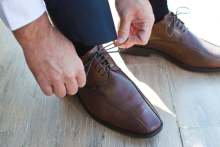
Footwear materials: leather vs synthetics

Although global leather production continues to rise, so too does cruelty-free, vegan footwear.

But many of the animal-free alternatives to leather are made from plastic-based synthetic materials. While many people may want to avoid animal use in the form of leather shoes, are fossil-fuel based alternatives the answer?

We delve into the pros and cons of leather versus synthetic materials for footwear and look at other plant-based options.

Global leather production continues to rise, from 10.5m tonnes in 2005 to 13.8m tonnes in 2024. And around half of leather is used for footwear, with the rest going to other clothing, furniture, accessories and more. 

And despite a continued interest in animal-free footwear, some major trainer brands have recently pulled some of their flagship vegan models. 

Some people who are keen to avoid animal products are also keen to avoid materials made from fossil-fuel, such as plastic-based synthetic materials. So are bio- or plant based alternatives the solution?

Animal welfare issues with leather

The skins of other animals have been used by humans for millennia. However, the way that mainstream leather is processed, and the industrialisation of animal farming may be some of the reasons that people are looking for leather alternatives. 

Most companies use the narrative that leather is a by-product of the meat industry. However, leather is economically valuable with high demand for leather-based goods, including shoes. This makes it a profitable industry in its own right, worth over £300bn globally in 2025. It sustains and feeds the meat industry as a co-product of animal slaughter, and at the slaughterhouse level it’s very difficult to say what ‘comes first’ when different animal bodily parts are shipped off for different industries.

We couldn't find any animal welfare policies for companies’ leather supply chains in the shoes or trainers guides.

Companies were only treating it as a ‘leftover’, thereby ignoring the type of farming or animal welfare issues that their purchases were sustaining. The Leather Working Group certification, which a number of companies use, does not formally include animal welfare and focuses on the environmental impacts of production.

 

Cattle penned inside barn
Image courtesy of Louisa Gould, reproduced with permission.

Carbon emissions of leather and synthetic leather

As well as the high CO2 emissions that occur raising cattle and other farmed animals used to make leather, transforming animal skin into smooth leather is a highly energy-intensive process.

In their sustainability reporting, footwear companies using leather report that their highest emissions came from leather. Some only count the impact from the tanning process onwards after the animal skin is obtained. This paints a misleading picture as it doesn’t take into account where the skin came from.

When comparing emissions of animal leather with synthetic leather made from polyurethane (PU), even without including emissions from farming, animal leather emissions are still higher:

  • animal leather emissions = 17kg CO2e per square metre
  • PU emissions = 15.8kg CO2e per square metre

And, if farming impacts are included, cow leather comes out at 110kg CO2e per square metre.

Using this data and shoe data, Collective Fashion Justice estimates the following:

  • pair of shoes made from cow leather carbon impact of 40.7kg CO2e
  • pair of shoes made from PU synthetic leather of 5.8kg CO2e 

Pollution from leather production

To turn it into a wearable product and to prevent decomposition, animal skin undergoes tanning. The majority of leather is tanned using chromium, which is highly toxic to both people and the environment.

Other hazardous substances used in leather processing have been classified by the European Chemical Agency (ECHA) as Substances of Very High Concern (SVHC). Tannery waste is highly toxic and polluting to the environment, plant and animal life, as well as being hazardous for tannery workers.

There are some processes which reduce some of these impacts. 

Chrome-free leather is processed without the use of chromium, heavy metals, and particular acids. It also means that water use is reduced and water is recyclable after use, which is not possible with chrome leather. 

Vegetable-tanned leather uses tannins from trees or other organic fibres during processing.

Buying secondhand footwear gets around some of these issues.

Are synthetic ‘faux' leather shoes better?

Concerns around the emissions of cattle, animal welfare, and pollution associated with leather processing have led some to look for vegan leather. Although for some, the priority may be whether shoes are vegan or not, many synthetic materials which are marketed as vegan alternatives to leather come with other ethical issues.

Synthetic leather alternatives typically consist of fossil fuel-based materials such as polyester or similar coated in PVC or PU. Some brands in the trainers guide, such as New Balance and Salomon, are now PVC free due to its toxicity. Hylo also did not use PVC in its synthetic shoes. 

At the end of the product’s life, shoes made from synthetic plastic-based materials will not biodegrade but just break down into microplastics which infiltrate every corner of the world. However, although made from animal skin, the disposal and recycling of the majority of leather is also not straightforward due to its chemical treatment, among other factors.

For some, leather means buying a long-lasting product, but from this perspective the same could also be said for synthetics.

Aerial view of mushroom in different stages to make mushroom 'leather' material
Vegan leather alternative from mushroom mycelium

Vegan ‘bio-based' shoe materials

Several companies in our guide to shoes and trainers have either been researching or already sell vegan 'bio-based' footwear products. 

Although cow leather is technically ‘bio-based’, by vegan bio-based materials we mean animal-free materials that are based on plant fibres. These alternatives aim to replicate leather without its links to methane, deforestation, chemical pollution and animal welfare concerns. 

Beyond grapes and apples, vegan bio-based leathers for shoes can be made from mangoes, cacti, pineapples, and even fungi. Other novel combinations include corn-based and sugarcane derived materials.

However, some experts warn these innovations may distract from fashion’s rising emissions and continued reliance on fossil fuel-derived materials. 

The majority of bio-based leathers used in footwear are actually plant-PU hybrids, often made up of 10-50% plastic. There are also worries that companies are producing new bio-based leathers as marketing narratives to drive sales, rather than delivering meaningful sustainability improvements. “Apple leather, orange leather, pineapple leather, fruit salad leather. It’s like, seriously do we really have to call it leather?” the founder of Nature Matters, Dr Helen Crowley, says. “I haven’t yet seen an alternative leather become an alternative, I’ve seen it just added to the portfolio. It’s about more variety and more stories to sell more stuff.” 

There are also concerns about scalability. Several prominent vegan leather alternatives, including mushroom-based Mylo, pineapple-based Piñatex and cork-based Mirum, have ceased production, despite more than $1bn in investment. High costs, limited interest from brands, performance and dependence on fossil-fuel-derived coatings remain major obstacles for producing innovative materials at scale. More advanced plastic-free and lab-grown options are emerging, but remain niche.

Most commercially available vegan leather is still PU or PVC plastic, which relies on fossil fuels, sheds microplastics and is difficult to repair or recycle. 

Availability of animal-free footwear materials

Of course, canvas shoes have been around for hundreds of years and still feature in the ranges of many of the larger companies in our guides. Although canvas can sometimes be synthetic, it can also be made from cotton, flax, or hemp which are all vegan, bio-based, and degradable materials. It's important to note however, that almost all of the bio-based materials currently used in footwear contain some proportion of synthetic material too.

We only found one company, Will's Vegan Shoes, that had a fully biodegradable sneaker, which had textile uppers and was not leather-like. 

We recommend looking for vegan bio-based shoes if buying new, but be aware that bio-based options are not yet a silver bullet. Progress away from animal suffering and away (if gradually) from fossil-fuel based synthetics has to be a good thing.

Is kangaroo leather used in trainers?

Kangaroo leather, prized for being unusually thin, light and strong, was never really a trainer material but was instead primarily used in football boots. At its peak, campaigners put Australia's commercial kill rate at around two million kangaroos a year, making it the largest land-based wildlife slaughter in the world.

But, following animal rights campaigns like "Kangaroos Aren't Shoes" by the Center for a Humane Economy, that market has now collapsed. Nike and Puma announced they were dropping k-leather in 2023, and Adidas, ASICS and New Balance have all ended their use as of 2026, alongside Diadora, Sokito and Umbro. Mizuno, long the last major holdout, has since committed to phasing it out as well. 

So if you are shopping for vegan trainers, kangaroo leather is unlikely to be your problem. Cow leather, and the polyurethane in almost everything sold as "vegan leather", are still very much worth checking for on the label however.

Symbols used for leather, textile and synthetic materials. Described in the text.

How can I spot leather or synthetic footwear?

Shoes and trainers, and other footwear, should have a label indicating what materials have been used. 

The image here shows the three main materials with their symbol:

  • leather = an outline of what might be a spread out animal hide
  • textile = cross-hatching of multiple lines
  • synthetic = diamond shape

Whilst some footwear may be all one type of material, trainers in particular can be made of many types of material, including suede (a form of leather which is the softer underside of the animal skin).

What about waterproof footwear?

Generally speaking, well maintained leather, as well as PU and PVC, are used in footwear because of their ability to keep feet dry. So far as we can tell, many vegan bio-based shoe materials also aim to be water resistant at the very least, for example SAYE uses water-repellent organic cotton. 

One problem with waterproofing is that, in 'high-performance' footwear particularly, it can lead to the use of the 'forever chemicals', PFAS. It's worth trying to avoid these in footwear. More information on some of the companies trying to do this appear in our PFAS feature.  

Our footwear materials rating

Our footwear materials rating column in our trainers guide awarded points to companies that were:

  • taking action to reduce the impacts of materials including leather, PVC and PU
  • designing footwear for recycling or repair
  • using biodegradable uppers
  • using bio-based uppers
  • using all organic or recycled cotton, or recycled materials

Plus points were awarded if the company’s whole focus was on providing lower impact environmental alternatives. 

For those companies using leather, the rating gives the most marks to recycled or secondhand leather. For virgin leather, we awarded some marks to those which only source from Gold-rated Leather Working Group tanneries. This certification assesses chemical management, water and energy use, waste treatment and more, helping reduce leather’s environmental impacts, but it does not address animal welfare. 

This way, we capture a holistic view of the impacts that a company’s footwear materials have, rather than only looking at one issue such as vegan or not, or synthetic or not. 

This article was published in 2024 and revised and updated by Ruairidh Fraser in September 2026.