Sunscreens

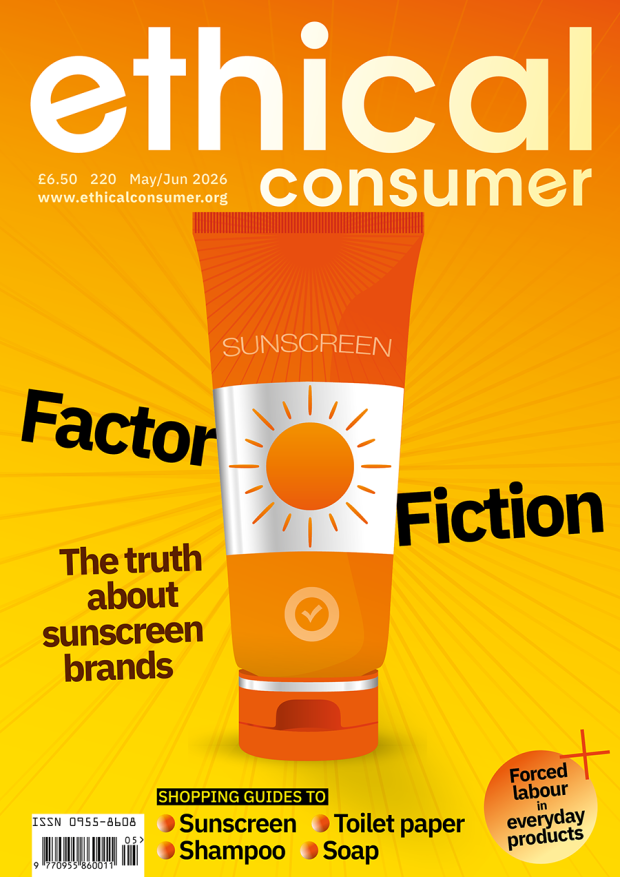
Find an eco friendly and cruelty free sunscreen. We rate 34 sunscreen brands on their environmental and ethical policies.

We all know about the dangers of too much sun on our skin, and most people now use sunscreen to protect their skin. But, are some of these suncreams harmful to the environment?

In this guide we look at the difference between chemical and mineral sunscreen, plus which have nanoparticles in. We also look at which sunscreens are eco-friendly and reef-safe - if any.

We also find out which brands make vegan suncream, if any brands are free of palm oil, who uses organic ingredients, and which brands make sunscreen which is suitable for darker skin. 

Plus we explore what the SPF labelling system means, and give our recommended buys and what to avoid. 

About our guides

This is a shopping guide from Ethical Consumer, the UK's leading alternative consumer organisation. Since 1989 we've been researching and recording the social and environmental records of companies, and making the results available to you in a simple format.

Learn more about our shopping guides   →

Score table

Updated daily from our research database. Read the FAQs to learn more.

← Swipe left / right to view table contents →
Brand Name of the company Score (out of 100) Ratings Categories Explore related ratings in detail

Brand X

Company Profile: Brand X ltd
90
  • Animal Products
  • Climate
  • Company Ethos
  • Cotton Sourcing
  • Sustainable Materials
  • Tax Conduct
  • Workers

Brand Y

Company Profile: Brand Y ltd
33
  • Animal Products
  • Climate
  • Company Ethos
  • Cotton Sourcing
  • Sustainable Materials
  • Tax Conduct
  • Workers

What to buy

What to look for when buying sunscreen:

  • Is it organic certified? A straightforward way to ensure the product has reduced environmental impact whilst avoiding some of the harmful chemicals used in sunscreens. Look for certifications such as the Soil Association label.

  • Is it cruelty-free? The Leaping Bunny logo helps ensure the product hasn’t been tested on animals anywhere in the world.

  • Does it use sustainable palm oil? Most sunscreens use some palm oil derivatives. It’s not easy to spot them, look at our palm oil rating to inform yourself.

What not to buy

What to avoid when buying sunscreen:

  • Does it have a SPF rating of less than 15? The NHS advises that sunscreen should have an SPF of at least 15 and therefore give adequate blocking to UVB rays. Avoid brands with an SPF lower than 15.

  • Does it have a UVA rating? Within the EU, the amount of UVA protection is indicated in one of two ways, either by a 5-star system or by the letters UVA inside a circle. Avoid brands without a rating.

  • Does it use animal ingredients? It is perfectly possible to produce sunscreen without animal-derived ingredients. We discuss which brands are vegan in this guide.
     

Best buys (subscribe to view)

Companies to avoid (subscribe to view)

In-depth Analysis

Ethical and eco-friendly sunscreen

Sunscreen has long been sold as a holiday essential, packed for beaches then forgotten by autumn. But consumer behaviour is changing. In 2024, UK suncare sales reached record levels despite fewer sunshine hours than the previous year, suggesting protection is becoming less seasonal and more habitual. 

SPF is now increasingly embedded in daily routines, with foundations and tinted moisturisers containing SPF 25 and above growing modestly, while lower-protection makeup is losing its appeal.

The sunscreen aisle is no longer just about bronzed holidays or tanning oils. For many consumers sun protection is now framed as important for skincare, prevention, and long-term health.

Awareness of skin cancer risk, photoaging and year-round UV exposure has grown alongside scrutiny of ingredients and environmental impact.

In this guide we explore what this means in practice, unpacking ingredients, labelling, and access.

What and who are in this guide to sunscreen / sunblock?

This guide to sunscreen (also called sunblock or suncream), includes all the big brands you can find in high street chemists including brands like Avon, Garnier Ambre Solaire, Nivea, and Piz Buin, as well as own-brand products from companies like Boots and Superdrug. 

We have also included and rated small and medium sized brands which can often be found in wholefood shops or online, including Neal's Yard, Tropic Skincare, JASON and Weleda. 

With ratings out of 100 ranging from 17 to over 80 it's possible to buy ethical and eco-friendly sunscreen, with options to suit different budgets.

Chemical versus mineral sunscreen

Most sun lotions fall into two major categories, depending on the active ingredients they use: chemical sunscreens and mineral sunscreens.

Chemical sunscreens

Chemical sunscreens contain compounds which act by absorbing UV rays and releasing them from the skin as infra-red rays, which is essentially heat.

Compared to mineral sunscreens, they spread more easily onto the skin, requiring less to be applied; they are also less susceptible to washing off in water or sweat.

On the other hand, some of the active chemicals they contain have been known to produce allergic reactions on sensitive skin, and some, like homosalate and oxybenzone, are not considered safe in the amounts they’re used, although some studies (including one funded by a consortium whose members include many big sunscreen companies) dispute this.

There are also concerns over potential harmful impacts of chemical sunscreens when they wash off our skin and into the environment – chiefly around the threat they pose to coral reefs, discussed further below.

Mineral sunscreens

The active ingredients of mineral sunscreens are zinc oxide and/or titanium dioxide which are naturally occurring compounds (although minerals used in sunscreens are produced synthetically). They shield the skin by sitting on the surface and scattering some UV rays, absorbing the rest.

The US Food and Drug Administration said, in 2022, that out of the 16 active ingredients (these are the ones that protect us from UV) it reviewed, only zinc oxide and titanium dioxide were “generally recognised as safe and effective”.

Mineral sunscreens tend to be gentler on sensitive skin compared to chemical sunscreen, since they generally contain fewer chemical allergens.

Mineral sunscreens work on the surface of the skin which means that they can be harder to blend into the skin, and wash off more easily. This can also create a visibly white layer as the light is reflected away unless nanoparticles are used.

Whichever option you choose, they're working in pretty much the same way: by reducing how much UV your skin absorbs to protect it from damage and the risk of developing cancer.

Nanoparticles: are they a health problem?

The zinc oxide (ZnO) and titanium dioxide (TiO2) particles traditionally used in mineral sunscreens don’t rub easily into the skin and can produce visible whitening effect, which may be undesirable to some.

Producers of mineral sunscreen have found the problem can be resolved by breaking these minerals down into tiny nanostructures, which rub into the skin much more easily.

The engineering and application of materials at a scale of 100 nanometres or less is referred to as nanotechnology (one nanometre equals one billionth of a metre or one-thousandth of the thickness of a human hair).

Concerns around nanotechnology have been centred mainly around the potential harmful effects to the human body. Although many nanoparticles occur naturally, synthesised substances at this scale have only very recently come into existence, and there is limited research as to how our own bodies and other natural organisms will interact with them.

That said, research into nanoparticles in sunscreens suggests that they do not penetrate healthy skin, even after repeated application. A study on sunburned skin found minimal penetration into upper skin layers but no significant systemic absorption.

Spray or powder sunscreens that generate airborne nanoparticles can be inhaled though, and tiny particles in lungs can be associated with respiratory risks. Titanium dioxide is suspected to cause cancer if inhaled. As a precaution, any product containing TiO2 above a certain limit must contain a warning on its label. It is probably advisable to stay clear of these types of sunscreens or use them with a lot of caution.

The environmental impact of nano TiO2 or ZnO is still very poorly understood but it is known that zinc oxide may be particularly toxic to aquatic life at high concentrations.

Non-nano sunscreens

Mineral sunscreens have become very popular in recent years. This is evidenced by the fact that only two companies in this guide don’t sell them: Avon and Superdrug (own brand). 

The following brands produced mineral sunscreens and used explicitly non-nano zinc oxide or titanium dioxide:

Is sunscreen toxic to the environment?

Sunscreen in aquatic environments

Concerns about sunscreen and coral reefs have circulated for over a decade. The evidence base is growing but it’s more nuanced than viral headlines suggest.

A widely cited estimate suggests that 6,000–14,000 tonnes of UV filters may enter coral reef areas each year from swimmers, snorkellers and divers, and from wastewater discharges in coastal regions. This figure originates from studies dating back to the early 2000s and continues to be referenced in scientific reviews.

More recent research confirms that UV filters are now routinely detected in seawater, sediments, and marine organisms, particularly in high-tourism areas.

However, scientists stress that global estimates are uncertain and vary by method and, therefore, should be understood as indicative rather than precise.

Below water image of coral reef and fish
Image by Francesco Ungaro on Pexels

What does the science say?

Studies have found that certain UV filters, including oxybenzone and octinoxate, can hurt coral reefs.

They’ve been linked to coral bleaching, damage to baby coral’s DNA, and hormone problems in some sea creatures.

That said, translating lab concentrations to real-world reef ecosystems is complex. Field data show these chemicals are present in popular swimming areas, but concentrations vary widely

Major scientific reviews emphasise that rising sea temperatures, ocean acidification, nutrient pollution, and overfishing remain the primary drivers of coral reef decline. So sunscreen is just one potential extra problem, particularly in enclosed bays with heavy tourist use, but it’s unlikely the leading cause.

For ethical consumers, the question is perhaps less “Should I wear sunscreen?” and more “How do we demand safer formulations, clearer labelling, and stronger environmental regulation whilst protecting human health?”

Regulatory responses

Some jurisdictions have acted already: 

Lower-impact steps

Wearing UPF clothing, so you need to use less cream, and applying sunscreen well before swimming to minimise immediate wash off, are two small steps you can take to minimise impact. Also avoid unnecessary additives like glitter!

Organic sunscreen

Buying organic certified sunscreen (not to be confused with organic as in 'chemical' – see 'active ingredients' entry in table further below) ensures that the product has reduced environmental impact whilst avoiding some of the harmful chemicals used in sunscreens. That said, none of the active sunscreen ingredients can be organic – they’re either mineral or synthetic chemical. It is the inactive ingredients that are organic, such as aloe vera, seed oils, etc.

With that in mind, the following brands sell sunscreen that’s as organic as it can be: 

A few brands use certain organic ingredients, such as Shade, which uses Soil Association shea butter and coconut oil, and Yaoh, which uses organic hemp seed oil.

Vegan sunscreen

Sunscreens often contain animal-derived ingredients such as keratin and lanolin, as well as honey and beeswax.

Of the brands rated in this guide, the following were fully vegan

Bulldog and Organii were also vegan but not their parent companies (Edgewell and Earth Aid Group respectively).

Cruelty free sunscreen

Although animal testing in the cosmetic industry, for the most part, has been banned in the UK and the EU, hundreds of thousands of animals are still used in cosmetic tests worldwide.

While most brands in this guide have a policy not to test their final products on animals, several still lack meaningful statements on how they reduce the risk of animal testing in their supply chains or allow animal testing “for medical or legal reasons”. This includes Beiersdorf (Eucerin and Nivea), Clarins, Edgewell (Banana Boat, Bulldog, and Hawaiian Tropic) and Kenvue (Aveeno, Neutrogena, Piz Buin).

Although the Australian Gold, Superdrug, and Ultrasun brands have quite strong policies to prevent testing, their parent companies (New Sunshine, CK Hutchinson, and the Lalique Group respectively) don’t.

Highest scoring brands for animals rating

In our rating system the following brands scored the highest in the 'animals' category:

Full marks (100/100)

80/100 

60/100

All the rest of the brands in the guide scored below 50 for the animals rating. Boots and No7 both scored zero.

The Leaping Bunny logo and certification is often used by brands for their animal testing polices. Remember that even if a product carries the Leaping Bunny logo it doesn't mean it's vegan, as this scheme allows animal products as ingredients.

Woman sitting on beach putting suncream on from blue plastic bottle
Image by Karola G on Pexels

Palm oil free sunscreen

Palm oil and its derivatives are commonly used in sunscreen. It acts primarily as an emulsifier, stabiliser, and moisturiser. In cosmetics, where palm oil is used it won't be listed simply as "palm oil." It is often hidden under different names such as cetearyl alcohol, glyceryl stearate, stearic acid, and others.

The global demand for palm oil in the past couple of decades has had devastating consequences in tropical countries. Forests are destroyed, often by burning, to be turned into plantations, displacing people and wildlife, releasing greenhouse gases.

Company approaches to the issue vary hugely, from some providing no information at all about palm oil sourcing (despite listing palm oil derivatives in ingredients lists), to others going to great lengths to reformulate products to avoid using it at all.

Palm oil free brands

Shade is the only brand in this guide that is completely palm oil free. It uses coconut oil and shea butter instead.

Next best for palm oil policies

Most companies use at least some certified-sustainable palm oil. 

Higher scoring brands in the palm oil ratings category were:

Of those that scored very little in this category, Avon, Superdrug, and Ultrasun are large companies that should have scored much better.

SPF and UVA: what’s the difference?

While the relative health risks of nanoparticles and organic chemicals are debatable, the dangers of too much sunlight exposure are not. More than 150,000 new cases of skin cancer are diagnosed each year in the UK. Of these, 10% is melanoma skin cancer which can spread to other organs rapidly if not treated at an early stage. 

Sun exposure is considered to be responsible for the vast majority of all skin cancer cases. With this in mind, the safest sunscreens are always going to be those that provide the best protection from the sun’s harmful UV rays.

Sunscreens use a number of different rating systems and it can be complicated to understand exactly which one provides the best protection. The Sun Protection Factor (SPF) rating was introduced in 1974 and represents the fraction of burning rays that reach the skin (i.e. factor 30 = one-thirtieth).

However, the rating relates only to UVB rays – the type that causes visible sunburn and the only type that was known to be harmful at the time. We also now know that UVB exposure (in small amounts) is necessary for humans to generate most of their vitamin D. During spring and summer, when most sunscreens are used, about 8 to 10 minutes of sun exposure are sufficient for our bodies to produce the recommended amount of vitamin D.

What about UVA rays?

It has since been established that UVA rays, which make up 95% of the sun’s UV radiation, can also cause harm. UVA exposure is associated with long-term skin cancers such as melanoma and can also damage the skin long-term. Unlike UVB, UVA rays penetrate glass windows and cloud cover, and their intensity remains more or less constant all year round.

Modern sunscreen labels, therefore, include both an SPF factor, and a second indicator for UVA

Many products sold in the UK use a five-star rating for the UVA protection. The stars indicate the level of UVA protection in sunscreen relative to its SPF. More stars mean better protection but a minimum of 4 stars is recommended for high protection.

Elsewhere, you’ll find products labelled simply with ‘UVA’ inside a circle – this indicates that the ratio of UVA protection is at least one third of that of UVB, and therefore in line with EU recommendations.

Understanding sunscreen labels

Reading a sunscreen label shouldn’t be like deciphering a foreign language. You might think you understand how the product protects your skin, but one study found that only 43% of survey respondents understand the meaning of an SPF value. Given the noise around sunscreen safety, it’s worth returning to basics.

Here’s what the key terms on the bottle actually mean and what matters when you’re choosing a product.
 

Table: Labels and terms found on sunscreen products
Label Meaning
Broad spectrum Broad spectrum means the sunscreen protects against both UVA and UVB rays. 
SPF (Sun Protection Factor) SPF measures protection against UVB, not UVA. No matter the SPF, sunscreen should be reapplied every two hours and after swimming or heavy sweating. Above SPF 50, the increase in protection is marginal. Most public health bodies recommend at least SPF 30, and SPF 50 for extended outdoor exposure.
Water-resistant No sunscreen is fully “waterproof”. In fact, regulators in the US prohibit the terms “waterproof” and “sweatproof”. “Water-resistant” means the product maintains its stated SPF for either 40 or 80 minutes.
Active ingredients The active ingredients are the UV filters doing the protective work. There are two main types: Organic (often called “chemical”) filters and mineral (often called “physical”) filters. Many modern formulations combine both to achieve stable, broad-spectrum protection with a more wearable finish.
“Baby”  Some sunscreen is marketed for babies. Despite how reassuring it sounds, “baby” is not a legally defined term for sunscreen in either the US or UK/EU. Regulators do not set specific criteria for what can be marketed this way. In practice, products labelled “baby” typically contain only mineral UV filters: Titanium dioxide or Zinc oxide. These ingredients are generally considered less likely to irritate sensitive skin compared with some organic filters, which is why they’re commonly used in infant formulations.
Sensitive There is no formal legal definition of “sensitive skin” in sunscreen labelling. Typically, when a product is marketed for sensitive skin, it means that, as above, it: uses zinc oxide and/or titanium dioxide as the active filters and avoids common potential irritants such as fragrance. For readers concerned about reactions, mineral-only sunscreens are often a safer starting point for reactive skin.
Chemical-free This term is typically used to mean the product contains mineral filters instead of organic (chemical) filters, but there is no regulatory definition.
Paraben-free This means the product does not contain parabens, a group of preservatives used in cosmetics. Their use is already regulated in the UK and EU, where certain parabens are restricted or banned. So, the label is more of a formulation choice than a safety requirement. 
Non-toxic This is not a regulated cosmetic claim and has no legal definition. Lots of substances can be toxic at certain doses and are considered safe at concentrations set by regulators. The term is primarily used for marketing.
Reef-safe There is no internationally regulated definition of “reef-safe”: the claim itself does not guarantee environmental safety.

Full online access to our unique shopping guides, ethical rankings and company profiles. The essential ethical print magazine.

Alternative packaging for sunscreen

Beyond chemical run-off, the sunscreen industry contributes to ocean pollution through its reliance on single-use plastic packaging.

In 2025, the global personal care packaging market was valued at approximately $45bn, with a substantial portion dedicated to non-recyclable or partially recyclable plastics.

Finding sunscreen without a plastic bottle or tube remains a challenge amongst many mainstream brands. However, a growing number are shifting toward eco-conscious alternatives.

A few notable brands offering alternatives to standard plastic packaging are:

Table: Different types of packaging and which brand uses it
Type of packaging Brand
Metal tins Badger
Glass jars Odylique, Weleda
Sugar cane packaging Green People
Aluminium tins Shade
Aluminium tubes Weleda

Mist vs lotion: does it really matter? 

The short answer is, yes!

Lotions and creams

Traditional lotions and creams remain the most reliable format. They make it easier to see where you’ve applied the product and to achieve the recommended thickness used in SPF testing. 

Under-application is common across all sunscreen types, but creams tend to reduce the margin of error.

Mists and sprays

Sprays are convenient, especially for children or hard-to-reach areas, but studies have repeatedly found that people apply too little when using mists and sprays. Wind dispersal and uneven coverage can further reduce real-world protection. One Australian study also found that a standard aerosol sunscreen can be 30%-60% propellant. In other words, you're actually getting way less SPF than the bottle says.

Barriers to accessing sunscreen

Access to sunscreen that is good quality is a big issue. Here we explore barriers to sunscreen access, including exploring the costs of ethical (and not so ethical) brands.

How much does ethical sunscreen cost?

The NHS advises that an adult needs to use 6 to 8 teaspoons of sunscreen if they are covering their entire body. At that rate, an adult can empty a 200ml bottle in a matter of days in the heat of the summer and the cost quickly adds up.

The most ethical sunscreens definitely cost more than the big brands: for example, a 175ml bottle of Garnier Ambre Solaire sunscreen is currently available for just £6.50, while Piz Buin sells 200ml for £7. 

That said, as usual, the reason why more ethical brands are more expensive is because it costs more to produce products ethically that reflect the true cost of the sunscreen – so, if you can afford the Best Buys, buy those.

If other precautions are used such as long sleeves or UV shirts or a hat, the more expensive sunscreens can become more affordable.

Below we list the price of some of the higher scoring brands, two big brands and a couple of the slightly more affordable brands with overall middling ratings.

Table: sample costs of some of the recommended brands and two big brands (cheapest first)
Brand

Cost/100ml (SPF 30, broad spectrum) 

Prices are “from”

Piz Buin £3.50
Garnier Ambre Solaire £3.70
Avon £5.66
Yaoh £7.49
Lavera £10
Tropic £14 (SPF 50)
Badger £20
Weleda £20
Organii £20
Shade £20 (SPF 25)
Odylique £27
Neal’s Yard £58

(Prices correct as of spring 2026.)

Poverty and sunscreen

Sunscreen is central to public health but prevention only works if people can afford it. Charities have warned that during the cost-of-living crisis, sunscreen has become one of the “optional” items families cut back on despite the health risks. According to Melanoma Focus, around 25,000 cases of skin cancer each year in the UK are linked to deprivation, including approximately 4,000 cases of melanoma, the deadliest form of skin cancer.

Survey data published by the charity in 2023 found:

  • 50% of UK adults believe sunscreen is too expensive.
  • 67% say they would use it more if it were cheaper.
  • 1 in 10 people report not using sunscreen at all because of cost.
  • People on the lowest incomes are the least likely to wear sunscreen.

The biological risk is well established with Cancer Research UK stating that getting sunburned just once every two years can triple the risk of melanoma, and around 86% of melanoma cases are preventable, linked to UV exposure. There have been calls for high-factor sunscreen to be made more affordable, including by removing VAT from SPF 30+ products. Other benefits foreseen are reducing long-term NHS treatment costs while improving access to prevention.

Free sunscreen in the Netherlands

In 2023 and 2024, municipalities in the Netherlands expanded a public health initiative placing free sunscreen dispensers in parks, beaches, festivals, and schools. 

The programme aimed to normalise sun protection and remove cost as a barrier. The scheme reflects a broader shift to treat sunscreen less as a cosmetic product and more as preventive healthcare, akin to hand sanitiser or condoms in public settings. An ethical consumer conversation cannot stop at formulation or reef impact, it must confront financial barriers too.

Darker skin female putting lotion on hands
Image by Tima Miroshnichenko on Pexels

Inclusive sunscreen for darker skin

Historically, sunscreen has been formulated and marketed with lighter skin in mind. While melanin provides some natural protection against UVB, it does not prevent photoaging, hyperpigmentation, or skin cancer and those with darker skin tones still need additional protection. Late diagnosis of melanoma in people of colour is a documented health inequity in both the UK and US.

One of the biggest practical barriers to sunscreen use for people with darker skin is white cast, the chalky residue left by some formulations, particularly mineral sunscreens. This happens because traditionally they use relatively large zinc oxide or titanium dioxide particles that scatter visible light as well as UV, leaving a grey finish on deeper skin tones.

Smaller particles reduce this effect, as do tinted formulations that use iron oxides to offset visible residue. Organic filters tend to leave less visible residue, which is why they’re a better bet for many people of colour.

We have compiled a non-exhaustive list of products from our scored brands that have been praised for offering low-residue formulations.

Table: Brands with some low residue sunscreen products
Brand Example product
Australian Gold Ultimate Hydration Continuous Spray SPF 30
Boots (Soltan) Soltan Age Defence Advanced 8hr Protect Facial Suncare Cream SPF30
Eucerin Oil Control/Invisible Fluid SPF 50+
Garnier (Ambre Solaire) Super UV Invisible Face Fluid SPF 50+
Neutrogena PureScreen Mineral UV Tint Liquid SPF 30
Nivea Nivea Sun Babies & Kids Sensitive Protect Sun Cream Spray SPF 50+
Superdrug (Solait) Solait Protect & Moisturise Suncare Lotion SPF50+
Vichy Capital Soleil Anti-Imperfections Water Fluid SPF 50+

Outside workers and sun protection

For people who work outdoors, from construction workers to delivery drivers, UV exposure can be an occupational hazard. But who is responsible for providing sun protection?

Under the Management of Health and Safety at Work Regulations 1999, employers must assess workplace risks and implement control measures “so far as is reasonably practicable”. Exposure to ultraviolet (UV) radiation is recognised as a workplace risk, particularly for outdoor workers, and must therefore be considered within risk assessments.

The question of employer responsibility reached the Courts in 2014 when a council gardener developed a skin growth attributed to UV damage and argued that her employer should have provided sunscreen and a hat. The court dismissed the claim, finding that there was no specific legal duty requiring the employer to supply sunscreen in order to comply with health and safety law. From an ethical perspective, this leaves a grey area. In a country where non-melanoma skin cancer is one of the most common cancers, and where certain sectors rely on prolonged outdoor labour, some unions and occupational health bodies argue that sunscreen provision should be treated in the same way as other personal protective equipment (PPE), particularly during high UV months. 

Legally, sunscreen may sit with the employee, but it could be argued that moral responsibility sits with the employer.

Don't make your own sunscreen

Concerns about toxicity and nano-particles might make you tempted to make your own sunscreen. Although some oils such as carrot seed oil do absorb some UVA and UVB rays, they are not reliable. If you are determined to make something yourself, the only realistic approach is using non-nano zinc oxide as the UV filter. Even so, you wouldn’t be able to confirm real SPF or full UVA coverage without testing. Not to mention the dangers of inhaling zinc oxide in the process.

If your goal is fewer chemicals then choose a company that makes broad-spectrum mineral sunscreen with very few ingredients, such as Shade which only uses four ingredients.

Workers in the supply chains

Workers’ rights issues in the sunscreen industry largely arise in the global supply chain for ingredients, rather than in sunscreen factories themselves. Major issues have been documented in mineral supply chains, such as mica, and palm oil supply chains. Both of these are supplied from poorer countries with less rigorous workers’ rights laws.

Odylique’s sunscreen is certified by the Fairtrade Foundation, which is very rare in the industry. The certification helps assure that workers’ rights are upheld. 

Neal’s Yard also claims to use fairtrade ingredients.

Green People, a company that readers may associate with high ethical standards, received no marks in this category due to the lack of policies or discussion that would prevent workers’ rights abuses in the supply chain.

New trend: Korean sunscreens

Korean sunscreens have been trending recently, with searches generating around 20,000 Google searches per month. Building a global following over the past decade, many have been sought out, by Gen Z and millennial consumers in particular, for their lightweight textures, minimal white cast, and strong UVA protection.

South Korea has access to several newer-generation UV filters (such as bemotrizinol and bisoctrizole) that offer broader UVA coverage than some older filters. In South Korea, sunscreens are regulated as “functional cosmetics” under the MFDS (Ministry of Food and Drug Safety), allowing for faster innovation in formulation and texture.

This is in contrast to places like the US, where sunscreens are regulated as over-the-counter drugs by the FDA (U.S. Food and Drug Administration), a system which has historically made it slow and costly to approve new UV filters. As a result, many filters commonly used in Europe and Asia have not been permitted for sale in the US market. It’s important to note that “Korean” doesn’t automatically mean better protection. It’s probably equally effective as other mainstream sunscreens. But because Korean companies have access to a wider variety of chemical filters, they can make sunscreen formulas that often feel nicer on the skin.

Additional research by Shanta Bhavnani and Yalda Keshavarzi 

Company behind the brand profile: Nivea

Nivea is owned by Beiersdorf AG, a German multinational.

Both Nivea and Beiersdorf claim that they are against, and prohibit, animal testing for cosmetic purposes but they still allow it for legal reasons. Only a handful of sunscreen companies do this and it usually means that they want to stay in the Chinese market where animal testing of cosmetics is still sometimes required. Beiersdorf says that it is working to “convince authorities in China and other parts of the world who still require animal testing for specific cosmetic products that it is unnecessary”.

Of the large companies, Beiersdorf has a relatively good palm oil policy. It uses an annual 40,000 tonnes of palm oil and 100% of it is certified. However, it opts to use weaker RSPO certifications.


Want to know more?

If you want to find out detailed information about a company and more about its ethical rating, then click on a brand name in the Score table. 

This information is reserved for subscribers only. Don't miss out, become a subscriber today.

Places to buy

Ethical Consumer makes a small amount of money from your purchase. This goes to fund our research and campaigning. We ethically screen all the sites we link to.