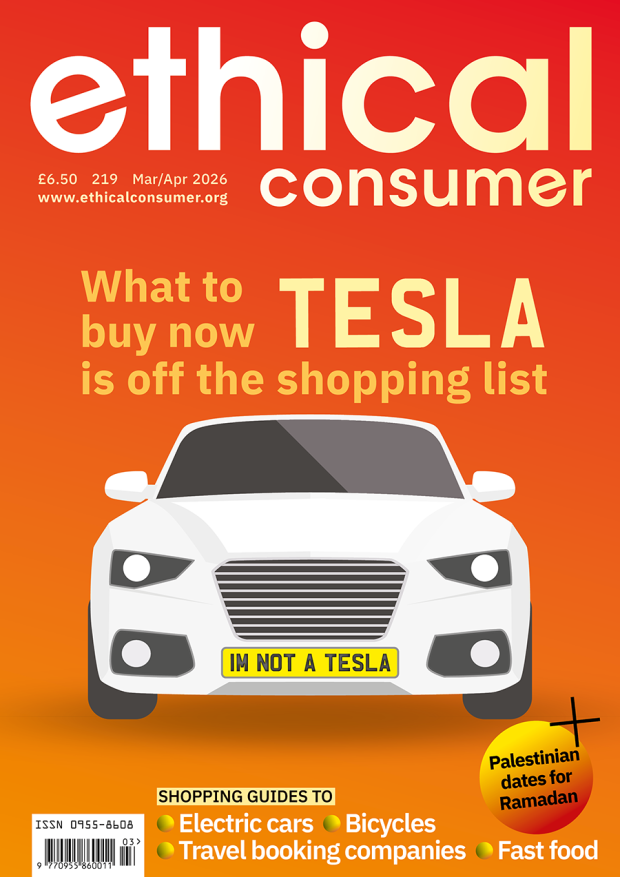
Find ethical bicycles and e-bikes
This guide covers a wide range of bike types, with most bike companies on our score table making children’s bikes, urban and mountain bikes, and electric. We’ve also included some which specialise in folding bikes and cargo bikes.
We cover the most widely available brands and have compared the companies on various ethical and sustainable issues from climate to tax and conflict minerals to complicity with the Israeli regime. We also look at where new bikes are made, recent successes tackling forced labour in Taiwan, and which companies have anything to say about harms caused by mining minerals for electric bikes.
The bike sector, like many others, has a thriving secondhand and repair market, and we discuss rental and subscription bike schemes, as well as options for passing on a bike to another user when you no longer want it. Finally, we look at overcoming barriers to cycling.
Which bike brands are in the guide?
We cover a wide range of bike brands from the ubiquitous Halfords and its five brands, to Tandem (eight brands), Trek, Raleigh, Specialized and Giant. We've also included folding bike brands like Brompton and Dahon, and smaller UK brands like Alpkit.
We’ve also included brands which specialise in kids’ bikes (Elswick, Hoy, Squish - all Tandem) and cargo bikes (Urban Arrow, Babboe).
Most bike companies on our score table make road bikes, off-road bikes, and electric bikes.
How popular is cycling in the UK?
The boom in UK cycling and bike sales due to the Covid pandemic appears to have levelled off, but the general trend is still upwards.
In England, around 10% of adults cycle about once a week. The figures are apparently lower in Scotland and Wales but data is collected differently so it’s hard to say. Around 40% of people in England (over the age of 5) own a bike, and this includes e-bikes.
But the cycling modal share (the share of people cycling compared to using other modes of transport) in the UK is 2%, far lower than in many other European countries.
Among the highest are Germany and Finland with a cycling modal share of around 12-13%, Denmark and Sweden 16-17%, Hungary 22%, and The Netherlands on top at around 27%. Public pressure on politicians to create safer cycling conditions plays a big role in how well cycling is provided for, and is said to have been the turning point for the Netherlands in the 1970s.
These statistics from Europe show that there is huge potential to increase cycling in the UK.
Cycling campaign groups across the UK have been working for decades to make cycling safer and more enjoyable; find out if there local campaign groups near you by checking out Cycling UK's Cycle Advocacy Network.