What is factory farming and why is it a problem?

We often think of the UK having small local farms with frolicking lambs in fields. But the reality is often quite different. 

In fact, over 70% of animals are raised on factory farms.

Factory farms are associated with poor animal welfare and high environmental costs. In this article we explore the problems of factory farms. 

What is factory farming?

Factory farming is an intensive form of industrial agriculture focused on massive meat, fish and dairy production. Animals are reared year round in huge numbers. They are bred to grow quickly and many are fed on mono-cropped grain instead of their traditional diet.

Factory farms are focused on generating profits. But they’re associated with many animal welfare and environmental costs, which we explore below. Factory farmed animals are kept inside, in large numbers and forced through a life cycle designed for human consumption. Factory farmed fish are kept in incredibly high densities in small nets or containers, either in sheds on land or in the ocean.

Factory farms can be enormous in scale, and they are on the rise in the UK. In 2024, the Times reported that there were nearly 1,200 mega farms in the UK – a 20% increase since 2016. These are farms that have more than 125,000 broiler chickens, 82,000 egg-laying hens, or 2,500 pigs each.

According to the animal advocacy group Compassion in World Farming, over 70% of animals are raised on factory farms.

What are the problems with factory farming?

We explore issues such as animal rights abuses, climate change, impact on biodiversity, water pollution, antibiotic resistance, food security, and Indigenous land rights.

Factory farming and animal rights abuses

Animal rights organisation Peta says, “Factory farming treats animals as though they are meat factories rather than sentient beings. Animals are selectively bred and genetically manipulated to gain weight quickly or to produce more eggs or milk than their bodies would naturally. They are crammed into cages and pens so small that they can barely move. Their food, lighting and breeding cycles are regulated in line with productivity. Most, if not all, of their natural instincts are denied.”

Animals in these systems also face mutilations, forced impregnation and separation from their offspring. We explore these issues further in our article on animal rights and animal welfare in the food industry.

Factory farming and climate change

In 2006, the UN’s FAO stated:

“Factory farming endangers the survival of other animals and plants, with impacts including pollution, deforestation and climate change.”

The animal farming industry is responsible for around 57% of greenhouse gas emissions from our food. Yet it provides just 38% of our protein and 17% of our calories.

According to a 2023 report by campaign organisation Feedback, investigative outlet Desmog and advocacy organisation the Institute for Agriculture & Trade Policy, the total combined livestock emissions of 15 of the world’s largest meat and dairy companies exceeded the individual emissions of each of ExxonMobil, BP or Shell.

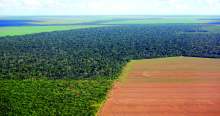
There are two big sources of emissions from the animals we eat. Cows and sheep burp large amounts of methane during the torturous process of digesting grass. Methane is a very powerful greenhouse gas. Animals also require a large amount of land, both to live on and for their feed. This demand for land can result in massive deforestation, including of the Amazon: in fact, it’s the biggest single cause of deforestation globally.

According to the non-profit project Our World In Data, 80% of agricultural land is used for livestock production, including a large proportion dedicated to growing crops fed to animals rather than people. This is incredibly inefficient. The most straight-forward way to understand this is by thinking about a cow being fed. If a cow eats a meal of soya, they won’t save up all the energy for our steak or milk: they’ll use some of it up by walking around, mooing or just generally being alive. If we’d eaten that soya directly, we’d have received much more energy compared to the emissions from growing it.
 

In fact, a farmed cow will eat somewhere between sixteen and twenty five times the weight of crops that it will ‘give’ in the form of meat.

By a very conservative estimate, someone who eats a large amount of meat will therefore have two and a half times the dietary carbon footprint of a vegan. These figures don’t even account for all the things we could be doing with land currently used for animals if it were freed up – like storing carbon.

Read our feature on the climate impacts of meat, vegetarian and vegan diets for more on this.

Does factory farming have a higher carbon impact than other animal farming?

If comparing calorie for calorie, factory farming can have a similar or sometimes lower carbon impact than other ways of animal farming, because it rears animals so quickly and requires less land.

In 2020, a study compared the greenhouse gas emissions from organic and non-organic meat. It found that emissions were largely equivalent. While emissions from non-organic meat came from methane burping and feed, organic animals were found to generally grow slower, live longer and therefore have higher emissions before being slaughtered.

A similar study in March 2024 also found that grass-fed beef had similar emissions to intensive beef in the U.S., and between 3 and 40 times as many emissions as plant-based alternatives. 

Environmental columnist George Monbiot has argued that the world’s worst farm products when it comes to the environment are in fact organic, pasture-fed beef and lamb. He wrote,

“Perhaps the most important of all environmental issues is land use…. Arable crops, some of which are fed to farm animals, occupy 12% of the planet’s land surface. But far more land (28%) is used for grazing: in other words, for pasture-fed meat and milk. Yet, across this vast area, farm animals that are entirely pasture-fed produce just 1% of the world’s protein.”

Nonetheless factory farming holds a big responsibility for our unsustainable approach to producing and consuming meat. Factory farming isn’t geared towards using less land so that we can save it for nature: it’s geared towards farming more animals so we can eat more meat and dairy for its profits. Arguably, this is the key climate problem – the sheer quantity of animal products we consume.

Factory farming and biodiversity loss

Carbon is not the only environmental issue associated with meat, dairy and fish consumption. Many of the impacts discussed above also come at a high cost for biodiversity and natural ecosystems. 

Converting land for grazing or feed destroys natural habitats. In 2019, a study found, “At least 200 species of large animals are decreasing in number and more than 150 are under threat of extinction… [and] humans' meat consumption habits are primarily to blame.” The Amazon rainforest, in particular, is under threat. Huge areas are being deforested or burned to grow soya – 90% of which is fed to animals.

Likewise, trawling for fish and fish feed destroys the seafloor, jeopardising the homes of other sea life. 

As with carbon emissions, non-intensive animal farming may have as much or more of an impact when it comes to biodiversity loss, due to the large amounts of land required. Nonetheless, factory farming has a significant role to play in its unsustainable use of feed and the way that it drives increased meat and dairy consumption. 

Rear view of tractor spreading manure on field
Manure being applied to fields.

Factory farming and water pollution

Animal farming also causes widespread pollution.

In 2022, the BBC reported that livestock farms in England had “polluted rivers 300 times last year, causing 20 major incidents, according to the latest government figures.” The article stated, “The dairy industry - mostly thanks to the waste its millions of cows produce - is the worst environmental offender, linked to half of all farm pollution.” 

Factory farms are the prime cause, because they house huge numbers of animals. This means that manure builds up in large quantities. EarthJustice reports,
 

“An average dairy cow, for example, produces well over 100 pounds of manure a day – more than 200 times what an average human produces. A facility with hundreds or thousands of cows can produce the same amount of waste as an entire town, or even a large city.”

In the US, this waste can be stored in huge, open-air lagoons, often as big as several football fields. These slurry and manure stores can leak, and liquid manure is also often sprayed on crops. But sometimes too much is applied to avoid the high cost of transporting the manure off site, or the plants just cannot absorb all the nutrients, meaning that it runs off into waterways.

This manure pollution can cause eutrophication – where the excess nutrients cause massive growth in aquatic plants and algae, absorbing all the available oxygen. The impact from this might be familiar to those living in the south of England and Wales, where the River Wye is facing collapse due to pollution from local industrial chicken farms. At its most extreme, such pollution can lead to dead zones – biological deserts home to almost no life. In 2017, an investigation by environmental campaign group Mighty Earth identified industrial meat production as a key cause of one of the largest dead zones ever recorded, in the Gulf of Mexico.

More pollution from factory farms than cities

Just 10 factory farm corporations produce more toxic excrement than the UK’s 10 largest cities, according to research from the Bureau of Investigative Journalism, Sustain and Friends of the Earth in 2024.

The companies, including 2Sisters, Arla, Avara Foods, Cranswick, and Moy Park, have over 144 million animals in production at any one time. They are responsible for up to 55,262 tonnes of animal waste per day. 

Analysis of these agribusinesses’ operational areas shows that they are clustered in polluted river catchments including the Wye, Trent, Severn, Lough Neagh, and the Broadland Rivers. All supply to major UK supermarkets, and none were found to have policies to prevent pollution leaching into water bodies. According to Compassion in World Farming, the number of intensive livestock ‘megafarms’ has increased by 20% since 2016.

Campaigners are calling for:

  • An immediate halt to the expansion of factory farming in already polluted river catchments.
  • Government to better regulate companies that own intensive livestock operations and hold them to account when they pollute our rivers.
  • Just and equitable options available for farmers that want to transition to more sustainable farming that benefits food security including growing more vegetables, pulses, and legumes.

Arla and Noble Foods (Happy Eggs, Big & Fresh) feature in our shopping guides to eggs and dairy milk.

Factory farming and air pollution

Animal farms are also a major source of air pollution, which can cause health problems, from respiratory problems to cancer and heart disease. 

In March 2023, a study from the University College London (UCL) found that between 25% and 38% of air pollution in UK cities that could harm human health was the result of agriculture – more than produced by the city itself. 

The research focused on a pollutant known as fine particulate matter or PM2.5 – tiny particles that can enter the bloodstream when inhaled – in Birmingham, Leicester and London. UCL stated, “This kind of fine particulate pollution can have serious health effects, with estimates saying it may contribute to between 29,000 and 99,000 additional premature deaths each year in the UK.”

PM2.5 forms when ammonia – a gas produced by fertilisers and animal waste – mixes with industrial pollutants and car fumes. It has been linked to higher death rates, respiratory problems and cardiovascular diseases

Cattle are the largest single source of ammonia emissions in the UK, accounting for about 43% of the total. 

What is the environmental impact of farmed fish?

Fish is often considered to be a lower impact substitute than meat or dairy. While this is generally true from a carbon emissions perspective, it can very much depend on how the fish is caught or farmed. For example, a 2021 study found that boats trawling – dragging heavy nets across the ocean floor – release as much carbon dioxide as the entire aviation industry. The seabed is a massive carbon sink. By damaging it, we release greenhouse gases and harm biodiversity.

For farmed fish, one key issue is feed. Most farmed fish are fed on fish meal or fish oil, produced from smaller fish like anchovies or herring, or sometimes crops like soy. A fifth of the world’s fish catch is used for fish meal and fish oil production, 70% of which goes to fish farms. Fish farming is therefore responsible for a significant proportion of the emissions, overfishing and other environmental impacts associated with wild-caught fish.

As with other animal feed, this process is incredibly inefficient: feeding and rearing fish on fish meal essentially wastes calories that could otherwise have been directly consumed by humans.

A 2019 study found that farmed fish had higher emissions per 100g of protein than poultry or eggs, although it had substantially lower land-use impacts. Farmed salmon is often cited as the prime example of a high impact fish, due to its carnivorous diet. It can take up to 350 wild caught fish to raise a single farmed salmon.

Factory farming and antibiotic resistance

In 2020, the World Health Organisation (WHO) warned that antibiotics were already failing and that

“without urgent action we are heading for a post-antibiotic era in which common infections and minor injuries can once again kill”.

It says that this possible antibiotic failure is “one of the biggest threats to global health, food security, and development today.”

Over time and due to their overuse and misuse, antibiotics become less effective as bacteria adapt to them and build up resistance. Across the world, it’s estimated that 73% of antibiotics are used on farm animals. A piglet will often receive its first antibiotics within hours of being born. Throughout their life, many animals will be fed antibiotics in their food and water, not to treat illness but to prevent disease or promote growth – although there are restrictions on the practice in Europe and the UK.

This overuse of antibiotics is intertwined with factory farming. Preventative use of antibiotics allow farms to continue keeping animals including fish in cramped, unhealthy and confined conditions, which would otherwise cause the spread of disease. Antibiotics are also used to make animals grow faster on less food, a key aim of factory farming.

According to the animal welfare organisation Compassion in World Farming, “In the UK, British livestock farmers have made good progress in reducing their antibiotic use, and farm antibiotic use now accounts for about 30% of all British antibiotic use. British pig and poultry farmers have reduced or, in some cases, ended routine use. This progress is welcome, however, much more needs to be done, as antibiotic use remains too high.”

Some alternative animal farming systems, such as organic, ban the routine use of antibiotics. Read more about these certifications here in our article on animal welfare including certification schemes.

Factory farming and zoonotic diseases

An estimated 60% of known infectious diseases and up to 75% of new or emerging infectious diseases are transmitted from animals to humans. These include Ebola and Covid19.

Some of these are transmitted from wild animals, but animal advocacy group World Animal Protection says that factory farming also has a significant role to play:

“Driven by global demand for cheap animal foods, the industrialisation of animal production has resulted in a focus on fewer and more genetically similar productive livestock breeds. The transition from subsistence and extensive to more commercial and intensive factory farming systems has resulted in the greatest zoonotic spill overs, because of higher livestock stocking densities, poor hygiene, lower animal welfare standards, and genetically similar breeds with less resilience to disease. Factory farming of pigs, for example, promoted transmission of swine flu due to a lack of physical distancing between animals. Moreover, as livestock population densities increase, more natural habitats are converted into farmland (for grazing or animal feed), which in turn reduces biodiversity and, thus, the ability of ecosystems to provide crucial functions, such as disease regulation or dilution.”

Deforestation fires burning in Amazon
Image from Greenpeace - Christian Braga

Factory farming and Indigenous rights

Animal farming drives an unsustainable demand for land – which in some parts of the world is being stolen from Indigenous communities who have lived there for centuries. In the Amazon, land is taken for cattle ranching or for growing soya, used for factory farmed animal feed.

In March 2022, an investigation by British NGO Earthsight and the Brazilian observatory De Olho Nos Ruralistas found that “Chicken supplied to UK supermarkets is fed with soy connected to violations of Guarani Kaiowa indigenous people's rights”. The report stated that the Guarani Kaiowa people had been evicted off their ancestral lands in Brazil, and that attempts to regain access had been “brutally suppressed” by authorities and landowners.

Tonico Benites, a Guarani Kaiowá leader, told the organisations,

“It's as if soy came from nowhere. There's nothing to identify it so the consumer is not able to see that it comes from an indigenous land."

Factory farming and food insecurity

Almost one in ten people around the world do not have enough to eat. There are many complex reasons for global food security, including the way that food is currently traded and consumed. The overconsumption of meat and dairy in rich countries is part of this complex web.

As discussed above, eating meat, fish and dairy is extremely inefficient. It uses up land, water and other resources that could otherwise be used to directly feed the world’s population. Factory farming of animals plays a major role in this. 

One example is the demand for fishmeal and fish oil to feed farmed salmon, seabass and other species, which is depriving families in West Africa of a vital food source. In countries like Senegal, small highly nutritious fish are increasingly being ground up and sold to feed farmed fish abroad – pricing out locals and destroying the artisanal fishing economy. The amount of these fish eaten by locals has plummeted, at a time when nearly 70% of people in the region cannot afford a healthy diet. 

In May 2025, environmental investigations outlet DeSmog reported that farmed seabass sold in UK supermarkets including Waitrose, Co-op, Lidl, Asda and Aldi were all being fed on fishmeal and fishmeal from Senegal, leading to “devastating overfishing”. 

Meat and dairy consumption also contributes to food insecurity through its high emissions. By driving climatic change, it is threatening production of food for many communities now and into the future.

While all forms of meat and dairy farming have high climate impacts, factory farming is a key cause of rising meat consumption. Over the last decade, the UN, scientists and MPs in the UK have all called for us to eat less meat as part of measures to address food insecurity.

What are companies doing about factory farming?

Lots of companies have animal welfare policies, with criteria like ‘freedom from hunger and thirst’. However, for the vast majority of multinationals, the bar is very low and still allows factory farming. It can therefore be difficult to separate those talking the talk from those actually making changes.

Companies that are serious about changing practices will likely have a certification such as Organic or Pasture For Life, to show they are not using factory farming practices.

Find more information about different animal welfare labels and what they mean in our article.

What can consumers do about factory farming?

plate with 5 stuffed mushrooms

1. Cut down on meat and dairy

Our current rate of meat and dairy consumption is unsustainable and relies on factory farming. If you want to address this damaging system, the best step you can take is to cut down on meat and dairy or cut it out altogether.

Check out our guides to vegan cheese, vegan and plant milks, and meat-free sausages and burgers, and look out for vegan options in many of our guides including chocolate and butter & spreads.

In our shopping  guides we highlight totally vegan companies, as well as vegan products or brands – so you can make sure none of your money is going to companies using animals.

The food feature from our Climate Gap report has further information about meat and dairy consumption, along with food waste.

2. Buy from a farm you know and talk to them about conditions

Farms often sell directly at markets or through delivery. Find a farm you think looks good and spend time reading their website and, if you can, speaking to them. Work out your primary concerns and ask them questions. These are good ones to start with:

  • How do you ensure high animal welfare? Ask about enrichment, transportation and access to pasture.
  • How many days a year can your animals graze outside? The best farms for welfare will ensure their animals have access to outside pasture for the majority (180 days and nights or more) of the year.
  • What is your policy on antibiotic use? The best farms will only use antibiotics to treat animals, rather than to prevent disease or promote growth.
  • How are you reducing emissions and pollution from your farm? They may talk about feed, treatment of slurry or manure, and sustainable use of manure for spraying crops.

3. Look for better meat standards

While they may not be able to address the carbon footprint related to meat and dairy, the strongest animal welfare standards address issues like animal welfare, antibiotics and feed.

Find out more about different certification schemes in our article on animal welfare.

How to avoid companies involved in factory farming

Our ratings track companies' record on factory farming. Our ratings reward companies whose products are certified free-range, organic or an equivalent animal welfare standard. Companies lose points under hen welfare for selling any cage eggs, or under dairy welfare for having no discussion on animal welfare.

All of the major supermarkets in our supermarket guide lost a full mark under animal products, hen welfare, dairy welfare, and agriculture. 

For example, Morrisons lost a mark under animal products, after reports of animal abuse on suppliers' farms. Asda lost marks under dairy welfare for misleading messaging, after an undercover investigation by Viva! confirmed that some of Arla's suppliers operate a zero grazing dairy where the animals will never go outside. M&S lost points in the same category after reports of abuse at an intensive goat dairy. And Tesco lost marks in Agriculture after a report found its pork products were linked to deforestation in the Amazon.

Our dairy milk, butter and eggs shopping guides highlight options that are free from factory farming. For milk, for example, we recommend Hill Farm Real Food and Old Hall Farm, which have cow-with-calf dairies – a system that allows mothers and calves to stay together throughout most of the weaning period, unlike intensive farms where they are removed long before they would naturally separate causing major distress. You can search the cow-with-calf directory for dairies using this practice local to you, or if you’re not able to buy from a cow-with-calf system, we recommend fully organic brands Acorn, Calon Wen, and Riverford who score well across our categories.

More and more companies are also moving away from animal products altogether. In our chocolate guide we featured eight companies selling only vegan chocolate, including MonChoco and Paccari. In all our guides, we highlight the vegan alternatives so that you can avoid animal products if you want to.

Shopping guide to milk

In our shopping guide we review 31 brands of dairy milk. We look at industrial farming, animal welfare, pollution, packaging and give our Best Buy recommendations.

Shopping guide to milk

Shopping guide to butter

Our shopping guide looks at 50 brands of butter and spreads including vegan butter and margarine. We investigate issues such as palm oil and animal rights, shine a spotlight on Arla and give our recommended buys.

Shopping guide to butter and spreads

Shopping guide to eggs

Our shopping guide to eggs reviews 43 brands of eggs and vegan egg alternatives.

We investigate egg labelling, vegan egg substitutes, the carbon impact of egg production, and the differences between cage, barn, free range, biodynamic and organic eggs.

Shopping guide to eggs and egg alternatives

Vegan cheese shopping guide

We review 17 vegan cheese brands, look at non-vegan companies making vegan cheese, ethical and environmental issues of the key ingredients of vegan cheese, and give our Best Buy recommendations.

Shopping guide to vegan cheese

Vegan and plant milk

We review 26 brands of vegan plant milk.

We look into their sustainability; what they're made from including almond, coconut, hemp, rice and soya; packaging, and who produces them. We shine a spotlight on Alpro, owned by Danone, and make Best Buy recommendations.

Shopping guide to vegan and plant milks