
A quick guide to fair trade and fashion

We unpack some of the issues around ethical fashion and fair trade fashion. 

We take a look at the world’s leading fair trade standard, alternative fair trade labels, and a selection of fashion brands selling fair trade clothing.

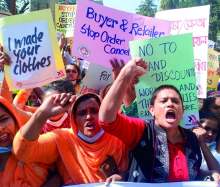
Describing an item of clothing as fair trade is often shorthand for saying that a product was ethically produced - in particular, that the workers who helped produce it had safer working conditions, fairer pay, and other workers' rights.

Our last Ethical Markets report showed that demand for fair trade products continues to grow - sales of fair trade products increased by16% to £2.3bn in 2022 from the previous year.

However, since any company can describe a product as fair trade or fairly traded, it can be hard to know how meaningful the term is and whether buying clothing labelled as fair trade actually benefits workers.

What does fair trade mean in fashion?

Fair trade is not a protected term (unlike for example organic - to be labelled ‘organic’ a product must be produced using at least 95% organically farmed ingredients, and the definition of organically farmed is defined by the government).

As such, while the general idea of fair trade is fairer conditions for workers, in the fashion industry the term can be used loosely to mean a range of things.  

This creates ample opportunity for greenwashing - companies marketing clothing as ethical and fairly traded, when in fact they might not know (or care) about the conditions of workers who help make their clothes. 

Our Supply Chain Management rating helps consumers to know which companies are supporting the livelihoods of people making their clothes. Many companies with a best rating ensure the materials they use are fairly traded (even if they might not market their products as ‘fair trade’).

Certification is the best way of ensuring that clothing is truly fair trade, making brands more accountable and assuring consumers that the extra cost associated with fair trade clothing is being used to ensure fair working conditions.
Fair trade fashion labels

Logo of Fairtrade International

Fairtrade International

If an item of clothing is certified by Fairtrade International (FI) it will often be referred to as Fairtrade (capital F) or in all caps (FAIRTRADE). While it does provide an indication, the spelling alone isn’t enough to guarantee a product is FI certified so look for a clear statement saying who certifies it, or the Fairtrade logo, to make sure.

FI has a global network of nearly two million farmers and workers and works in almost 80 countries. Around the globe countries have licensed the use of the Fairtrade Mark from Fairtrade International. The Fairtrade Foundation is the UK member of Fairtrade International.

Fairtrade International certifies small farmers organised into cooperatives (these can be very large organisations, involving thousands of farmers. Kuapa Kokoo cocoa cooperative in Ghana, for example, has 100,000 members), and estates. It requires specific social, economic and environmental criteria to be met, and it sends inspectors occasionally to check that producers are compliant.

Companies then source from these certified producers, paying a premium to the coop or estate for the assurance that someone's checking that what they buy is produced in more ethical conditions, and also paying the Fairtrade Minimum Price should the market price drop below it, which is there to protect producers from market fluctuations.

Fairtrade International was formerly called the Fairtrade Labelling Organisation (FLO). 

FLOCERT is the leading certifier for Fairtrade products, so if a product has been certified by FLOCERT this means it is Fairtrade certified.

Fairtrade Mark

Fairtrade International’s ‘Fairtrade Mark’ - the blue, green and black icon of a person raising an arm (see above) - is the world’s most recognisable fairtrade certification logo.

If a garment features this original Fairtrade Mark (without any extra arrows, words, or different colours) then this means that all of its contents are certified by Fairtrade International. All of the ingredients or materials in the product are fully traceable - kept separate from non-certified products from field to shelf.

There are however variations on this Fairtrade logo, which indicates that not everything in the product is certified - just some elements of it are.

Fairtrade Mark with an arrow

If you see the Fairtrade Mark with an arrow next to it, it means that all of the materials that can be sourced under Fairtrade conditions were done so (though it may contain some materials that Fairtrade International does not certify). To feature the Fairtrade Mark with an arrow the garment must have at least 20% certified Fairtrade content.

Fairtrade Textile Standard

If a product is certified under the Fairtrade Textile Standard then the whole piece of clothing must meet Fairtrade standards, including the cotton. 

Fairtrade International ingredient logos

Fairtrade Sourced Ingredient (FSI) Mark

This mark features the same Fairtrade logo but it is blue, green and white instead of blue, green and black. Next to the logo it says which components in a garment are sourced Fairtrade - for example, cotton.

The component must be directly traceable through all stages of production and separated from non-Fairtrade cotton. So for example, 100% of the cotton used in the garment must be Fairtrade certified to feature this mark.

Logo of the World Fair Trade Organization

Alternatives to Fairtrade International

Fairtrade International only provides certification for a limited number of products, materials and ingredients, and as such it is not always possible to get certification - some products just can’t be certified.

In these cases a company may choose to find its own way to source ethically. 

Positive alternatives to Fairtrade International certification may be listed on the World Fair Trade Organisation (WFTO) website or the British Association of Fair Trade Shops and Suppliers (BAFTS) website.

According to the WTFO website, ““Fair Trade Enterprises are changing the way business is done on a global scale. Active throughout 84 countries, with more than 1 million livelihoods impacted from North to South, they are demonstrating a viable alternative to the current exploitative businesses by prioritising social and environmental sustainability, alongside with economic success.”

BAFTS is a network of independent shops and suppliers that claim to be “dedicated to promoting Fair Trade retail in the UK”. Its members state that they adhere to the 10 Principles of Fair Trade laid out by the World Fair Trade Organisation (WFTO).

Sometimes companies are not connected to any of these bodies. In these instances it is worth visiting their website. They should publish detailed information on their website about what steps they have taken to ensure their produce is fairly traded.

Own-label fair trade

Some companies create their own fair trade standards instead of Fairtrade International’s certification. 

For example, Sainsbury’s used to be the world’s largest retailer of Fairtrade certified products but then in 2017 it decided to withdraw many of its products from certification and instead launched its own ‘Fairly Traded’ scheme.

Fairtrade International highlighted the key issue of companies setting up their own fair trade schemes:

“Fairtrade is a fully independent and transparent system supported by the third party organisation” while “Sainsbury’s Sustainability Standards are established by Sainsbury’s, which means that Sainsbury’s will in future carry responsibility for their implementation, review and performance”.

The obvious downside of companies creating their own fair trade standards is that they can decide what does and does not count as fair trade criteria (which may on occasion align more closely with corporate interests than workers’ rights), and it will likely have a less independent third-party enforcement mechanism than established certifying bodies.

Are organic products fairly traded?

There is a small overlap between organic and Fairtrade requirements. 

For example, organic farming can benefit farmers and workers who may otherwise suffer health impacts due to harmful chemicals in pesticides and herbicides. 

Organic certifications might also include some workers’ rights requirements, such as The Soil Association, whose certification includes brief clauses on involuntary and child labour.

Organic cotton is less risky in terms of workers’ rights because it requires a physically certifiable supply chain, and recycled produce is less likely to be directly funding unethical practises too. 

However when it comes to workers’ rights Fairtrade certification is the most robust. Fairtrade certification and explicit supply chain policies on the company website are much more likely to guarantee that workers’ rights are respected than organic or other types of certification. 

Where to buy fairly traded clothing?

If you want to buy fairly traded clothing, where should you look?

In our guides to high street clothing and sustainable clothing we rate brands on several categories, including workers' rights. This includes assessing if they sell fair trade clothing. 

Brands in our recent ethical clothing guide that received top scores for workers' rights were:

  • Community Clothing
  • Finisterre
  • Indilisi
  • Kuyichi
  • Lucy & Yak
  • Outsider
  • THTC
  • Where Does It Come From?

This article was first published in 2021 and reviewed and updated in 2026.