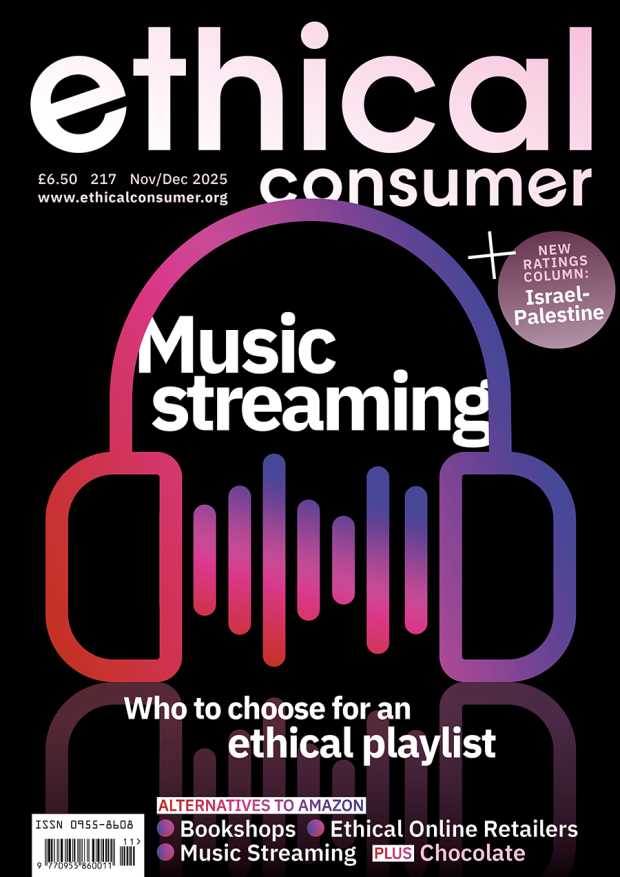
Music Streaming

Looking for ethical alternatives to Spotify, Amazon, and YouTube? 

Our guide rates and ranks 13 music streaming services and digital music download platforms, offering Best Buys advice, recommended brands, and brands to avoid. Discover the best options for ethical music consumption. 

The guide rates the big players in the music streaming business including Spotify, Amazon and YouTube, explores other digital music platforms and puts the spotlight on some radical alternatives.

The guide also covers:

  • an in-depth investigation into the ethics of Spotify
  • how to switch to a different music streaming service
  • how much musicians are paid by the platforms
  • the ethics of platforms like Qobuz, Deezer, TIDAL and Bandcamp
  • the carbon impacts of streaming music

About our guides

This is a shopping guide from Ethical Consumer, the UK's leading alternative consumer organisation. Since 1989 we've been researching and recording the social and environmental records of companies, and making the results available to you in a simple format.

Learn more about our shopping guides   →

Score table

Updated daily from our research database. Read the FAQs to learn more.

← Swipe left / right to view table contents →
Brand Name of the company Score (out of 100) Ratings Categories Explore related ratings in detail

Brand X

Company Profile: Brand X ltd
90
  • Animal Products
  • Climate
  • Company Ethos
  • Cotton Sourcing
  • Sustainable Materials
  • Tax Conduct
  • Workers

Brand Y

Company Profile: Brand Y ltd
33
  • Animal Products
  • Climate
  • Company Ethos
  • Cotton Sourcing
  • Sustainable Materials
  • Tax Conduct
  • Workers

What to buy

What to look for when buying music streaming services:

  • Support artists directly. Choose platforms that pay artists fairly. Purchasing music gives artists significantly more than streaming. Our Artist Compensation rating highlights payout models and innovative actions in the music sector, guiding you to support ethical platforms.

  • Choose a company with an editorial focus. The corporate embrace of AI and algorithmic slop is resulting in mass layoffs and is changing how we consume music. Look for platforms that prioritise human curation.

What not to buy

What to avoid when buying music streaming services:

  • Is the company linked to the arms sector? Spotify's CEO's role in an AI weapons firm has sparked an exodus from the platform, but Amazon and Google (which owns YouTube) have their fair share of dubious links.

  • Is the company exploiting the artists that keep it afloat? Major platforms heap fortunes onto their executives, but 80% of UK musicians make under £200 per year from streaming.

Best buys (subscribe to view)

Companies to avoid (subscribe to view)

In-depth Analysis

Find an ethical music platform

Tech companies – and make no mistake, the bulk of the companies in this guide to music streaming are tech companies, not music companies – have dramatically changed the way that most of us consume music. 

This guide to music streaming is part of our 'Alternatives to Amazon' series, because Amazon is becoming a dominant force in this industry. We've been running a boycott of Amazon since 2012 over tax avoidance.

The guide also focuses on Spotify, which is currently facing a well-deserved public reckoning over a whole host of ill-doings. 

Which music platforms are in the guide?

This guide assesses Amazon and Spotify alongside their direct competitors (other streaming services), plus a range of digital music sales platforms, including for downloads, and radical alternatives. 

We've included platforms like Apple Music, Bandcamp, Deezer, Soundcloud, Tidal, along with smaller services like Qobuz and Presto, plus the very new Subvert.

It is not an exhaustive list, but we have included the most popular sites alongside a selection of alternatives that appear to be trying something different. 

This was one of the top guides voted for in a readers' survey we conducted earlier in 2025.

An introduction to Spotify

Spotify has faced consistent criticism, particularly regarding artist compensation since its 2009 launch. 

Recent controversies include the sponsorship and platforming of Trump-adjacent conspiracies via the Joe Rogan Experience, alleged promotion of "fake" artists to lower royalty payments, and founder Daniel Ek's involvement in computerised weaponry development

These issues have raised concerns about the platform's ethical practices.

Although contemporary pressure appears to be mounting, Spotify has, in its time, weathered household names including Thom Yorke, Taylor Swift, Neil Young, Prince, and Joni Mitchell removing their music from the platform in protest, each to quietly return after a few weeks. 

There are also few signs of any of this impacting its business model. Spotify has tripled its revenue over the past five years, and reported its first fully profitable year in 2024. Crucially, it retains a hegemonic position with more paying subscribers than Apple and Amazon – its closest competitors outside of China – combined. 

Perhaps Spotify’s resilience stems in part from consumers’ recognition that they are getting a pretty good deal from it. Having on-demand access to more or less the entire history of recorded music for the price of a few coffees a month would have been unthinkable thirty years ago. 

But what is the price of this convenience for the artists that we love, and are any of Spotify’s competitors offering anything meaningfully better?


Is music streaming broken?

It's important to note that while Spotify receives extensive criticism regarding artist compensation, it does not use a significantly less equitable payout model than most of its competitors. The norm in the sector is called a “pro rata” or “market share” payment basis. This is used by Spotify alongside TIDAL, YouTube, Apple Music, Amazon, and more. 

The streaming platform aggregates all revenue from subscriptions and advertising, and this pot (minus a cut taken by the company, often around 30%) is split between rights holders on a market share basis. 

For example, if an artist’s tracks accounted for 1% of all streams, then that artist’s rights holder (generally their label) receives 1% of the available payout. Contrary to popular conceptions, artists are not paid a set per-stream rate. 

While it may make intuitive sense, the pro rata model favours superstars. The top 1% of creators receive 90% of streams, so get the lion’s share of the available revenue, meaning that niche and independent artists effectively subsidise the biggest artists. Algorithmic playlists and recommendation engines amplify this effect, creating a rich-get-richer cycle of streaming revenue and visibility.

Streaming is not bad for all artists. If an artist has a large, passive listener base – for example from being playlisted on one of Spotify’s “coffee shop jazz” or “background piano” playlists – they can earn significant money. And while per-stream payments appear very low, the sheer weight of listeners and subscribers on Spotify make it a viable revenue stream for many labels and artists. 

One independent label boss that we spoke to estimated that they’d need to fire three staff to cover lost revenue if the label quit Spotify today.

Streaming is, however, generally terrible for artists with small but highly engaged audiences. In the pre-streaming world, an artist with 1,000 engaged fans who each bought an album could receive a meaningful sum of money. Today, 1,000 fans streaming a full album 10 times each will earn the artist a few hundred pounds at best. 

It's also important to note that these rates are payments to rights holders, not to artists. Record labels typically take the largest share of this revenue, especially for artists under traditional deals, leaving musicians with a miniscule fraction of total revenue, as low as 2% of the payout in some cases.

What’s wrong with Spotify?

Although the above issues are shared by most mainstream platforms, there are ways in which Spotify has actively driven standards down in the sector which make it deserving of special scrutiny. The company scored very poorly in our ratings system, and beyond fairly generous parental leave and work-from-home policies (at least for those workers not yet replaced by computers – Spotify has axed some 2,300 jobs in recent layoffs to "move faster into AI"), we found little to sugarcoat its dismal rating. 

Some of the most pertinent critiques concern the company’s links to AI weaponry, its alleged use of fake or “ghost” artists to improve profitability, and the effects of its hyper-individualised, algorithmically mediated playlisting model on music culture more broadly.

AI militarism and Spotify

Daniel Ek, Spotify’s co-founder and Executive Chairman, has a well-documented history of investing in AI weaponry through his backing of Helsing, a European AI defence company. Since 2021, Ek has directed hundreds of millions of euros into Helsing via his private investment firm, Prima Materia, and has also taken up a leadership role on the company’s board, currently serving as chairman.

News reports often refer to Ek as an investor in Helsing, implying that his interests in AI weaponry could simply be financial. But his role as chairman of its board of directors indicates an interest in AI militarism that goes beyond “good business sense”. Perhaps monopolising music is just the day job for Ek, building autonomous killing machines is where the real passion lies?

This investment is not directly coming from Spotify itself, but Ek has reportedly cashed out $724m of company equity since 2023. It seems reasonable to assume that at least some of this money has been directed towards his killer robot passion project, and that there is therefore some likely causal relationship between a Spotify subscription fee and funding AI militarism.

Ghosts in the playlist

Liz Pelly’s 2025 book 'Mood Machine' provides a fascinating investigation into Spotify allegedly cramming its popular playlists with low-cost stock music or ghost artists, alongside the rise of new payola practices in streaming. Payola is the term for the much maligned practice of financial bribes in return for media promotion, which has persisted between record labels, radio stations, and other industry players despite an official ban since 1960. 

Spotify’s alleged “ghost artist” strategy involves commissioning cheaply produced tracks, often designed to blend seamlessly into mood playlists like “Deep Focus”, “Coffee Shop Jazz”, or “Peaceful Piano”. This music is designed to sound similar to other artist's music, and is allegedly given undue prominence in Spotify’s playlists at the expense of the artists whose sounds it aims to replicate.

If, as widely alleged, Spotify owns much of this music outright, then it doesn’t have to pay any royalties when it is listened to. These tracks are not promoted as creative works in their own right, existing instead as a form of sonic wallpaper to keep users streaming on the platform.

One doesn’t need a PHD in cynicism to spot the insidious financial incentives here. Spotify has effectively persuaded its users that its algorithm knows their tastes and interests perfectly – surely it wouldn’t exploit that trust in order to instead feed them music that matches the interests of the company’s profit margins and shareholders?

As Liz Pelly puts it in a report for Harper’s magazine: 

Spotify had long marketed itself as the ultimate platform for discovery—and who was going to get excited about 'discovering' a bunch of stock music? Artists had been sold the idea that streaming was the ultimate meritocracy – that the best would rise to the top because users voted by listening.”

The company’s mood playlists still contain some genuinely “real” artists, but many of the tracks are credited to faceless pages that apparently lack any digital or real-life footprint. Try searching for them yourself if you can bear staring into the abyss of digital platform degradation. As AI music creation tools proliferate further, it's not hard to envision a depressing direction of travel towards entire playlists that do not pay any humans but were not made by any humans either.

While Spotify denies the practice, multiple investigations have uncovered networks of production companies tied to its playlists

Algorithmic payola

Independent artists may face pressure to surrender royalties for playlist consideration via Spotify’s “Discovery Mode,” a practice seen as algorithmic payola. 

Major labels, as early Spotify investors, leverage their influence to secure playlist placements, raising concerns about fair access and artist compensation.


Music as disposable content

The controversy is not only about the financial hit to musicians who miss out on playlist placements but also reflects the erosion of cultural value. Spotify’s Daniel Ek has infamously stated that the cost of creating music or “content”, is “close to zero” in the modern world, and his platform certainly appears to treat it accordingly, as a disposable commodity.

This is important because Spotify provides more than just "on demand" streaming. It is ostensibly designed as a music discovery and recommendation tool – a one stop shop for all your musical needs. Yet while features like Spotify’s AI DJ and "radio" playlists drip feed users with an infinite scroll of content, this is presented without the context that gives music its cultural weight and meaning. Algorithmic playlists rip songs out of their cultural contexts: the places and times that birthed them, the political forces and history that drove them, and the actual human beings who worked on them; and repackage them into a user-personalised experience to be consumed passively.

Compare this to the experience of community and grassroots radio shows, which often dive into a particular movement, sound, place, or time, in order to place music within a broader cultural history. Like most forms of neoliberal “culture”, the tech platform approach is instead hyper individualised: it doesn’t matter where and when these songs come from, it only matters that they fit a data-driven model of an individual’s taste preference, which – if we are to dial up the cynicism further – can then be mined to generate more data to target users with more personalised ads.

Algorithmic playlists rip songs out of their cultural contexts: the places and times that birthed them, the political forces and history that drove them, and the actual human beings who worked on them.

Mainstream alternatives to Amazon and Spotify

YouTube Music

Don't ditch Spotify and Amazon Music for YouTube Music (owned by Google) if you are looking for a more principled alternative. It is the lowest scoring company in this guide and can't credibly be pushed as a fairer or more artist-friendly choice.

Apple Music, TIDAL and Deezer

While Apple Music and TIDAL haven't faced the same scrutiny as Spotify regarding ghost artists or digital payola, the lack of transparency in playlist curation across all platforms suggests that ghost or algorithm-biased content may still be present. This highlights the need for vigilance when choosing streaming services.

French platform Deezer offers a similar service to the others, but is notable for its move towards artist-centric payouts, designed to reward artists with engaged listener bases. Under this model, an artist gets paid more per stream when a user actively searches for them than they would if they are recommended algorithmically. This goes some way towards deincentivising the “music for passive consumption” issue found on Spotify. It's also got more protections around using non-music – such as an album of white noise for sleeping – to fraudulently game the system.

TIDAL, once pitched as an artist-first disruptor, appears to be drifting towards the mainstream. Its promises of radical redistribution largely evaporated when TIDAL ditched its “Direct Artist Payouts”’ scheme in 2023 and, since a 2021 acquisition by Jack Dorsey’s Block Inc, the company’s strategic direction appears focused less on music than on crypto ventures. A 2024 shareholder letter stated: “We are scaling back our investment in TIDAL [...] giving us more room to invest in our bitcoin mining initiative”. 

CEO Jack Dorsey formerly ran Twitter in the pre-Musk halcyon days. This particular tech oligarch’s drift into cryptocurrency is at least less malevolent than Daniel Ek of Spotify’s pivot towards AI weaponry, so perhaps we should be grateful for that? 

Niche alternatives: Qobuz, Presto, Soundcloud, and Bandcamp

Looking for a Spotify alternative without the harmful features? 

Qobuz , a French platform, offers a similar catalogue of major label releases but avoids free subscriptions (which lower artist revenues). It integrates music purchasing options and emphasizes editorial content and human curation, making it a strong ethical choice.

According to the company, an independent audit confirmed that Qobuz generates on average five times more revenue per user than the market average. The trade-off is price: Qobuz costs more than Spotify, but that premium supports a less exploitative model.

Presto Music demonstrates an even higher rate of compensation, due to its unique “pay per second” model. The service is focused on classical and jazz repertoires, which tend to have long track lengths that are disadvantaged by conventional stream accounting – on most services, a play of a 2 minute song will generate the same revenue as a 30 minute one. Presto reports that it often pays out up to tens times more than other major streaming services. Choose this if you are happy with a classical- and jazz-focused catalogue.

SoundCloud has long been an essential hub for underground scenes, a place where careers are launched outside of the major label machine. It has not been free of controversy, particularly around licensing disputes, but its adoption of a “fan-powered royalties” model in 2021 set it apart from the pack. Under this system, a listener’s subscription fee is distributed directly to the artists they listen to, rather than being pooled into the wider market share. The company’s low score is largely due to a lack of public policy rather than evidence of poor practice.

Bandcamp has long been treasured by independent musicians for its focus on buying music and its direct-to-creator sales model. The company’s decision to waive its sales fees on selective Bandcamp Fridays provided a lifeline to many artists throughout the pandemic, and Bandcamp has earned a reputation for prioritising editorial curation over algorithmic slop. 

Yet successive acquisitions by Epic Games and then Songtradr have spread spinal shivers throughout the Bandcamp community. Since Songtradr took the reins, half of Bandcamp’s workforce has been shown the door and, according to Bandcamp union, “the company’s Black and trans/non-binary/gender non-conforming employees were reduced by 82% and 84% overnight”.

This goes to show how seemingly progressive workplaces can still leave their workers exposed when they are operated for profit. They exist within capitalist market relations, and no amount of friendly messaging can disentangle workplaces from that context. 

Bandcamp was penalised under our Workers category for this, but the platform remains a good way to ensure money reaches artists directly. Its future as a beloved outlier does look less certain than it did just a few years ago however. Tech history is paved with well-intentioned platforms swallowed and digested into corporate mush – it would be naive to think Bandcamp is immune to the same fate.

So perhaps we need something more radical?

More radical alternatives to conventional platforms

A crop of revolutionary alternatives emerged during the pandemic, buoyed by news linking Spotify to weapons development and by a scathing Select Committee report into the economics of streaming. But fast forward a few years and most of those challengers are looking less like the future of music and more akin to abandoned Myspace profiles.

Take Resonate, a cooperative with a genuinely radical “stream-to-own” model wherein plays would gradually add up until users actually own the track outright. This idea challenged the “infinite-rent” logic of mainstream streaming and encouraged the exploration of new music at a low cost. Unfortunately, the platform today is something of a ghost ship: no updates, no new memberships, and no apparent way forward. 

Sonstream, which pitched a pay-per-stream model, is technically still alive and usable. But the platform has had no apparent updates in years, failed to file recent accounts, and its last disclosures showed declining revenue and huge losses. Attempts to reach out for clarity went unanswered – none of this bodes well for its longevity. 

We therefore did not include either Resonate or Sonstream in this guide. 

Subvert

Mercifully, there are other options on the horizon. Subvert is a cooperative which pitches itself as a “collectively owned successor to Bandcamp”. The platform has not yet launched publicly, but listeners, artists, and labels are already able to join the cooperative as founding members. There will be a phased launch throughout 2025 and 2026.

We would usually be hesitant to recommend an untested company, but Subvert has released a transparent and comprehensive manifesto-style plan called the “Plan for the artist-owned internet”. This can be accessed by signing up for free on its website.

Subvert doesn’t appear to be reinventing the wheel in terms of its usability – it instead looks likely to be functionally similar to Bandcamp – but couples this interface with cooperative principles like transparent accounting, democratic decision-making, and a payout structure that can be adjusted by members rather than dictated by opaque contracts with shady industry players.

We’re hopeful that a cooperative model might help alleviate the issues currently faced by Bandcamp, and it’s promising to see a project with such an explicit aim to challenge corporate power enter the anti-Spotify fray. 

EVEN and Nina Protocol

These two both scored highly but, like other alternatives, they do not provide a directly comparable experience to conventional streamers. EVEN is a direct-to-fan platform for artists to sell their music alongside fan “experiences”, offering early access to music, merchandise, behind the scenes exclusives, events, and more in exchange for direct support.

Nina Protocol is a more radical, techy affair: a decentralised music platform and marketplace that allows artists and labels to directly sell their music to fans, keeping 100% of the revenue while also pushing fan engagement and discovery. The technology-heavy, blockchain focus might imply a lack of human touch, but Nina Protocol stands out for its daily editorial write ups about new and interesting music. It is a great option for those wanting to explore niche and DIY music cultures.

Headphones sitting alongside mobile phone with music displaying on screen
Image by Viktor Forgacs on Unsplash

How much do musicians receive?

A major issue in the music industry is financial compensation to musicians for their creative output. 

Our new bespoke rating on Artist Compensation condensed much of the information in this guide into a score out of 100. It primarily awarded companies which offered direct sales, as buying a song for £1 is far better for artists than the fractions of pennies earned by streaming it. 

Marks were also available to streaming companies that were meaningfully acting to combat the passive, algorithmically mediated consumption of music normalised by conventional streaming services. This might be through a focus on editorialised articles and deep dives, a focus on human curation, and payout models that reward active engagement between artists and fans.

We’ve put the scores into the table below, which also has some detail on the models used and musical specialisms of each platform. Note that we did not base this rating on “pay-per-stream” rates as they are potentially misleading. Platforms do not generally set a “per stream” pay rate, rights holders (and therefore artists) instead receive a share of revenue relative to their slice of the overall number of streams on a platform. 

If one platform has more overall listeners than another, pay-per-stream rates may appear lower despite rights holders not necessarily being paid less. We therefore only awarded marks for high average payouts if a company demonstrated meaningful action to boost artists' compensation. Only Qobuz and Presto received marks for this.

Support The Musicians' Union: #fixstreaming

The Fix Streaming campaign, led by The Musicians' Union (MU), aims to secure a more equitable revenue share for musicians and creators by changing UK copyright law and promoting fairer negotiation terms with the music industry and government.

The campaign offers a few ways for the public to support it. There is a petition for legal reform, which you can sign and share.

It also has a wealth of resources, including videos, articles, and letters, which it encourages readers to share widely. The more people talk about how streaming is broken, the more the union can show that musicians and public support are on their side.

There is also some fascinating work happening across the Atlantic, spearheaded by United Musicians and Allied Workers and progressive congresswoman Rashida Tlaib. At the time of writing, Tlaib is poised to reintroduce the Living Wage for Musicians Act – a bill to regulate streaming services like Spotify and ensure fair streaming payouts to artists. The act would create a new streaming royalty paid directly to artists, ensuring that musicians can build sustainable careers in the digital age. We’ll be watching it keenly from our side of the pond.

Music platform comparison

In the table below we briefly note the key features of the music services in this guide, whether they offer sale downloads or streaming, what music they cover, and their rating for our artists compensation category.

Music platform features and artist compensation rating
Platform name What does it offer? What music does it cover? Notable features Artist Compensation score out of 100
Amazon Music Unlimited Streaming and sales Massive catalogue including all major labels Facilitates music sales alongside streaming. 30
Apple Music Streaming and sales (via iTunes) Massive catalogue including all major labels Facilitates music sales alongside streaming. 30
Bandcamp Direct sales Focus on independent artists and labels, but hosts some big names Waives its sales fees on set Fridays in order to better compensate artists. 100
Deezer Streaming Massive catalogue including all major labels Some action to reward artists based on active fan engagement rather than overall stream numbers. 20
Even Direct sales and direct fan-artist experiences Focus on independent artists and labels, but hosts some big names Artists set their own prices and keep a high percentage of sales, and can build direct relationships with their fans. 100
NinaProtocol Streaming and direct sales Heavily focused on DIY music scenes Allows artists to keep 100% of their revenue and to own their own data. 100
Presto Streaming and sales Focused on classical and jazz music “Pay-per-second” model provides significantly better payments for classical and jazz artists than conventional streaming platforms. 80
Qobuz Streaming and sales Massive catalogue including all major labels Focuses on sound quality, comprehensive editorial content, and human curation. Offers significantly higher compensation rates than conventional streamers. 60
Soundcloud Streaming Varied but notable focus on electronic music and unofficial remix culture. “Fan-powered royalties” provide a boost to niche artists with engaged fanbases. 40
Spotify Streaming Massive catalogue including all major labels Spotify for Artists offers artists a platform for managing their profiles, tracking analytics, selling merchandise, and promoting new releases 0
Subvert – yet to launch Direct sales Yet to launch, but focused on independent artists and labels Describes itselfas “a collectively owned successor to Bandcamp”, with a focus on democratic governance and fair compensation. See p32. 100
TIDAL Streaming Massive catalogue including all major labels Pulled out of its flagship “Direct Artist Payouts” system in 2023 but still offers some editorial focus and artist support. 20
YouTubeMusic Streaming Massive catalogue including all major labels None 0

How do music platforms treat workers?

Notable low scorers under our Workers rating included Apple, Amazon, Spotify, and YouTube, which all failed to gain a single mark in the category. Apple and Amazon have faced particular criticisms for the treatment of workers in their supply chains. In 2024, the GMB Union claimed that Amazon had engaged in widespread attempts to coerce staff to cancel their trade union membership, and Apple faces long-standing accusations of worker mistreatment in its factories. 

Spotify too lost marks for allegedly refusing efforts by two unions – Unionen and Engineers of Sweden – to negotiate a collective agreement defining the terms of its night work for employees. It has also faced criticism for repeated mass layoffs, including that of 17% of its entire staff in December 2023.

No music for genocide

Over 400 musicians and labels have pledged to remove their music from streaming platforms in Israel as part of a new boycott initiative. 

No Music For Genocide is calling on artists to edit their release territories or send geo-blocking requests to their labels as part of a deepening cultural boycott. 

Hundreds of independent and major label artists have pledged their support, including longtime Palestine campaigners Massive Attack and Kneecap.

How to switch between platforms

If you quit Spotify or another conventional streaming service, you will lose access to the library that you've built on that platform, even if you have it downloaded. Streaming services use Digital Rights Management (DRM) to encrypt your library, so you cannot easily move these downloaded songs to other devices or convert them into other audio formats like MP3.

There are some legally dubious tools which can decrypt the actual files but, alternatively, there are programs that can port, or transfer, your entire library from one platform to another. Soundizz, SongShift, TuneMyMusic and FreeYourMusic all offer this service, but you may need to pay them in order to move larger playlist libraries. These are all third-party platforms – streaming services themselves are unsurprisingly uninterested in making moves between platforms easy.

A major advantage of digital sales sites like Bandcamp is that you own music outright when you purchase it. Downloading music on a streaming service is instead more akin to song rental – if you stop paying, or the platform dies, then your record collection dies with it.

Full online access to our unique shopping guides, ethical rankings and company profiles. The essential ethical print magazine.

Carbon impacts of streaming music

Did you know streaming music impacts the environment? Each play activates data centers, increasing emissions. 

A 2025 study estimates Spotify's carbon footprint at 187,040 tonnes of CO2e, 12 times that of Vatican City. Be mindful of your listening habits!

Downloading music on a streaming service, or buying it on Bandcamp, doesn’t demand the same constant energy draw as streaming it online. Once a file sits on your hard drive, it doesn’t need to awaken a server farm halfway across the world every time you fancy a listen.

Buying physical media looks worse at first glance: pressing plants, plastic cases, and global shipping are hardly hallmarks of environmentalism. A typical PVC vinyl record creates 1.15Kg of CO2 emissions, putting it in a similar region to a pint of cow's milk (around 1.1Kg). There are also a host of toxicity issues associated with PVC. Buying your records or CDs secondhand mitigates some of this impact, and loving that record to death rather than playing it on Spotify a thousand times could even tilt the carbon accounting back in your favour.

Big pay for people at the top

The major streaming services generally came out worst under our Company Ethos category rating

For a sector that’s infamously stingy when compensating its artists, streamers appear happy to heap abundance upon their own executives.

Spotify was not the only company with links to the arms sector. Both Google, which owns YouTube, and Amazon lost marks under Company Ethos for their involvement in Project Nimbus – a $1.2bn deal with Israel’s government and defence establishment. Both are targets of the BDS boycott movement.

Challenging corporate power in music and beyond

Music has interesting potential for collective anti-corporate action because consumers, i.e. fans, are often already part of real, tangible communities. This is more true of music than many other sectors we cover – there aren’t as many fan communities centred around, say, margarine or washing machines. Music fans are engaged, and fan communities are often inherently political.

There's also an engaged community of people that actually create and perform music. In most sectors the people that actually make the product are hidden away, powerless, and voiceless – think garment workers in Cambodia or migrant farm workers in Southern Spain.

In contrast, in music the creators are often visible, relatively powerful, and their voices are part of the actual product. They have a huge amount of potential leverage and, again, many artists make explicitly political music. Artists may be getting a bad deal from streaming, but their experience is a far cry from that of the poorest and most vulnerable workers on the planet.

Artists have a powerful voice and platform. This fertile ground for creator-consumer solidarity makes music a great potential pressure point and an inroad for challenging corporate power more generally. We're hopeful that the current momentum against Spotify can expand to demand more fundamental reforms of the music industry, tech platforms, and all forms of extractivist corporate models.

Company behind the brand

Presto Music's streaming service is just one feather to the Leamington Spa-based company's bow. Founded in 1986 as a small high-street shop, the company has grown into a major online store for classical and jazz recordings, sheet music, music literature, and instruments. It was held to a higher standard than some other companies in the guide due it having a significant physical supply chain – many of the other platforms are more or less digital-only spaces with few suppliers or employees.

Presto's certification by the Good Business Charter and Living Wage Foundation also demonstrates good company practice across the board.

Want to know more?

If you want to find out detailed information about a company and more about its ethical rating, then click on a brand name in the Score table. 

This information is reserved for subscribers only. Don't miss out, become a subscriber today.