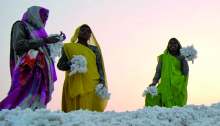


The human rights abuses perpetrated by the Chinese state are numerous, and many are linked to global corporations and products sold around the world. Increasingly people are asking should we boycott ‘made in China’?
In this article, Clare Carlile explores the question through the cases of China’s abuses in Tibet, Hong Kong and the Xinjiang Uyghur Autonomous Region.
Read more
In this article we explore the Chinese government’s ongoing persecution of the Uyghur population, the brands and products accused of being linked to forced Uyghur labour, and the campaign groups taking action.
Who are the Uyghur people?
Uyghur people have lived in a region in northwest China, now called Xinjiang (formerly East Turkistan), for centuries. The Uyghurs are culturally and linguistically different to the Chinese population, and most are Muslim.
Tension has long existed between the Chinese government and Uyghur population. The Uyghurs previously established two independent republics, seeking freedom from Chinese rule, but in 1949 the Chinese military marched into the region and ended the republic.
The Uyghurs are the largest community affected by the Chinese government’s persecution of Muslim-majority communities. But other ethnically Turkic and Muslim communities, such as Kazakhs and Kyrgyz, are also affected.
Over the past century, increasing numbers of Han Chinese people have moved into the Xinjiang region. In 2017 the Chinese government decided that 300,000 settlers should move into Xinjiang by 2022, through a strategy involving attracting Han Chinese citizens from other parts of the country through promises of free land, housing and government jobs. Academics say efforts such as this demonstrate a deliberate attempt by the government to dilute the population of Uyghur and other mostly-Muslim ethnic groups.
Tensions escalated after the U.S. government announced its ‘War on Terror’ following the attacks on the World Trade Centre in 2001. Experts and Uyghur advocates say the Chinese government adopted the concept and began to brand all Uyghur people as terrorists in the following years.
Since 2017, the Chinese government has arbitrarily imprisoned large numbers of Uyghur people. Estimates vary, with Amnesty International estimating at least one million detainees, while Uyghur advocacy groups place the figure at over three million. Internal Chinese police records point to an estimate of 1-2 million.
The Chinese government claims that it is, in fact, educating these Uyghur people in schools across the region – but as we explore below, the evidence suggests a very different picture.
Life inside a Uyghur ‘re-education’ centre
In 2017 the Chinese government began sending Uyghur people to what it refers to as ‘re-education centres’, or ‘vocational training centres’. It claimed that participation in them was voluntary, and that the centres helped counter terrorism and extremism, increased job opportunities, and alleviated poverty. Other Uyghurs were detained directly in prisons, including for ‘crimes’ such as ‘using WhatsApp’.
However, satellite imagery and investigations, alongside testimonies from family members and people who have managed to escape, show that the Uyghur people detained within ‘re-education’ camps or just in prisons have been tortured, banned from practising the Muslim faith, and are not allowed to leave.
In 2019 the Chinese government said that re-education centres had been shut down, with all those held inside having ‘graduated’, but in 2025 Uyghurs are still being held in detention, with international media reports suggesting that former re-education camps had been converted into high-security prisons.
The Xinjiang Police Files, a major cache of leaked documents published in 2022, “provide some of the strongest evidence to date for a policy targeting almost any expression of Uyghur identity, culture or Islamic faith,” according to the BBC.
The files showed that:
- Uyghur people were detained in a mixture of ‘re-education’ camps and formal prisons
- State police enacted a shoot-to-kill policy for people trying to escape.
- Many are detained just for having outward signs of Islamic faith.
- Relatives are routinely detained for the “crimes” of their families.
- The youngest recorded prisoner was just 15 when arrested, and the oldest 73.
Amnesty International says the camps aim to erase the beliefs and practices of the Uyghur people, with those detained given classes about the “evils” of Islam, and promoting the wealth, power and benevolence of the Chinese government.
Amnesty International also reports widespread torture in the camps. Guards, employed by the Chinese state, are reported to deprive detainees of sleep and food, and beat, rape and sometimes kill them. People have reported being physically punished if they spoke anything other than Mandarin Chinese.
Witnesses have also testified to say that the Chinese authorities administer unknown drugs and injections to Uyghur women in detention, forcibly implant contraceptive devices, and coerce women into surgical sterilisation. Organ harvesting has also been reported, with organisations from the UN to the British Medical Association expressing concern.