
Imagining a world without corporate power

At a time of great political turmoil and global crises, Rob Harrison explores what could happen if all businesses were required to undergo fundamental change.

Imagine, if you will, a world without for-profit corporations as we know them.

It could look like this:

  • Our banks could all be run by charitable trusts or mutuals.
  • Our supermarkets could all be co-ops supplying ethical produce.
  • Our cafes could be community enterprises.
  • Our water companies and trains could be state owned.
  • Our social media could be run by customer-owned co-ops.
  • Energy generators could be run by local governments or communities.
  • And our football clubs could be owned by supporter’s trusts.
  • We could invent new non-profit corporate forms too.

Of course, no institutionalised form can make humans perfect.

In this world, non-profit banks, supermarkets and cafes will still make stupid decisions that leave us exasperated. State-owned trains will still run late or be cancelled. Hate speech and disinformation will still slip through attempts by the community to staunch the flow. And our supporter-owned football clubs will still play badly and lose.

But what these corporations are less likely to do is:

  • to build projects that generate dangerous levels of climate gases that threaten human life;
  • to drive forward schemes that lead to widespread species and habitat destruction;
  • to treat workers and animals as units of production to be forever optimised;
  • to continually try to grow bigger and bigger whatever the consequences; and
  • to treat customers as fair game for a wide range of dodgy and pointless goods.

In some ways, this world doesn't seem too different to the one we have now. It has banks, food markets, cafes, trains, social media, solar farms, and football clubs. They are all operating as a self-organising system, within a set of rules, and sometimes competing with each other.

In other ways, it looks impossibly different, and hopelessly unachievable. More than 95% of the businesses around us use standard for-profit corporate forms. Some giant businesses have become larger economically than governments. And many of the biggest use their money to persuade politicians to only make decisions their shareholders will like.

But one key to imagining this world is to get past the idea that it's impossible. And to do that it's helpful to imagine the route we might need to take to get there.

A route to ending corporate rule

First, we need to acknowledge collectively that large modern forprofit corporations are a problem, and that a plan to phase them out makes sense. The publicly traded limited liability companies that were so useful in building the infrastructure of modern societies in the Victorian era, are controlling too much of the political process in 2025 and are now creating more problems than solutions.

So far as we can see from here, we might need around six main waystations along the route. The first three, people can get on with whether or not governments are supportive. The last three require regulators to be onside.

1. Community Ownership

From community pubs and shops to community farms and community energy, people are increasingly finding ways to regenerate places and support systems abandoned by conventional business. Commonly, these enterprises use the cooperative model. They can be helped by supportive regulation such as that around Assets of Community Value in England and the Community Right to Buy land in Scotland but can succeed without them too.

2. Conversions made easy

The second is to make it easy to convert current for-profit corporations into not-solely-for-profit forms. The could-beimproved B-corporation movement is the poster child for this approach to change and, perhaps surprisingly, there are more corporations of all sizes wanting to do this right now than the movement's bureaucracy can manage. Other forms of social enterprise like co-ops and charities could perhaps learn and copy.

3. Boycotts and buycotts of old-style corporates

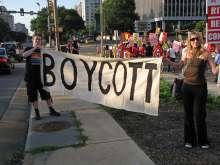
The third is collective embargoes or boycotts of old-style corporations from both individuals and institutions that support this change. They could be local authorities, churches, trades unions, environmental groups or ordinary consumers. The flip side, "buycotts", which involves positively choosing to buy from social enterprises, co-ops, and charities, is important too. This is a well-trodden route that civil society can take to persuade reluctant companies to have a change of heart, and is our specialist subject here at Ethical Consumer.

4. Equity fines

Number four is a thing we call 'equity fines'. Instead of paying cash fines for pollution, or corporate manslaughter, or fraud and malpractice, or abuse of monopoly position, companies could be required by law to issue new shares to the value of the fine instead. These shares then become owned by the communities they have affected who become shareholder activists for more responsible behaviour inside the business going forward.

Ethical Consumer explored the idea of equity fines in more detail in 2023 with Professor David Whyte, but more work needs to be done.1

5. Nationalisation

Once the sole theoretical alternative to capitalism, state-owned companies still play a vital role in most economies. For some core services like railways, it makes little practical sense to operate in other ways.

In other cases, the relationship has been temporary, as with NatWest and HBOS following the banking crash in the UK in 2008. Innovating state ownership to include other voices and interests should not be off the table either. Local governments and local communities directly can also own and manage key assets, as is common with renewable energy generation schemes in Germany and increasingly in the UK.

6. No new registrations

Finally, it will be important to make sure that, from a certain point, we're not creating any new conventional for-profit corporations. It would make sense to start by making it cheap and easy to register charities and social enterprises, and expensive and complicated to register for-profit corporations (it is currently the other way round). After that, a phase-out date for new registrations would focus the mind in the way that it has for other political changes.

Imagining the end of capitalism

But perhaps the most important way to make it possible is to have the courage to ask for it as a desirable political goal. It's obvious to millions of people these days in an era of climate change, habitat destruction and consequent mass migration that global capitalism – which is still working really well for shareholders – is failing to deliver for pretty-much everyone else. People are crying out for fundamental change, but there is less clarity or unity on what that should be. There are many complex reasons for the rise of the far right all across the world, but one often discussed is the absence of clear and simple alternative visions for a better future.

The goal – to phase out or "re-invent" for-profit corporations completely – is simple and easy to communicate. It offers the role of a key, or of being a final piece in a jigsaw where the other pieces are already there. Co-operatives, state-ownership, social enterprises, solidarity, social responsibility, and boycotts are all terms we are familiar with. People are also developing important new approaches such as legal actions against corporations for crimes of ecocide. And governments are requiring new levels of transparency around corporate supply chains and tax avoidance too.

The British writer, Mark Fisher, once quipped that it was easier to imagine the end of the world than it was to imagine the end of capitalism. However, with the vision here, it might be possible to turn that around. For not-solely-for-profit corporate forms, capital (money in the bank) and annual trading surpluses are still important – as they are for any of us individually. But profit is no longer the primary interest.

Other goals are necessary. If capital and profit no longer take primacy, would we really have capitalism anymore?

A vision for the future

For this reason, the idea of re-inventing the corporation provides a vision of how corporate rule and even capitalism itself could "end". It offers a non-violent route to navigate and discuss the great changes that must necessarily come. It offers a route where many institutions remain largely intact by converting to other forms. Others may need to wither and die.

And because it offers new rules for a self-organising system – in the way that capitalism did – it allows the kind of freedom for people to innovate that gave capitalism much of its appeal.

In this new world our language is likely to change a little too.

We'll need to remember words like community and cooperation. And we'll need to forget phrases like profit maximisation and quarterly stock values.

Perhaps we'll be keeping alive ideas like solidarity and compassion, and beginning to forget how hate speech was once encouraged and common.

And if the vision feels a bit dry and technical, it’s good to remember at the end that the change is just an enabler for the things in life that are really important.

  • Nature pulled back from the brink can begin to share ecosystem spaces again.
  • Our universal basic services can thrive in a new imagining of work, income, and service.
  • As inevitable climate disruptions reshape our world, regenerative businesses can respond collectively and with compassion for those worst affected.
  • And a slowing of pace will allow everyone to breathe more, to love more, and to play more.

“We must dramatically change the publicly traded, limited liability global corporation, just as previous generations set out to eliminate or control the monarchy.”

Quote source: John Cavanagh and Jerry Mander (eds) (2004) Alternatives to Economic Globalisation (p.273)