Ten reasons to avoid Amazon

From ongoing abuses of its workers to aggressive tax avoidance, we list ten reasons to avoid Amazon.

Why avoid Amazon?


1. Amazon is an aggressive tax avoider.

In 2024, the UK lost over £575 million from Amazon’s tax avoidance, according to an investigation by Ethical Consumer. It paid £18.7 million, about 4% of what it may have been expected to pay in the UK. The £575 million could have been used to help the most vulnerable with fuel costs, recruit more nurses and pay them better, or do the same with teachers. 

In 2024, Amazon's UK revenue soared to an enormous £29 billion. Despite this growth, the company likely continues to underpay taxes and withholds details of its actual profits while boasting about the amount of tax it pays.

Paul Monaghan, chief executive of Ethical Consumer's sister organisation, the Fair Tax Foundation said: “Amazon are once again tactically releasing their total tax contribution calculation to distract attention away from the pitifully low levels of corporation tax that have been contributed by Amazon UK Services over recent years. The public are not interested in how much VAT Amazon has collected and passed on to the Government. They want to know how much profit they actually account for in the UK from the £29billion of revenue they collect here. One can only surmise that the lack of transparency is connected to the sizeable chunk of UK revenue that is still shunted to the historically ‘loss-making’ subsidiary in Luxembourg."

And its tax avoidance isn't only affecting the UK: globally the gap between what Amazon reports it is paying in tax and the actual cash it's handing over to authorities amounts to $6 billion in the decade between 2012-2021, according to the campaign organisation Fair Tax Foundation

Ethical Consumer continues to call for a boycott of Amazon over its outrageous tax avoidance. 

2. Amazon has violated workers’ rights for years.

Nine-hour days standing, seemingly impossible targets, having to pee in a bottle for fear of taking breaks – these are all allegations from Amazon workers.

Amazon prioritises speed and profit over worker safety. In 2023, the US’ Strategic Organizing Center recorded more serious injuries in Amazon warehouses than in the rest of the warehouse industry combined. In recent years, the company has faced multiple fines in the US for putting workers’ safety at risk by placing punitive production targets on them. In 2023, workers were found to be at greater risk of musculoskeletal disorders and back injuries from having to lift multiple heavy parcels and work long hours to meet quotas, according to inspectors.

Similar conditions have been reported in the UK.

In 2018 ,the GMB union revealed that there had been 115 ambulance callouts to an Amazon warehouse compared with only eight to a nearby Tesco warehouse of a similar size over the same period. 

In October 2020, TUC released a report that found that employees in Amazon warehouses worked 55 hour weeks and 10 hour days on average, were expected to pack around 300 items per hour (1 every 12 seconds), and were harassed, disciplined or fired if they failed to meet their targets. Workers felt unable to take breaks or visit the bathroom and sometimes had to urinate in bottles.

In 2023, ‘prankster’ Oobah Butler went undercover and was able to confirm some of these allegations by using hidden cameras. The Channel 4 documentary revealed bottles filled with urine around Amazon’s Coventry fulfillment centre. 

In India, where workers’ rights are much less protected, things are even worse. The Independent reported in June 2024 that warehouse workers were allegedly made to pledge not to take drink and toilet breaks until their targets were met while temperatures soared past 50C. Dharmendra Kumar, Convenor of the Amazon India Workers Union said at the 2023 Make Amazon Pay Summit that healthy workers in their early twenties regularly contract urinary infections due to this practice. The 2023 Make Amazon Pay Summit took place in Manchester. Campaigners from all around the world gathered to “develop policy solutions… as well as strategies for turning popular power into progressive legislative and regulatory change to Make Amazon Pay.”

Little has changed since 2023. According to recent UNI Global Union survey, three quarters of the 474 interviewed workers in India reported that they or a co-worker needed medical attention on the job, including fainting from the heat

3. Amazon workers say abuse comes at a high price for workers in the cost of living crisis.

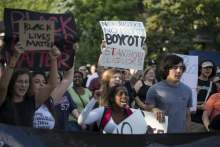
Amazon workers have led protests against the company’s appalling workers’ rights.

In recent years, Amazon workers and activists from all over the globe have taken action against Amazon’s atrocious working conditions, as well campaigning for better pay, as part of #MakeAmazonPay and Black Friday protests. Make Amazon Pay campaign says:

"While tripling profits in early 2024, Amazon surveils and pressures drivers and warehouse workers at the risk of severe physical and mental harm."

An average Amazon warehouse worker earns just under £14 an hour. A recent study by GMB Union found that over half Amazon workers in the UK are forced to borrow money just to cover basic needs and 15% even have to use food banks.
Meanwhile, Andrew R Jassy, the president and CEO of Amazon, received a total of USD $40.1 million (about £29.8 million) in 2024. Five other executives earned over $20 million each in 2024.
 

4. Amazon sells its services to fossil fuel companies, and is supporting new nuclear power plants.

Amazon offers its high tech services to help fossil fuel companies find more oil and gas.

In August 2022, Bloomberg reported that Amazon was a "quieter beneficiary" of the boom in oil and gas prices, and was, for example, "helping drillers run simulations to maximize how much oil they can pump from existing wells. Amazon was said to have stated that it was making "oil companies more efficient" as "part of their sustainability work".

Amazon has previously been accused of ‘aggressively courting’ the industry and offering machine learning and AI technologies to enable fossil fuel extraction at a time when “it is imperative most fossil fuels be left in the ground if we are to avoid severe climate disruption”.

Amazon was also found to have sponsored a 2020 event held by the Competitive Enterprise Institute, a think tank well known for spreading climate denial misinformation.

Amazon is also now expanding into the nuclear industry. In October 2024 it announced that it “signed three new agreements to support the development of nuclear energy projects - including enabling the construction of several new Small Modular Reactors (SMRs)”. Earlier this year, together with Google and Meta, Amazon signed a pledge to support efforts to at least triple nuclear energy worldwide by 2050.

5. Amazon has a poor climate record.

In 2020, Amazon announced its target to be carbon neutral by 2040. 

But Amazon uses outrageous methods to make its emissions appear smaller than they are. An article by Reveal News in 2022, titled “Private Report Shows How Amazon Drastically Undercounts Its Carbon Footprint”, highlighted how Amazon vastly understates its emissions by taking responsibility for the full climate impact only of products with an Amazon brand label. According to the organisation Amazon Employees for Climate Justice, this number could be as low as a staggering 1% of all sales. There’s another 39% of sales that Amazon should be counting: emissions from the products that Amazon buys from manufacturers and sells directly to the customer. The remaining 60% of sales come from third-party vendors who use Amazon as an online marketplace; Amazon doesn’t count those emissions either, but that’s more of a grey area.

And Amazon’s growth in its cloud computing arm, Amazon Web Services (AWS) and AI means that it is investing heavily in data centres around the globe. These consume vast amounts of power, most of which is not generated by renewable energy. In fact, Amazon Employees for Climate Justice (AECJ) recently said that in spite of Amazon claiming that its operations are run entirely on renewable sources of power, in truth just 22 percent of power used by the company's data centres is from renewables. AECJ explains this by saying: “Amazon is using creative accounting and an overreliance on low quality renewable energy credits”. 

Furthermore, Amazon Employees for Climate Justice points out that Amazon is expanding its data centers in regions that rely heavily on oil, gas, and coal, such as Northern Virginia and Saudi Arabia. They ask the question: “How can Amazon claim that its operations are powered by 100% renewable energy when the renewable energy projects it is responsible for… don’t actually power its operations?”

According to the organization Not Here Not Anywhere (NHNA), the massive electricity demands of data centres pose a serious threat to achieving the swift and equitable transition to a fossil-free future that is urgently needed.
 

Cartoon showing Jeff Bezoz in front of row of closed shops
Image credit Mike Bryson for ECRA

6. Amazon is damaging small independent businesses.

Amazon has come to dominate many online markets globally.

It entered the UK market in 1998, just three years after its inception in the US and today its name is synonymous with online shopping. 

In 2024 Amazon controlled 30% of the total retail market and over 86% of people in the UK shop on Amazon. Its monopoly has marginalised many small independent businesses.

Since Amazon launched as a bookseller a quarter of a century ago, the UK and Ireland have lost almost 1,000 independent bookshops.

Bookshops are not the only independent retailers that believe themselves to have been damaged by Amazon’s monopoly. A 2022 report found that in the US, Amazon's market capture had displaced 136,000 bricks and mortar shops, and the rise of its warehouses provided only half as many jobs as the 1.7 million retail roles that have been lost to its monopoly. 

Amazon’s monopoly supports staggering inequalities:the company’s owner Jeff Bezos is estimated to have accrued over $250 billion (£185.5 billion) in personal wealth. If a worker was paid the UK living wage of £12.60 an hour, they would have to work a full time job for more than 7.5 million years to make as much money.


7. Amazon has repeatedly been accused of racism. 

Year after year, accusations surface about Amazon’s racist behaviour. 

In 2024, the human resources and recruitment journal Grapevine reported the case of a black female at AWS who alleged that she “has been harassed, sexually assaulted, and kept from advancing to positions she deserved in the corporation.” Her attorneys argued in the lawsuit that "Like so many other black and female employees at Amazon, Charlotte Newman was confronted with a systemic pattern of insurmountable discrimination based upon the color of her skin and her gender". Amazon said it was reviewing the allegations and that it does not “tolerate discrimination or harassment of any kind”. In March 2025, Bloomberg reported that US District Court judge dismissed the suit and Charlotte Newman agreed to stop pursuing it. The terms of reaching the agreement weren’t made public.

In July 2022, Amazon was accused of failing to respond after American warehouse workers received death threats and racist abuse. One worker said she was fired after telling Amazon she'd take legal action if her complaints of racism weren't addressed. 

In 2021, Amazon was sued in the US over accusations of "systemic" racism in its offices. A manager said that Black people were hired for lower positions and were not promoted as quickly. 

Amazon has also enabled racial-bias and racial profiling through its technology. 

In 2018 and again in 2020, testing of Amazon’s ‘Rekognition’ facial software showed it to be fundamentally racially-biased. The software was found to disproportionately identify Black members of Congress or Parliament as people who had been arrested and had mugshots held in a police database. 

In 2020, campaigners won a victory after the company announced a one-year moratorium on selling the technology to US police. A year later, the company announced that it would be extending the moratorium indefinitely. Nathan Freed Wessler, a deputy project director at the American Civil Liberties Union said in response to the announcement:

"Face recognition technology fuels the over-policing of Black and Brown communities, and has already led to the false arrests and wrongful incarcerations of multiple Black men.”

However, in early 2024, the Department of Justice has disclosed that the FBI is in the “initiation” phase of using Amazon’s Rekognition software. Amazon defended the sale by claiming it was only ever applied to police forces when conducting criminal investigations.

8. Amazon is accused of union busting.

Amazon has been consistently working to break unionising efforts.

On many occasions Amazon has aggressively opposed unionisation and organising efforts at its UK warehouses. In April 2024, the GMB labour union initiated legal action against the company, alleging that Amazon had made broad attempts to pressure employees into withdrawing their trade union membership

According to the GMB amazon has:

  • "Pressured staff to leave the union. Company bosses have erected QR codes in Amazon fulfilment centres which generate an email to the union’s membership department requesting that membership is cancelled.
  • Forced workers to attend hour long anti-union seminars. Led by senior company managers, these briefings forced workers to listen to anti-union messages on work time.
  • Displayed anti-union messages throughout Amazon workplaces, including on billboards and screens.”

Following this, in July 2024, in a historic vote, Amazon workers very narrowly rejected a union in its Coventry warehouse in the UK.

Gaining formal union recognition would have required Amazon to engage in negotiations with GMB over issues such as wages, working hours, and holiday entitlements.

Amazon has reportedly spent tens of millions on anti-union consultants. According to the Huffington post, this figure was $4.3 million in 2021 but increased threefold by 2024.  

“Amazon is busting democracy, not just unions”, said Christy Hoffman, General Secretary of UNI Global Union in a piece published in November 2024, reflecting on Black Friday.


9. Amazon has faced questions over spying on politicians, trade unions, and consumers.

In January 2025, the Medium reported that a group of U.S. consumers has filed a class-action lawsuit accusing Amazon of deliberately spying on millions of users by giving a software development kit to app developers that allegedly gave the company backdoor access to users’ timestamped location data.

In June 2023, Amazon agreed to pay over $30 million to settle two privacy cases relating to its Alexa speakers and security camera unit, Ring. The company was accused of storing the voices and geolocation of children after they used Alexa. It was also accused of security failures for its Ring cameras, which put users’ private videos, their accounts, cameras, and videos at risk of being controlled by hackers, according to the suit.

In 2020, Amazon was accused of spying on politicians and trade union workers. The company published two job posts for ‘intelligence analysts’ in the US, the roles for which included investigating the threat of organised labour against the company and monitoring ‘hostile political leaders’.

The company deleted the job posts after they were widely publicised, and has since stated that they were inaccurate and posted in error. But a group of MEPs wrote to Jeff Bezos – Amazon’s founder and chief executive – expressing concern over “increasing warnings about your company’s anti-union policy”.

10. You’ll be in solidarity with workers and activists globally.

Organisations all over the world have been protesting Amazon’s actions - from workers' unions and civil society organisations to anti-racism and anti-gentrification campaigns. 

#MakeAmazonPay is a global coalition demanding that the company address its workers’, environmental and political abuses. It has brought together a wide range of those campaigning against Amazon, including Ethical Consumer. It leads global protests against the company, including recommending boycotts of Black Friday and Cyber Monday.

Some campaigns have seen major success. 

It was reported in July 2025, that the UK Competition Appeal Tribunal has approved a £1.3 billion collective lawsuit against Amazon, allowing a major consumer compensation claim to proceed. Led by advocate Robert Hammond, the case alleges that Amazon’s “Buy Box” algorithm unfairly favoured its own offers and those using its Fulfilment by Amazon service, causing around 49 million UK shoppers to pay inflated prices between 2015 and 2023. The ruling means all eligible UK consumers are automatically included unless they opt out. This case adds to growing regulatory scrutiny of Amazon across Europe for anti-competitive practices and could lead to significant payouts if successful.

In April 2022, workers formed the first ever dedicated union at the company. 

In May 2021, the European Parliament challenged Jeff Bezos over Amazon’s union-busting and spying on workers.

In 2019, New York activists successfully drove Amazon away from the city where it had planned to build an HQ2 in return for almost $3 million in tax deals

By boycotting the company, you will be taking part in this global movement and building the pressure on Amazon – or the legislation that allows its abuses – to change.


Take action

Although this is a depressing list of problems associated with Amazon, there are things you can do as consumers.

  1. Where possible, reduce the amount of money you give Amazon, through not buying things from Amazon. We have an alternatives to Amazon series which can help you find more ethical options for a wide variety of products.
  2. You can also contact Amazon to tell them why you're boycotting them.
  3. You can also sign up to our boycott pledge, or share it if you already don't use Amazon.
  4. Join other campaigns targetting Amazon.

Alternatives to Amazon

Our guide to ethical online retailers rates 25 online shops, from eBay to Oxfam, to help you find ways of shopping without supporting Amazon.

Ethical online retailers

Additional research by Katalin Csatádi.