Challenging corporate power

It's time to think outside the box and imagine a different economy. One not based on capitalism, corporate greed and domination by a few oil, tech and food multinationals.

Our new challenging corporate power series will explore options, generate discussion and consider how consumers can use their influence to help bring about change.

It is now 36 years since we set off on our mission to "help consumers shop ethically and to challenge corporate power".

And the success of the vision to normalise the discussion of ethics in consumer products everywhere has surpassed all our expectations.

Challenging corporate power

However, if you view the new US president as largely a mouthpiece for giant oil and tech multinationals, the idea that, in early 2025, corporate power is being successfully challenged by us or indeed anyone else right now seems laughable.

To make matters worse, this latest wave of anti-ethical political behaviour is occurring at a time when people and the planet are crying out for fundamental change of a different nature.

In addition, as we have learnt through our Climate Gap work and at our sold-out de-growth conference in London in 2024, there is growing support for moving away from the capitalism promoted by corporations, with its requirement for perpetual economic growth, that is causing rather than fixing many of the core problems we face.

When we were founded we identified corporate power and the pursuit of profit as lying at the heart of many of these problems. We noted that many corporations had grown to become more powerful than the governments that were meant to be regulating them. We also noted that our democracies were failing because they had been "captured" by corporations pursuing their own economic self-interest.

In the same breath, we were always careful to point out that "consumer action is not a replacement for other forms of political action but is an important additional way for people to exert influence."

However, the political situation right now feels alarming and in rapid flux.

Researching and talking about corporations is our specialist subject, so we are returning to our roots to look at other ways of challenging corporate power. 

Crowdfunder to Challenge Corporate Power

Join us in campaigning to challenge corporate power for a better society for all.

Support our crowdfunder so we can do more

We have launched a Challenging Corporate Power fundraiser so that we can do more of this important work.

Please watch the video (above) narrated by actor Mark Rylance, to find out: 

  • why this work is important
  • what we plan to do
  • how you can support us

Head to our Crowdfunder page to donate.

Read about our plans in our separate article.

Ditching for-profit companies

Our challenging corporate power series will contain news items, features, and interviews to help us think outside the box and imagine a different economy. 

We will explore the possibility of reinventing the corporation, and the idea that the for-profit corporation, like oil and coal, needs to be consigned to history as no longer useful for the times we are in.

When we were founded in 1989, we put the word 'ethical' next to the word 'consumer' to be provocative and to make people think. Discussing the ethics of companies and brands is now pretty mainstream.

Perhaps soon, we will find that discussing the end of the for-profit corporation has somehow become part of mainstream discourse too? 

Feature 1: Imagining a world without corporate power

What could happen if all businesses were required to undergo fundamental change?

What if there were no for-profit companies any more? What if there was an end to capitalism?

We ask what society might look like, how we might get there and why this is important right now.

Read the feature

Feature 2: Challenging corporate power in the fight against the far right

Corporations frequently act in self-interest, with the impact passed on to society, such as tax payers having to pay more for public services because some companies don't pay their fair share of tax. 

Social inequalities are increasingly exploited by the far right, blaming the problems on scapegoats. 

We explore the connections between corporate power, governments and neoliberalism in more detail, and how things might change. 

Read the feature

Feature 3: Converting more businesses to co-ops and social enterprises

Other European countries have more co-ops and social enterprises than the UK.

These types of organisations are more beneficial, for people, the planet and society. 

One step towards challenging and reducing corporate power is to make it easier to convert current for-profit corporations into not-solely-for-profit companies instead. This article explains how this might be possible.
 

Read the feature

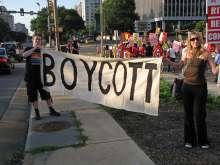
Feature 4: Using boycotts and buying power to bring about change

Many boycotts seek to bring about change by people not buying a company's products or services. Consumers also have the power to actively seek to buy from companies who are doing things better.

In this feature we look at how different types of boycotts and also the purchasing power of consumers and of corporations and public services.

Read the feature

Profiles of campaigning groups

There are other organisations who are challenging corporate power in the UK and globally. 

We profile various groups, from We Own It to Global Justice Now, highlighting their activities and successes.

Read on to find out more and support these organisations. 

Profiles of campaigning groups

News of challenges to corporate power

It is heartening to see challenges to corporate power taking place across the UK and the world. These may be grassroots and community resistance or structured campaigns with wide geographical support.

We report on some recent examples.

Thames Water debt debacle

It’s been hard to avoid reading about Thames Water in the news recently. Its combination of near bankruptcy, polluted water, high consumer prices and enormous shareholder payments have proven one of the most compelling arguments yet against privatisation of public services. In February the High Court approved the company taking on a further £3bn of loans to stave off ‘temporary nationalisation’.

We Own It’ is a UK campaign group calling for public ownership of public services.

They are also thinking hard about how modern nationalised companies could be governed, much in line with our call for ‘innovating state ownership to include other voices and interests’.

We Own It produced a infographic of what such governance could look like if applied to a supervisory board at Thames Water which was shared widely across social media. 

For more information and to support We Own It. 

People sitting in town square for a meeting in evening sunshine
In Auletta's main square, a public assembly is held to discuss a massive gas extraction project that was kept hidden from them. Image provided by Auletta Casa Mia with their Lush Spring Prize entry and reproduced with permission.

Community resistance to toxic waste

The Auletta Casa Mia project was founded in 2024 by young residents from marginalised areas in the province of Salerno, Southern Italy. 

This region has faced numerous cases of toxic waste trafficking (whereby hazardous waste is falsely said to be non-hazardous and is then dumped in the region) and related legal proceedings, and is currently under threat from speculative projects that aim to exploit its pristine lands with extractive gas operations.

In response to these threats, Auletta Casa Mia was established to protect common goods – soil, air, water and biodiversity – through processes inspired by mutualism and active citizenship. The project’s committee employs participatory and assembly-based methods with a transfeminist and ecological approach. 

Within six months, Auletta Casa Mia had successfully halted a proposed mega gas and methane plant, triggered an anti-mafia investigation, and catalysed involvement from over 25 young people under 18 who now participate in and organise various local activities.

Auletta Casa Mia is one of 58 projects on the shortlist for the 2025 Lush Spring Prize, a more than £200,000 prize fund that seeks to build capacity for those regenerating the earth’s damaged systems. The award recipients will be announced in May 2025. 

Lush Spring Prize is a joint venture between Lush Cosmetics and Ethical Consumer.

Challenging corporate courts

Formally known as Investor-State Dispute Settlement (ISDS), the corporate court system has allowed multinational companies to sue governments for everything from enforcing plain packaging on cigarettes to raising the minimum wage. Ethical Consumer has often written in the past about how these secretive, private tribunals protect the profits of overseas corporations at the expense of human rights and climate action.

In 2025 multinational mining firms are suing Colombia to the tune of $13 billion through corporate courts like this. In one such case, mining giant Glencore is suing for losses after the Wayuu Indigenous community won a ruling against the expansion of its massive Cerrejón coal mine, which had displaced thousands from their land and polluted their water.

The UK NGO Global Justice Now, having long campaigned against these courts, is now focussing on creating pressure to scrap this element of the UK-Colombia trade deal specifically. It is asking supporters to email the UK trade minister to ask that this is done.

Booklet with more information about the Columbia campaign

Take action: Email the UK trade minister using the campaign template

Digital disobedience and challenging tech monopolies

The campaigning journalist specialising in investigating tech monopolies, Carole Cadwalladr released a Ted Talk on YouTube called "This is what a digital coup looks like". During the talk she encourages digital disobedience and states “You have more power than you think”. 

In her final piece for the Observer, she ended on a positive reflection that "These vast data-harvesting tech monopolies that control our online world were never inevitable. And there is another way. We can go back to the future, to the democratic, inspiring, non-corporatised web that [Jimmy] Wales [founder of Wikipedia] proved was possible."

Logo of Rainforest Rescue - drawing of a tropical bird on a branch

Challenge rainforest destruction in Papua

The excellent German NGO, Rainforest Rescue, has been using multi-language petitions to expose destructive projects and name the perpetrators for many years.

Indonesia’s government is implementing a state-run sugar and ethanol program in southern Papua under military protection. 

Two million hectares of rainforest and Indigenous land are at risk which is a significant threat to biodiversity and local communities.

In April 2025 Rainforest Rescue launched a new petition calling on the Indonesian government to abandon its “National Strategic Project” for sugar and bioethanol. A second project for one million hectares of rice is also being implemented there by the Ministry of Defence and the Ministry of Agriculture. Previous promises of rice growing for food security at a similar project were replaced by clear-cutting and oil palms which now dominate the landscape.

The Indigenous communities, the Marind and Yei, are defending the forest with all they have, but international condemnation can help. The campaign is also a useful reminder that state-run projects can be problematic too. 

Sign the petition to save rainforest in Papua.

ClientEarth opposes weakening of EU sustainability rules

In response to corporate pressure over 'complexity' in recent new sustainability laws, the European Commission introduced the Omnibus Simplification Package in February 2025. The proposal allegedly aimed to "streamline corporate sustainability reporting while maintaining the EU’s sustainability goals."

Leaks revealed that these new rules had been hastily reviewed without public consultation, with input only invited from a select group which included energy giants, banks, and other industry lobbyists.

In April, a coalition of eight NGOs, led by ClientEarth, lodged a formal complaint with the European Ombudsman, condemning the undemocratic, un-transparent and rushed way in which the European Commission has developed the Omnibus proposal.

In their statement, they said: “The Omnibus proposal was made without any public consultation, sidelining civil society, with a lack of evidence or environmental and social impact assessments, and with a primary focus on narrow industry interests. This reckless move not only weakens sustainability rules but also damages public trust in the EU’s democratic foundations.”

The complaint argued that the Commission had failed to assess whether its proposal aligns with the EU’s climate neutrality target – in breach of its obligations under the European Climate Law. The NGOs also warned that the Omnibus could undermine EU economic stability and the competitiveness objectives it is supposed to help.

The eight NGOs were: ClientEarth, Anti-Slavery International, Clean Clothes Campaign, European Coalition for Corporate Justice, Friends of the Earth Europe, Global Witness, Notre Affaire À Tous and T&E.

For more information visit the ClientEarth website.

What do you think about corporate power?

Our challenging corporate power series is designed to generate discussion.

We welcome any reflections and ideas you may want to share. Contact us via our contact form (select 'general enquiries'), or email us on letters [at] ethicalconsumer.org.