Israel-Palestine: our new company rating

Do you want to avoid links to the Israeli government, or support brands standing up for Palestine? 

Jasmine Owens introduces the new Israel-Palestine rating and applies it to bookshops. 

This article explains what our rating on Israel includes, and which bookshops to avoid.

In perhaps our most unanimous survey ever, 96% of Ethical Consumer newsletter subscribers who responded to our survey said they would find a rating assessing a company’s links to the Israeli government useful. 

We launched the survey and subsequent rating category after not just two years but decades of readers getting in touch to ask: ‘Is this brand linked to the Israeli government?’

We’ve designed a rating which answers that question. 

We’re planning to include this rating in every product guide from our next issue (December 2025). We’ve trialled it on the companies in the new bookshops guide, and a summary of the results are below. Do share your feedback on any of this by contacting us.

Why create the Israel-Palestine rating?

While this is the first time we’ve created a dedicated column in our score table for Israel-Palestine, in some ways it’s nothing new. 

Ethical Consumer had a dedicated column focused on company links to Apartheid South Africa when the magazine was founded in 1989. And we’ve spotlighted campaigns against companies complicit in Palestinian human rights abuses since then, too. But we think it’s worth adding this column formally to our score table, for several reasons.

1. Demand. Our readers want this rating.

And, providing it helps us fulfil our core mission: making it easy for people to spend according to their ethics, by putting as much relevant information as possible in one place in an easy-to-understand format.

2. Trust. There are brilliant apps and websites highlighting brand complicity in this issue, but there is also a lot of misinformation and poorly referenced advice. We know readers trust our research.

3. Niche brands. Most of the niche ethical brands in our scoretables don’t feature on other apps and websites on this topic, so there’s no simple way of knowing what their stance is. Adding this into the scoretable means, for the first time, their approach is assessed too.

4. Ranking. There’s a big difference between a brand that sells weapons, and a brand that tells staff members not to wear a watermelon pin. This more nuanced and detailed rating helps to draw out these differences between companies.

5. Normalising. This rating enables us to normalise and promote companies that have strong policies in solidarity with Palestinian human rights. By designing a rating so that companies can only receive high scores when they publish an explicit policy on Israel-Palestine, we hope to make it uncontroversial for companies to distance themselves from the current Israeli government, building international pressure to make Israel abide by international human rights resolutions.

Why Israel is a special case

When we were surveying readers about our plans to create this ranking, we were sometimes asked why we want to focus on Israel and not on other parts of the world where horrific abuses are taking place – such as Sudan and Myanmar.

Although Ethical Consumer has a long history of publishing around a more general notion of oppressive regimes, we think that in September 2025 Israel has become a special case.

In the post-war period following 1945, international institutions were developed to create a rule-based system built around the notion of human rights. Although there have been many hundreds of transgressions since then, by and large the most high profile of these have been called out by other governments and collective responses have emerged.

What has happened in the aftermath of the October 2023 Hamas attacks is that Israel has gone on to transgress so many rules so quickly, in such an obvious manner, that even the flawed pretence of international order that we once had is in danger of being lost.

This is especially the case because most Western governments, unlike in their response to the Russian invasion of Ukraine for example, have failed to respond anywhere near adequately to what has become the most blatant and documented moral issue of our time.

Oxfam’s new Red Line for Gaza campaign recently encapsulated some of the boundaries which Israel has overstepped:

  • starving people
  • killing civilians
  • killing children
  • targeting aid workers
  • killing the hungry

To this we might add some more recent lines:

  • targeting journalists
  • bombing six neighbouring countries
  • genocide

Use of the word genocide, once carefully avoided here, has now become widely accepted as the correct term to be used in this case. On September 1st 2025, the International Association of Genocide Scholars stated that Israel’s conduct met the legal definition as laid out in the UN Convention on Genocide.

It is therefore this combination of number and seriousness of boundaries crossed, with the inadequacy of response from most governments in spite of the high profile, vast documentation, and demands from civil societies around the world, that makes Israel a special case. If governments and international rights bodies allow Israel to carry out these abuses with immunity in Gaza, what hope is there for other communities around the world whose oppression is far less covered or known about?

Ethical Consumer has formally supported the Palestinian Boycott, Divestment and Sanctions (BDS) movement since 2014, and we see contributing this research as part of what we can do to help respond to the Palestinian call for solidarity.

Initiatives such as Business Leaders for Peace - a list of over 1,000 UK business leaders, founders and professionals calling for government intervention in Gaza - show that there are many companies wanting to use what influence they have to call for justice in Palestine. We’re exploring ways to collaborate with this initiative.

What does the Israel-Palestine rating explore? 

Our ethical rating contains seven sections coving different aspects of engagement with Israel. Brands lose or gain points based on elements within each section.

The seven sections are outlined below.
 

Israel rating

Is the company an official Boycott, Divestment and Sanctions (BDS) National Committee campaign target? 

If yes, lose 100 points.

If not, has the company been named in any of the following reports documenting abuses of Palestinian human rights? (-90)

If not 1 or 2, does it actively enable Palestinian human rights abuses or support complicit institutions?

  • Products used for lethal purposes, e.g. weapons (-80)
  • Products used for less lethal purposes, e.g. settlement infrastructure, surveillance (-70)
  • Evidence of a relationship with the Israeli state or other directly complicit institution e.g. military, universities that conduct research and development into weapons (-60)

If not 1, 2 or 3, is there any flow of money from the company towards the Israeli government?

  • Owns a subsidiary in Israel so pays taxes (-60)
  • Sources from settlements (-50)
  • Sources from tax-paying companies located in Israel (-40)
  • Other relationship with Israel-based company, e.g. distribution partners (-30)

If none of the above, does the company have relevant human rights policies?

  • Policy against working with Israeli government and complicit entities (Scores 100)
  • Has some policy or has taken non-normalising action in support of Palestine (Scores 90)
  • No relevant policy (-20)

Has the company or its leadership taken other significant negative actions regarding Israel-Palestine?

  • Backtracked on support for Palestine following pressure (-10)
  • Penalised staff or other entities for publicly advocating for Palestinian human rights (-10)
  • Senior figures in company have taken action to support the Israeli government or Palestinian human rights abuses (-10)
  • Senior figures in company have expressed views supportive of the Israeli government or Palestinian human rights abuses (information only)

Are there any other positive actions that the company has taken, or reasons for an exemption? (up to 20 additional plus points). 

Where this exception is used, we’ll clearly explain why to readers.
 

Bookshops ranked on Israel-Palestine 

Access to books and education is one of many rights denied to Palestinian people. 

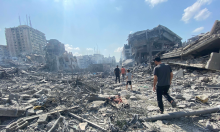
Gaza’s main bookshops were bombed by Israel in 2021. The Samir Mansour Bookshop and Library was rebuilt in 2022 with help from a fundraising campaign, but damaged again in an airstrike in October 2023.

In 2025, Palestinian bookshops in Jerusalem were ransacked by Israeli police, who confiscated boxes worth of books that featured, for example, the Palestinian flag, or were authored by Banksy or Noam Chomsky.

While we value our bookshelves and the authors whose labour stocks them, buying a book still means handing profits to a company – and is it a company you want to financially support?

Book lying on ground amid rubble
Image of book in rubble from Samir Mansour Bookshop & Library, Gaza. Source: gofundme.

Bookshops with links to Israel

Over a third (38%) of the bookshop brands in our guide belonged to company groups that actively supported the Israeli government, or other institutions or companies whose operations facilitate Palestinian human rights abuses. 

These brands with active support of the Israeli government or other direct connections are: 

With Amazon’s share of UK book sales at more than 50%, we can also say that most books sold in the UK have links to the Israeli government.

Four brands (15% of the brands in the guide) – AbeBooks, Amazon, Audible, and Google – have been identified by Palestinian campaigners as the most important boycott targets.

Bookshops that support Palestine

Half of brands in our guide appeared to have no relationships with the Israeli government, or companies or institutions inside Israel.

Just two (8%) of the bookshop brands in our guide had published statements confirming that they would not work or trade with the Israeli government or other complicit institutions or companies on the basis of Palestinian human rights’ abuses. These were Ebooks.com and Oxfam.

Some extracts from our ranking research appear in the table below. Scores are from worst to best.

Bookshops and Israel-Palestine rating (extract)
Brand Score (max 100) Reason/policy

AbeBooks

Amazon

Audible

0 Amazon (which owns AbeBooks and Audible) is a campaign targets of the Boycott, Divestment and Sanctions National Committee (BNC) because it provides services to the Israeli government and military.
Google 0 Google is a campaign targets of the Boycott, Divestment and Sanctions National Committee (BNC) because it provides services to the Israeli government and military.
Apple Books 30 Apple lost marks for funding student projects at Israeli university Technion. Technion has joint research projects with weapons and drones’ manufacturers Rafael and Elbit, and works with Israel Aerospace Industries. Apple also lost marks for disciplining employees or terminating contracts if they expressed support for Palestinian people through wearing pins, bracelets, or keffiyeh.

Blackwell’s 

Foyles 

Hatchard’s 

Waterstones 

Wordery

40 The ultimate owner of all these brands is hedge funds management company Elliott Funds. Elliott has been reported to hold a $1.5bn stake in Hewlett Packard Enterprises (HPE), amounting to a 7.4% shareholding in 2025. A 2025 UN Special Rapporteur report criticised HPE for its historical role in maintaining Israel’s population and immigration database. Elliott’s founder and president Paul Singer, based in the US, has also been described as a “longtime supporter of hawkish pro-Israel causes”. Singer donated US$1m to a US political action committee which worked to block candidates critical of Israel during the 2024 elections.
Rakuten Kobo 40 Rakuten Group bought online messaging app Viber in 2014. Viber was founded by two Israeli citizens with a high-level IT background in the Israeli military. Viber still has an R&D division in Israel.
Audiobooks.com 70 Audiobooks’ owner Storytel bought Israeli audiobook company iCast in 2021 in order to take up its place in the Israeli market and stated that it had “launched in Israel”.
Biblio 70 Biblio promoted the sale of books from partner stores in Israel, sales from which would result in contribution of tax flow to the Israeli government.
The Guardian Bookshop 70 In late 2023, following a protest letter on Gaza in Australia, the Guardian Editor in Chief instructed employees to no longer sign open letters or petitions on any subject. See below for the Guardian’s response on the rating.

Alibris 

Better World Books

Books Etc 

Bookshop.org

Daunt 

eBay 

Hive 

World of Books

Wrap Ltd 

xigxag

80

These companies appear to have no relationships with the Israeli government, complicit institutions, or companies located inside Israel. 

However, they lacked published policy confirming that this was a stance taken for human rights reasons, or only had limited policy e.g. saying they wouldn’t work with illegal Israeli settlements.

Ebooks.com 100 Ebooks.com states, “We do no business with and have no links with any Israeli government organisations or agencies or other complicit entities and will not do so while apartheid, genocide and ethnic cleansing continue.”
Oxfam 100 Oxfam states, “The UK government is complicit in enabling the Israeli government’s crimes – by its continued military, economic and diplomatic support … the government continues to trade with Israel preferentially as if nothing is wrong. This complicity must stop.”

*A Guardian News & Media spokesperson said:

On your petitions assertions: "In 2023 the Guardian added wording to our editorial code to clarify our position on outside interests that could appear to compromise the editorial integrity of individual journalists or Guardian News & Media."

On your coverage assertions: "The Guardian reports extensively on the crisis in the Middle East, with coverage led by our experienced journalists working on the ground across the region. Their deep expertise has enabled us to provide readers with coverage of exceptional rigour and depth, always placing the human cost at the centre of our reporting."
 

Bookshops guide

Our guide to bookshops covers high street and online book retailers, and rates 26 brands, including Amazon, Apple iBooks, eBay, Google Books, Guardian Bookshop, Waterstones and World of Books.

It also covers print books, audio books and ebooks.

Find out who to support and who to avoid.

Guide to ethical bookshops